
A strong storytelling album, highlighted by good songs, exemplary playing and a fascinating soundscape.
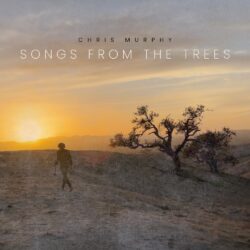 Chris Murphy was born into an Irish-Italian family in New York, growing up surrounded by a wide range of traditional music such as Italian, Irish and Latin rhythms. Later, at college, Murphy explored Turkish and Indian music, so with this spread of influences it’s perhaps unsurprising that his work encompasses a variety of styles and genres, including jazz, blues, Celtic, folk, ambient and country rock.
Now based in Los Angeles, Murphy is principally known for his performances as a violinist, but he is a multi-instrumentalist and singer-songwriter, having a canon of more than 500 compositions. Murphy has also collaborated extensively throughout his career, and his latest album, Songs From the Trees, sees him working with English folk singer, songwriter and multi-instrumentalist Seth Lakeman. Murphy says of the approach with Lakeman, “Together we explored a sound that blends americana, progressive folk, world music, and cinematic storytelling.” Lakeman produced the record and contributed vocals, banjo, violin, guitar, percussion and harmonium, while Murphy provided vocals and violin; the main part of the record was created using a power trio of Murphy, Lakeman and Josiah J. Manning, who played guitar, bass, piano and percussion, with the addition, at times, of Barney Kenny (vocals and lap steel). Of the seven pieces on the LP, Murphy wrote six of them, with the other, The End of Charlie Lee, written by Murphy and Lakeman.
Recording is credited as taking place in a 16th-century monastery at Dartmoor National Park, near Plymouth in the UK, where five of the songs were completed; the remaining songs, When She’s Around and The End of Charlie Lee, were completed at Manning’s own studio, Momentum Studio, in Plymouth.
Murphy is full of praise for the contribution of Lakeman, saying, “I was blown away by Seth’s power and beauty as a folk musician. I thought his records were very compelling and well-written, channelling something both ancient and modern. I love his approach to traditional melodies and themes, at the same time bringing something contemporary and relevant to the music.”
The record is relatively short, coming in at a shade over 28 minutes, so somewhere in between EP and LP. It opens with the title track, which introduces you to the atmospheric soundscape that characterises the entire album and Murphy’s vocal style, which switches between spoken word (verses) and singing of the chorus; it’s an approach that’s not dissimilar to that adopted by Bob Dylan on his Rough and Rowdy Ways album, or much of Leonard Cohen’s work. It’s fair to say that not everyone will take to Murphy’s vocal style, but it is effective here.
Clean Break is a little more uptempo and has a catchy melody, with guitar and banjo prominent and the violin played like a lead electric guitar, following the melody, adding fills and solos, making for an enjoyable cut, one of the record’s highlights. Following this is another highlight that’s perhaps the pinnacle of the album, Do You Ever Wonder? It’s a little more straightforward than the songs which precede it, and it’s all sung, rather than spoken, with Murphy pondering how things could have turned out differently: “Do you ever wonder how it could have been? If I kissed you in Berlin, trusted enough to let you in, Oh, how it might have been.”
Bitter Tea has an edge to the lyrics and bite to the vocals; there’s real bitterness here as Murphy croons “She never wanted it, was never so bold, Her beauty a power she didn’t know how to hold, We’re all making deals, I’m sure you agree, A cold cup of bitter tea.” Murphy’s a great storyteller, and that’s most apparent on 300 Days at Sea, which unsurprisingly has the feel of a sea shanty. The words depict a weary ship’s crew desperate to complete the voyage safely, but you know that as soon as they reach land, they will be looking forward to getting back out to sea, “Wind against the water, sweat upon my brow, Pray the wind picks up again and lifts this starry plough, Judgement of the moon, the mood of the banshee, Get on your knees and pray for us, 300 days at sea.”
When She’s Around rounds things off in reflective mood; it’s slower: “A grandfather clock just needs to be wound, I feel better when she’s around, I feel better when she’s around, that’s just what I found.”
This is an interesting album; the soundscape is striking, with the recording setting of the 16th monastery contributing to this, along with the impressive arrangements and the playing, with the violin being the star of the show. The songs are generally good, with a couple of standouts, highlighting Murphy’s songwriting talents and the art of the storyteller. The vocals are in some ways the weak link, but that’s Murphy’s style, and his world-weary voice works here, particularly when he’s singing rather than talking.