
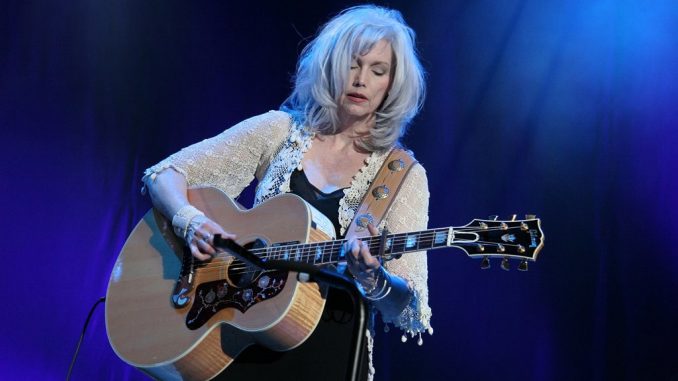
A number of the top music artists who have managed to have long, successful careers have had the ability to reinvent themselves periodically. Think David Bowie, Elvis Presley, Cher, Madonna, Neil Young, Kylie Minogue, Johnny Cash, Bob Dylan. To that list, you can add Emmylou Harris.
If you think of an artist’s reinvention as looking different, perhaps sounding fresher or newer, perhaps more relevant, whilst remaining unmistakably the same artist, then all of the above have successfully transitioned at least once during their respective careers.
For Harris, this reinvention was a very brave, but perhaps entirely necessary move. Known as an interpreter of other people’s songs, not noted as a songwriter, she has gone on since her reinvention to write a significant number of songs for her subsequent releases.
Following 1993’s “Cowgirl’s Prayer” LP, Harris had reached a point in her career where she was looking for the next step. Although not in a position where she was particularly struggling as an artist, she was searching for relevance and a place to fit in. Her songs were receiving less airplay on country radio, and she felt at odds with the country music (and its radio and press) of the time. Her record company asked her who she would like to work with and, based primarily on one of his solo records, “Acadie” and his production work on Bob Dylan’s “Oh Mercy“, both of which she was enjoying at the time, Harris suggested Daniel Lanois, who has also notably worked with Brian Eno, Peter Gabriel, Neil Young, Robbie Robertson, The Killers and U2.
‘Where Will I Be‘ is the opening cut from 1995’s magnificent “Wrecking Ball” record, an album that saw a significant change in approach, outlook and musical style from Harris. Gone were the pleasant, safe sounds of Harris’s previous releases. Although many of the songs were written by established composers associated with the americana genre, such as Dylan, Neil Young, Lucinda Williams and Rodney Crowell, others were not, including a song by a young songwriter by the name of Gillian Welch and one written by an artist from a genre distant from Harris’s familiar territory, Jimi Hendrix. For the recording of “Wrecking Ball“, Lanois and Harris put together a set of musicians with backgrounds in jazz and rock, all of this was topped off with a soundscape which was atmospheric, vibrant and new and fresh sounding, while that gorgeous voice, aching and haunting, couldn’t be anybody else’s. The approach, arrangements and production are far removed from Harris’s previous output.
The result was a completely unexpected departure (musically) for Harris and one which was generally heralded by critics. The record, Harris’ 18th album, won a Grammy Award (her 7th such award) for Best Contemporary Folk Album at the 38th Grammy Awards. Other nominees in the category were albums by Dylan, Steve Earle, The Chieftains and John Prine. Additionally, in February 2025, the record was inducted into the Grammy Hall of Fame.
The musicians featured, many of whom had previously worked with Lanois, include U2’s Larry Mullen Jr., drumming on most of the tracks; at the conclusion of U2’s “Zoo TV” tour, he had chosen to spend his downtime in New York, exploring other drumming styles and working as a session musician. Also featured are Louisiana-based musicians Daryl Johnson and Brian Blade (who plays the drum kit on ‘Where Will I Be’), plus Lanois on a range of instruments, including guitars, mandolin, and harmony/duet vocals, Tony Hall (bass and percussion), and Malcolm Burn, who contributes predominantly keyboards. Burn also did some of the engineering on the album and is credited by Harris in the sleeve notes with “innovative sounds” and for his “song and arrangement ideas“. A range of guest artists have an involvement too, including Kate and Anna McGarrigle, Steve Earle, Neil Young and Lucinda Williams.
The album had the effect of rebooting Harris’ career, introducing her music to new audiences, while undoubtedly alienating some existing ones – I saw Harris play at The Barbican in York on 10th June 1996, and while I thought it was a brilliant concert, I noticed some people walking out, clearly not enjoying the new approach.
On the “Wrecking Ball” tour to support the album, Lanois agreed to appear initially, until a suitable replacement could be found (this was achieved when Buddy Miller joined the band). In this clip of ‘Where Will I Be‘, Lanois can be seen playing the mando guitar and singing harmony. The other musicians in the band (known as Spyboy) were Johnson (bass and pedals) and Brady Blade (elder brother of Brian Blade, who was unavailable for the tour due to other commitments), occupying the drum stool. Brady Blade had, up until this point, spent some time away from playing music, instead concentrating on the business side of the industry, but the stint in Spyboy returned him to performing, and he would subsequently spend nine years touring with Harris.
For further reading about the album, check out AUK’s Classic Americana Albums piece from 2023


I think I’ve commented previously about some audience reaction during here mid 90’s UK tour. I was at the Corn Exchange Cambridge to experience an absolutely thrilling gig (I still remember witnessing one of the all time drumming displays from Brady Blade). and yet … although I didn’t notice any walkouts, the atmosphere amongst fairly considerable sections was polite but lukewarm. Oh well ….. I guess that’s the price you sometimes pay for being ahead of the times!
Hi Alan,
I appreciate you taking the time to read the article and commenting. Emmylou’s gigs at this time were indeed thrilling, I remember being absolutely captivated. Daniel Lanois had left the band by the time I saw the tour but I was so impressed by Buddy Miller’s contributions.
The Blade brothers are something else when it comes to drummers. I recall an episode of the “Norah Jones is Playing Along” podcast, where the guest was Brian Blade, and he talked about developing his drumming style, playing in church, the influence of Brady and how listening to the lyrics shapes his playing, it was fascinating insight.