
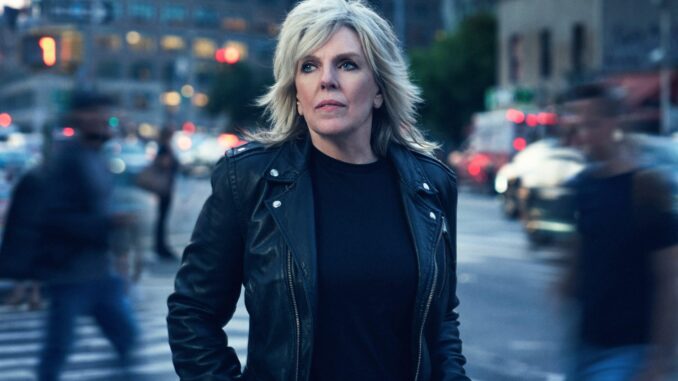
It would be strange to start things off by actually introducing Lucinda Williams, so let’s begin with a justification instead: Williams has been at it since her 1979 debut Ramblin’ Woman, though she only truly broke into a larger scene with her 1988 self-titled release, following that up by consistently releasing successful records in the 90s and keeping it up steadily since. That’s about 20 releases under her belt, depending on how you count them. And while her signature blend of styles hasn’t quite changed in the last decades, Williams’ back catalogue ranges from foot stompers to slow, mournful ballads and anything in between. That’s a lot to pick ten songs from, though they’re certainly worth picking. So for this top 10 I’m going for the slow ones. And since there’s no better through-line for a top 10 than whatever sticks in your craw for one reason or another, consider that the main criterion.
Number 10: King of Hearts from Happy Woman Blues (1980)
An early slow one that might just pack a harsher punch than the rest of the selection. Williams’s voice goes from an almost David Johansen snarl to a plaintive, Joan Baez vibrato. Desire and resentment strung together, from sweetness to bitterness. An early gem buoyed along by a fever-stricken violin.
“Can you relieve me, baby/Take your heart from your sleeve/And put it on the line,/Put it right here beside mine“.
Number 9: Greenville from Car Wheels On a Gravel Road (1998)
A gentle acoustic break-up song that builds into a 90s jangle apotheosis. The lyrics go from a list of ill-deeds and character traits to the constantly repeated refrain: “Go on back to Greenville“. If you’re just not capable of love, it seems, then you should just go on back to Greenville. It sounds like a hellish place.
Number 8: Big Black Train from Good Souls Better Angels (2020)
I have a penchant for Williams’ current timbre, like I have a penchant for Dylan’s Rough and Rowdy Ways croon: worn and blown out but capable of intent. Big Black Train is from 2020’s Good Souls Better Angels, famous for its searing indictment of Donald Trump. Big Black Train takes a turn for the simple and indirect: “I don’t wanna get onboard/That big black train/Last time through it took me far away/I don’t wanna get onboard/Didn’t know if I was ever comin’ back”.
There’s an obvious train Williams might not have wanted to board back in 2020, but who can think of a big black train and not think of any darkness that can’t be returned from?
Number 7: Lonely Girls from Essence (2001)
“Heavy blankets/heavy blankets/heavy blankets cover lonely girls“. Essence was a change in direction for Williams, a collection of mostly pared-down songs delivered in intimate fashion. The simplicity of Lonely Girls is striking. There’s an air of the old Blackburn and Suessdorf tune Moonlight in Vermont. That is to say, no rhyming scheme, no narrative, just portraits of the constant, returning chorus: lonely girls. And a strikingly subtle conclusion:
“I oughta know/I oughta know/I oughta know about lonely girls“.
Number 6: Reason to Cry from Essence (2001)
“When you lose your happiness/When no one’s standing by/When nothing makes any sense/You got a reason to cry/When nothing makes any sense/You got a reason to cry“.
Another song from the intimate Essence; the reason this one is on here has as much to do with the treatment of a love wilted and expired as it does with the subtle, liquid guitar work.
Number 5: Sharp Cutting Wings (Song to a Poet) from Happy Woman Blues (1980)
Endlessly covered, a classic from William’s second studio album that keeps fans wondering just who the poet might be. Does it matter? No. The words speak for themselves.
Number 4: Overtime from World Without Tears (2003)
There aren’t a lot of songs that feature the lines “Your pale skin/your sexy crooked teeth”, but this one does, and I like it.
Number 3: Something About What Happens When We Talk from This Sweet Old World (1992/2017)
This is a strong song no matter what recording. But when, in 2017, Lucinda Williams decided to rerecord the entirety of This Sweet Old World, the recording of Something About What Happens When We Talk gave the song a new breath of life. The noticeable change in Williams’ voice since 1992 lends it a worn, nostalgic feeling that both offsets and boosts its romantic idealism. But it isn’t just that. The subtle change in the melody of the chorus in the 2017 version gets me every single time. Slight changes make a world of difference.
Number 2: Fruits of My Labor from World Without Tears (2003)
There’s hardly anything to be said about this song. The tremolo guitar, the brushes soft and slow, the harmonica outro. The lyrics, the edge on William’s melancholy voice. The bittersweetness of tangerines and persimmons.
“Baby, sweet baby if it’s all the same/take the glory any day over the fame”.
Number 1: Minneapolis from World Without Tears (2003)
It isn’t often that a song’s lyrics can also read as poetry. Lyrics must come with a melody, a rhythm, and without them they’re caught out in the rain wearing nothing but a hand towel. Minneapolis is an exception, bordering on something that could be read on its own, and sung with such bleating abandon and vulnerability that I had to bump this song into number one and demote Fruits of My Labour for once:
“I’ve been wasted, angry and sad/Since you left Minneapolis/I wish my thoughts were pure like the driven snow/Like the heavens and the spring’s virgin buds/But they strangle me with their sin/Fill me up with poison/Black clouds have covered up the sun again”.



Was not ‘Minneapolis’ written about a failed tryst after crossing paths with Ryan Adams when both were on separate tours in the city of the same name?
Those Three Days would be the one with a bit of Ryan Adams in it, according to her. Minneapolis, who knows
I love all the tracks on this very interesting and well thought-out list, so heading off to listen to ’em all now. Hope it’s OK to point out that World Without Tears is that album’s correct title and not the way it’s been captioned.
It’s more than OK: somehow, sometimes we just write what we want to write
What? No room for Sweet Old World? Side of the Road? Ventura? Maybe I’d leave out Sharp Cutting Wings, or maybe Minneapolis? Or may be not. Jesus – it’s tto diffocult – this woman has written so many fucking great songs. Next time you’re doing the list thing with Lucinda, make it 20.
Couldn’t possibly leave Minneapolis out, but some of those had more than a foot in at some point