
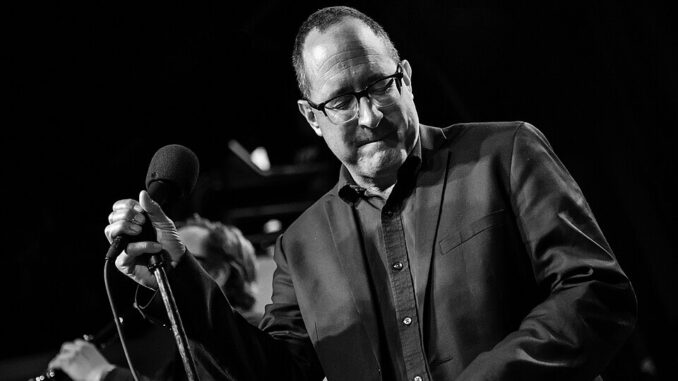
I am sure many of you will know of Craig Finn. The front man with The Hold Steady has been applying his raspy form of talk-singing to their blend of indie punk and heartland rock since before their first album in 2007. Live he presents an incongruous appearance as a more manic Paul Simon, complete with the jerky flailing arm movements patented by Joe Cocker. The band led by Tad Kubler, play the big riffs whilst he furnishes lyrics from the drug-based underground of America, with recurring characters such as Charlemagne, Gideon and Holly. Their annual weekenders at the Electric Ballroom are an addictive, high-energy thrash and singalong orchestrated by Finn at the front of the stage, staring occasionally bug-eyed at the audience. I have been to all eight of the Friday nights and can vouch for how they have supposedly sensible middle-aged people bawling their lungs out to the chorus and gang vocals and pogoing (gently)… sigh, I will be back there next year and as long as they and I can stand up.
Finn solo is a much sparser and reflective persona, more of an Americana feel with indie, folk and even soul in the mix. His lyrics are up there with Willie Vlautin as some of the best at documenting that particular seam of American tragedy which takes in poverty, desperation, difficult choices, love and hope. He has made six solo albums to date, each one refining his style, lyrically and musically, but with perhaps only the most recent, Always Been produced by War on Drug’s Adam Granduciel, making significant impact. These days the production is fuller, but the core of the sound remains as it did when he started. Live he also presents a more composed and reflective persona, a tendency to dress in black, with a black shirt under a black jacket. He is not cool; in The Hold Steady, Tad Kubler is cool – Craig Finn solo is mature, poetic and emotional.
This song, God in Chicago comes from his album, We All Want The Same Things. His third album, it was also the middle release of what he considered to be a cohesive trilogy sandwiched between Faith In The Future and I Need A New War. The track is in the middle of the album and so it occupies a pivotal role at the emotional heart of that trilogy. We All Want The Same Things is the title of the album and one of the key lines in God In Chicago. By this point in his career, he had found his identity musically and lyrically away from The Hold Steady and the album has a number of high-class songs such as Jester and June, Preludes and Birds Trapped In The Airport. But God in Chicago enters quietly at track 5 and inhabits your soul. He does this by perhaps playing to and developing his strengths.
Musically, it opens to a simple repeating piano riff. His voice comes in and he addresses the debate about whether he sings or talks, by deliberately talking the lyrics out over the accompaniment as a talking blues. Somewhere between prose and poetry, he murmurs an emotional story involving drugs, redemption, emotional connection and catharsis in a series of single lines which mix sparseness and detail to define exactly what is going on. The story is clear in just a few words, a skill few lyricists can manage. The first verse is the longest and proceeds to lay out the back story in unemotional lines. Following the presumably drug-related death of a friend, his mother finds his stash and his sister calls the song’s protagonist and asks for help. He knows a guy and he and the sister decide to travel to Chicago together to sell it and split the proceeds.
In a brief pause between first and second verse, drums and bass come in lightly, working with the piano. In a shorter second verse Finn describes the journey thus; “Went from St Paul to Cicero in my Chevrolet that didn’t have any radio. Had a boombox in the backseat that was running out of batteries. Played 1999 into Led Zeppelin 3. When the tape deck got all wobbly she still sang the harmonies.” The details in those four lines give insights into the characters of the still unnamed protagonist and the sister. The transaction is duly carried out and, in a chorus Finn sings with female harmony vocals, she entreats him to take her into Chicago for the night. The chorus is repeated before verse three kicks in, musically, the chorus is still the same piano riff. In verse three, the piano riff lightens, almost hopeful in its sound, emphasising the catharsis. They are sharing a hotel room and realise that at the end of the evening as they fumble with clothing, “We both want the same things”.
“And then it was morning.”
Musically there is a short interlude over which the female vocalist gives a cathartic sigh, before it carries on; “We drove back all hungover. All the way to Eau Claire she played with her hair. Came up on St Paul and she was sobbing.” The song ends there, clearly the sister has achieved some form of closure from the brother’s death, but there is no hint of where these characters go next.
It is difficult to convey in words what an impact this song had on me emotionally. It works as a piece of music, a piece of poetry and a piece of art. I have seen Finn live five times and he has played this song each time; sometimes with a full band, sometimes alone with just an electric guitar accompaniment – the piano riff replaced with staccato single chords, leaving all the space for the words. Each time it is not reserved for the encore but still gets one of the biggest cheers of the night. Each time when it is played you can hear a pin drop; people listen to this song and it clearly affects others as it affects me. Each time the hairs have stood up on my arms.
That is an achievement in any song.

