
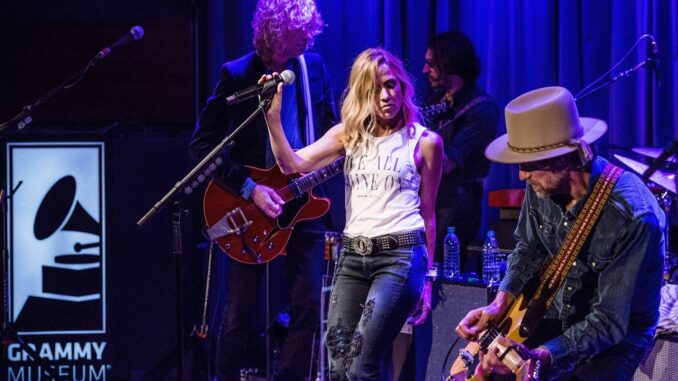
This song is on Sheryl Crow’s Wildflower album, released in 2005 to lukewarm critical response. It was a low-key collection of songs – no All I Wanna Do or Soak Up the Sun among them – that were introspective, touching on the sentiment of recognizing a relationship as a mistake (chances are it’s just a mistake) while also accepting the lessons learned from it. The key to the song Chances Are is acceptance, the fifth stage of the Kübler-Ross grief cycle, usually associated with a death but also relevant to a relationship. This stage is often seen as calming, learning to live with a new reality.
The ethereal track from Crow’s fifth studio album was co-written by her longtime songwriting partner, Jeff Trott, who doubled as the guitarist in her American Music Club touring band. Trott presented the song to Crow after being inspired by the works of eccentric author Terence McKenna, who achieved a notoriety in the 1990s for his experiments with psychedelics. Trott explained: “He studied psilocybin mushrooms, the effects and the religious aspects of these hallucinogenic drugs. He had this theory that human beings didn’t start talking until a Neanderthal picked a mushroom and ate it, and then all of a sudden, his brain started developing and he could speak, or he could communicate through words”.
McKenna traveled through South America in the 1960s, which shaped his theories on the ontological foundations of shamanism, no doubt by him foraging for wild fungi in the forests. Years later he wrote a book called Food of the Gods: The Search for the Original Tree of Knowledge – A Radical History of Plants, Drugs, and Human Evolution. McKenna wrote about “experiencing the fundamental essence of reality, the which of which there is no whither”. He also spoke of vivid visions of melting castles encrusted with precious jewels, luminous extradimensional landscapes, radiant beings, a parade of tiny Mayan figures on an unpainted wall, carrying serpent staffs, daggers and feathered fans.
It was this merging of spiritual and theoretical physics that intrigued Trott. “It’s really weird,” he is quoted as saying. “It’s kind of far-fetched, but I love reading stuff that’s just out there. He also called psilocybin mushrooms the telephone to God.” In McKenna’s book, he wrote about the Indians telling seekers of the magic mushrooms that while white men talked to God, the Indians talked with God, back and forth, and the mushroom was the conduit to conversation.
With Crow, Trott was careful not to swath his observations in the purple cloak of woo-woo. Chances Are really was inspired by this kind of philosophy, Trott related,“I managed to somehow talk Sheryl into writing it with me, and it’s pretty cool. I love the music in it, too. It’s really kind of odd and not what you would typically associate Sheryl with. It’s not that weird, but for her it was a little left of center“.
“I was lost inside a daydream / Swimming through the saline / I looked at you and you breathed in / Well, that’s the way it’s always been” Move over, Alice, we’re going down the rabbit hole into the second verse. “It all comes down to creating time / You don’t always have to make it right / We’ll all drive by in our hybrid lives / Chances are we’ll make it back”.
Next the songwriters name-dropped Terence McKenna. “Terence McKenna said / It is better to explore within / We were apes before we spoke of sin / The cosmos sits on the tip of a pin”
As you can tell, this has no relation to the 1957 hit song of the same title sung by the estimable Johnny Mathis, although some of the lyrics to that love song may give you pause. “In the magic of moonlight when I sigh, hold me close, dear / Chances are you believe the stars that fill the skies are in my eyes”.
At this point, full disclosure, back in the 1970s I once took a little magical mystery tour courtesy of some unpleasant tasting mushrooms, definitely unlike the chanterelles that come in a sauce in a fancy French restaurant. (Okay, I can imagine some AUK readers thinking, “That explains a lot.”) Anyway, these were simmered to a pungent broth by a young lady of my acquaintance, who was going to take this trip with me and be my guide. For about 20 to 25 minutes, nothing, then whoa! The universe slammed on its brakes; time sucked on a chloroform popsicle.
Our choice of soundtrack was the album by Cream, Disraeli Gears. When the needle slid into the groove starting Tales of Brave Ulysses, I could see the sound waves emanating from the speakers, not just feeling the sonic vibrations of Clapton working up a frenzy on the wah-wah bar but literally watching them shimmy into the room, the daisies in the vase on the coffee table swaying in time with them. I started to trace with my eyes the spiral arms of one daisy’s crown, moving inward towards the generation point. And here is where the woo-woo really kicked in with fairy slippers. I abruptly went inside the daisy! That is, my consciousness entered the daisy while my body remained slouched in an armchair. I’ve seldom told this story, all too aware that a person might judge me to be making it up or a nutcase (or both). Invariably, they asked me, “What was it like in there?” My answer: “Like a cathedral made of mathematics and honey.” Best I could come up with.
There is no telling if Trott himself was inspired to take a trip after reading McKenna’s account, or if he had Sheryl Crow along as a plus one. You read the lyrics, listen to the song and make up your own mind: “My karma was living inside a failure / No matter how it don’t matter now / Rest assured the rest is blurred”.
In case any of you readers are concerned, my friend and I made it back safe and sound from our dinner date with mushroom stew. The key is going along with someone you trust, then, as Mathis sung, “the chances are your chances are pretty good” of making it back to reality, whatever you imagine that to be.

It’s good to see a fresh take on a song from an album I’d somewhat discounted. I loved Sheryl’s self-titled second and The Globe Sessions for their sonic grittiness, as well as amazing writing but thought both elements dipped until 2017’s Be Myself. I’ll give Wildflowers another go…