
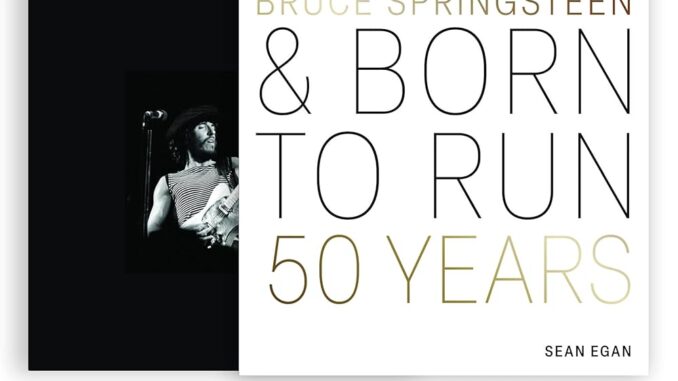
Half a century on, Bruce Springsteen’s third studio album remains one of the core texts of rock music. Released in August 1975, “Born to Run” helped Springsteen go from a promising, if poorly selling, New Jersey songwriter into “The Boss,” a voice for blue-collar America.
A box set was released for the 30th anniversary, featuring two DVDs that included a concert at the Hammersmith Odeon, as well as a documentary titled ‘Wings For Wheels: The Making Of Born To Run,’ and a remastered CD. With Springsteen on something of a roll with ‘Tracks II: The Lost Albums,’ 7 discs appearing this year, only the outtake ‘Lonely Night in the Park‘ has been shared to celebrate, along with some new photos from the cover shoot.
So ‘Bruce Springsteen and Born to Run: 50 Years’ is the celebratory document. Running to 170 pages in an album-size book, presented in its own slipcase, this lavishly printed offering was never going to be a heavyweight slating of either the album or the artist. The first of the seven sections, “The Context,” drifts towards a slight negativity, reminding us that after his first two albums, Springsteen was almost considered washed up. Quoting Charles Shaar Murray on the albums as “dumb and irrelevant” while praising his and the E Street Band’s live work is as harsh as it gets. A picture of The Partridge Family taught me that his early manager, Mike Appel’s only other significant client was that imaginary TV show group.
The second section on “The sessions” for “Born To Run” retells the well-known tale of CBS’s threat that it was make it or get dropped time, with third album funding only prompted by Jon Landau’s article “I saw rock and roll future and its name is Bruce Springsteen,” which led to Landau’s involvement as producer and manager.
The left page of each spread features pictures, clippings (including that Landau article), and brief biographies of the supporting cast. The right page walks through the story of the album’s creation and legacy. While I’m sure more diehard Springsteen fans may know many of the details, the fact that the title song was originally not going to be included was an interesting snippet. The comparative failure and the pressure of the last chance saloon see Springsteen shown as full of doubt about how good the album was, even throwing a test pressing into a hotel pool.
Sections three and four cover a track-by-track analysis of each side of the album. Listening to the album with the book in front of you is an illuminating way to spend time. Where ‘Tenth Avenue Freeze-Out’ gets five pages, ‘Night’ barely merits two. Egan’s assessments make a good stab at objectivity, although his view of ‘Night’ is a little harsh, as the 30th Anniversary remaster solves a lot of his problems with the song. The detailed critique of the title song is interesting, and once again, for the less committed listener, read with the song playing opens up some new ideas. The rest of side two is treated to a similarly forensic unpacking. ‘She’s The One’s’ Bo Diddley beat was the work of Max Weinberg, after a week with the band, we learn. I enjoyed his thoughts on ‘Meeting Across the River,’ and the contributions of Randy Brecker on trumpet and bassist Richard Davis, who had already provided “the greatest bass ever heard on a rock album” for Van Morrison’s “Astral Weeks,” according to Greil Marcus.
The next section looks at the reception from reviewers like Marcus, Robert Christgau, and Lester Bangs. The slightly less reverential opinions of the British music press are quoted at length, as well as retrospective reviews running up to the album joining the Library of Congress National Recording Registry of works which “are culturally, historically, or aesthetically significant, and inform or reflect life in the United States.” in 2003. The subsequent tour is poured over, along with stories of Springsteen joining rock royalty, and his subsequent career is examined in the light of “Born To Run’s” success. For the less committed fan, this last section is actually one of the most illuminating parts of the book and may well send the reader back to listen to later albums after reading Egan’s comments.
We’ve now reviewed four books analysing various aspects of Springsteen’s career in detail at AUK in the last year, so who is this book for? The committed Springsteen fan certainly. But for the general rock or americana fan who wants to learn more about one of the most significant artists of the last 50 years, this is a detailed study of how the album came about, its legacy, and what Bruce did next. While this type of coffee table objet is not for everyone, documenting albums in this much detail is a labour of love for the author, and a joy for anyone interested enough to pick it up.
We asked the AUK writers to reflect on the album and its place in history, or their own recollections of coming to it, now that it is 50 years old. Fewer than you might have expected responded, but maybe that reflects the relative youth of the ‘team,’ although one of our youngest writers, Fiona Golden, did announce that it was one of her favourite albums.
Andy Short and Jonathan Smith remembered not being impressed, but they were pre-teens at the time, and they both came back to it as they ‘matured’ and commented on the “timelessness” of the album. Others were looking to reacquaint themselves with the album after praising ‘Thunder Road’ and ‘Jungleland’. John Lee admitted being late to the party but described the album as “an emotional epic reflecting Springsteen’s trademark energy and the brilliance of the band“, a contrast to Dean Nardi, who noted that the quality of the musicianship in later albums was vastly improved. However, Dean acknowledged Springsteen’s success in making the sweeping cinematic nature of the songs an unqualified success. He also suggested that “the thrill of youth trying to make it had never been captured so succinctly.” Interesting because, as we mentioned above, Springsteen’s first two albums were commercial failures.
Only Fred Arnold admitted being old enough to have been at the historic Hammersmith Odeon concert in November 1975, a month or so after the album was released. The decision to purchase had not yet been made, but a nigh on ten-minute version of ‘Thunder Road’, with Springsteen perched on the front of the stage with harmonica in hand, and only Roy Bittan’s piano for accompaniment, made the decision for him. It is perhaps a sign of the esteem in which the album is now held that in 1975 the band played six of the tracks from the album, and nearly 50 years later, John Lee noted that, at a 2024 concert which he attended, a concert Springsteen said he thought was “the best he had ever done”, included five tracks from “Born to Run“. To re-quote an earlier comment, “timeless.”
My own journey with Springsteen has not always been as an uncritical fan. Although I’ve mentioned a preference for the less raucous aspects of his music in these pages over the years, I will now have to admit that songs like ‘Tenth Avenue Freeze Out’ are cracking examples of rock and roll at its finest. If you pushed me to a favourite song on “Born To Run“, though, it would have to be ‘Meeting Across The River’
And here’s that live version of ‘Thunder Road‘ mentioned by one of our writers…



That album is a complete masterpiece