
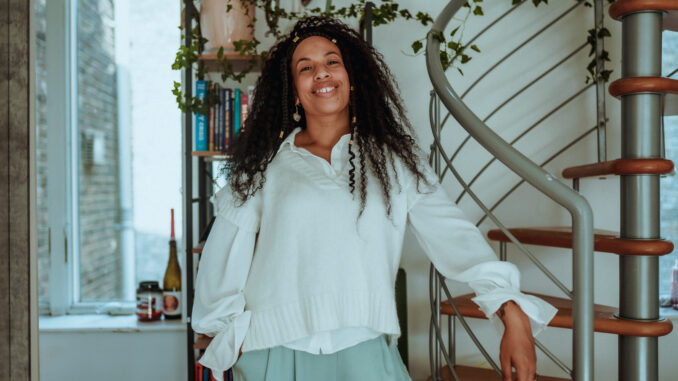
Lady Nade’s journey of self-exploration is brought to vivid life in this bold new single, Identity. With uplifting, joyous backing vocals and instrumentation, Lady Nade delivers thought provoking lyrics that reveal the many aspects of herself. She sings of being black and white, of her scars and being lost in the darkness before finding the light. Most notably, she sings: “Singing it for the first time in my life,” as she takes this moment to bloom. As ever, Nade’s distinctive voice is full of smooth, soulful warmth.
Filmed and directed by Aggy Rucin, the video is a truly vibrant accompaniment that shines brightly, bursting with joy. Rucin is a Polish videographer and visual storyteller, reflecting Lady Nade’s Polish ancestry and heritage, another aspect of her identity. The group of collaborators who feature in the video represent the diversity of communities we might identify with, while the pair of dancers seem to represent the duality of our selves, weaving together in controlled movement. Together, Antonia Latz and LJ (Lyndon Oghenekaro) explore culture and connection through their dance. Lady Nade herself is seen wearing a striking dress in bold, bright red, the colour of passion and strong feelings.
Identity is the opener and title track from Lady Nade’s brand new album, which is due out tomorrow – 2nd October 2026. As the title indicates, the complex notion of identity is the thread that runs through the entire album. Each song captures something of that private, inner-self – the conflicts and self-discovery – or the broader concept of how we identify ourselves and those we identify with. Produced by Archie Sylvester and featuring vocals from and co-writes with Ferris & Sylvester, it’s ambitious, taking deeply personal material and crafting something that will resonate with everyone, culminating in the the single Identity, a song that brings all these reflections together. Ultimately, the album asks us to celebrate ourselves and, while accepting the hardships along the journey, it is infused with joy and hope.
Lady Nade shares: “‘Identity’ exists because of the love that surrounds me. I hope these songs offer a safe space for anyone who has ever felt they had to hide parts of themselves to belong. We all deserve to be seen, heard and celebrated for who we are. This album is a reflection of what it means to be human, and to stand in our own truth.” Indeed. There are profound truths to be found here. For some incredible insights into the song, video and album, check out the exclusive Q&A below.
Exclusive Q&A with Lady Nade
Andrew Frolish: Identity is the title track of your new album, but listening to the record, it feels as though the song is also the culmination of a much longer journey. Perhaps we should start with the album itself. What does Identity represent for you?
Lady Nade: I feel that I have really gone on a journey with this album, and it has been deep – deeper than the others. Originally, the album was going to be about real, authentic conversations with my audience and people in my community. It feels like a calling of mine to tell and sing other people’s and my own experiences, and bring the reality of those experiences to life, so that we can all feel heard, seen and understood. I’ve spent a lot of my life feeling quite misunderstood, and that can feel really lonely. But through conversations with my community and fans, I don’t feel alone. I feel understood. I can talk about some real-life stuff and they’ll share their real-life stuff. Then I’m like, “Okay, right. So everyone’s got some real-life stuff going on.” But we also find it quite hard to talk about that because everyone’s worried about what everyone else is thinking, or that they’re going to get judged, or that they’re not going to feel accepted. I think that’s where Identity came in.
The writing of the songs actually came quite easily, although the process of releasing the album was long. When I got into the studio with Archie Sylvester and Issy Ferris, the bigger picture started to become clearer. Archie produced the album, and Issy features on it singing; we also wrote two songs together. I hadn’t initially realised what the whole concept was. I’d talked about generational trauma, masks and mental health, but I hadn’t actually talked about the broader message. Then I realised that all these songs were rooted in a journey to becoming. There’s Waiting for a Train, getting on the train; One of Us, generational trauma; Rainbow, accepting ourselves; Masks, taking off the mask; Bloom, becoming who I am. And then Identity was the thing that tied it all together.
AF: Sober seems like an important part of that journey too. You told me that you initially wondered whether anyone would want to hear a song about sobriety.
LN: Yes. I felt like writing a song about sobriety, but I didn’t think anybody would want to hear it because my experience of getting sober initially had been quite tough, isolating and alienating. In the music industry, drinking is how you navigate and socialise. It’s how you make friends and network, and in some cases it’s how you get paid. When you first start out, you’re encouraged: “Here’s some beer.” Getting sober meant all of that became very isolating. You get judged. People ask, “Why don’t you drink? Is there a problem with you? Is there a problem that made you have to stop drinking?” And then you’re going through a journey yourself. Initially it gets worse before it gets better. You feel FOMO, you feel like you’re missing out, you’re feeling tender, and you’re being reminded that you’re now on a different path. I didn’t think anybody wanted to hear about that. Then I remembered Mary Gauthier’s I Drink, which dealt with drinking quite humorously, and I was explaining this to Ferris & Sylvester. They said, “Yeah, there’s an absolute point.” I’m very influenced by Amy Winehouse, and they said that if Amy Winehouse had lived, she would probably have written about sobriety. There are people going through sobriety who are feeling quite alienated and haven’t got a song to sing. There’s a whole community that needs people to sing their experiences. So I thought, okay, let’s do it. We channelled Amy Winehouse’s retro soul sound, and Stax and Motown, with the backing vocals. I told it from the point of view of a love story and made it fun. I’m so glad that I released that song because it’s allowed me to have conversations and break stigmas. People from all around the world have sent me messages sharing their sobriety journeys and adding the song to their milestones. It’s made me feel less alone. Drinking might be heavily associated with music culture, but music is a worldly message. It’s for anyone in the industry who’s struggling with drinking, but also for people outside the music industry who are getting sober or don’t drink and want to hear that experience.
AF: And sobriety seems to have been much more than simply giving up alcohol. It became part of rediscovering who you were.
LN: Absolutely. When you’re drinking, I felt like I became quite ordinary. Drinking was a way for my persona and personality to come out. I think we’re all several different personalities, and that’s what Rainbow is about — the several ways that we show up and that we code ourselves to the room or whoever we meet. Then actually, it’s like, I’m quite ordinary. And as an artist, it’s not all razzle-dazzle. I think that’s why sobriety is such a journey, because you really start from scratch with who you are. You learn what you like, what you want to do, what you don’t like, what you think. It’s not just a generational programme or an identity that’s been put on you. You start to make the choices that you realise weren’t aligned with the choices you thought you had to make, and you have to discover those for yourself.
So it was a process of stripping back the layers.
AF: Which brings us to the song Identity. One of the lines that really struck me is that you’re singing it, “for the first time in my life,” and, “like never before.” Why not before? And why now?
LN: I think there was a timeline of different things that led to Identity. The first thing was getting sober. That was about rediscovery, so it wasn’t then because I was still early in knowing who I was. Then the pandemic happened. The world stopped and I went into the stillness. I went into sobriety, and then the murder of George Floyd happened. That was another moment of reflection because it was about the world looking at systemic racism, and that brought my heritage to the forefront. The press and media were asking, “What’s your experience of being Black?” And I was like, “Well, I actually haven’t been asked that question before. I’d like to have an answer.”
I have mixed heritage. I’m British Caribbean – my dad came over with the Windrush generation, my mum’s English – and I grew up in a white household with my grandad. I realised I hadn’t really been taught about my heritage or my culture, or about Windrush, or why I was brown, or what that meant for me navigating the music industry as a woman and as a working-class woman. In a way, because I didn’t see barriers, they didn’t exist. I just walked into spaces and places as if I was supposed to be there. For example, I walked into the Bristol Beacon and took part in a songwriting course and started writing my first songs in a building with such a complicated history around enslavement and Edward Colston. I thought, “Wow, if I’d known about that building, would I have stepped foot in there?” If I’d known about my cultural history, would I have done the things that I have done? So I had to do the work: understanding my heritage, understanding my privileges, understanding colourism and thinking about how I had experienced things and how other people might have seen me. I worked with Keith Harris, who was Stevie Wonder’s manager, for a year through the English Expo mentoring scheme. He taught me to think about what I was thinking in my head, but also how people were looking at me and how the world was looking at me – not just how I was looking at myself. In my head I’m basically a singer and an artist putting my songs out. But in the industry, people are seeing that I am a Black female, working-class person with an accent, and there is judgement. They’re not just judging my songs. So I spent time getting sober, understanding my heritage and my privileges, and understanding how to navigate the industry.
Then, in 2022, my grandad passed away and my dad passed away. That was another huge crisis of knowing who I am. My biological father wasn’t part of my childhood, so that was complicated, and my grandad, who wasn’t my biological father but had adopted my mother and me, also passed away. I was just raw. So raw. This huge loss. Then in 2023 my manager unexpectedly exited the industry. Again, it was, “Who am I? What’s going on?” All these huge losses and changes made it feel like my life was falling apart. And actually, what I realise now is that it was just falling into place. Because when we got into the studio, we realised that all these songs were rooted in the same journey. The thing that tied it all together was my journey into identity.
Why now? Why not earlier? Because I was on that journey.
AF: And that seems to lead directly into the lyrics of Identity, where you are able to say, “This is me.” You refer to being Black and white, to having scars, to being lost in the dark. There’s a real sense of accepting everything that has made you who you are.
LN: Exactly. I couldn’t control my past. I couldn’t control my childhood. I couldn’t control the loss or the change of direction. But I can accept the things I cannot change, change the things I can, and have the wisdom to know the difference. In order to do that, I need to accept my past. This is who I am, and I’m the way I am because of the life I’ve had. And singing, for the first time in my life, I’m like: “I know who I am.” I know who I am now. I accept who I am. I’ve realised who I am. I’m me. All the things that make me who I am. I’m Black, I’m white. I have scars because I’ve gone through some trauma. I’ve been lost in the dark.
AF: There’s also an interesting idea in the song about being able to go left or right – to turn your head and change your mind. You clarified afterwards that you don’t mean that identity or belief is simply a matter of choosing a political side.
LN: I can go left, I can go right, I can turn my head and change my mind. That’s how complex we are as humans. We can change and still be fixed in certain things at the same time, and that’s okay. I feel like I’m a bit more fluid. I feel like it would be more fluid to accept that sometimes a person can have differences. There are some things that are non-negotiable for people, and I completely value that. But sometimes you can believe something and then something can happen in your life that changes you, and you can be at a completely different point of view. If people only remember you for the view that you had at a particular time, there’s going to be a barrier between someone who has a strong view, learns something and changes their view. Perhaps, the song Stand is a good one to mention too, as in taking a stand, and how the right to stand up for what you believe in is important. Ultimately, what’s important to me is that if we can have compassion for each other, perhaps one day we might live in a world where we can all be at peace. This album is to celebrate each other for our individuality. We need more togetherness, not division. That’s what I feel passionately about getting across.
AF: And then the video brings that idea of individuality and togetherness to life. How did you want to represent Identity visually?
LN: I actively loved shooting the video. I really wanted it to be joyful and uplifting. I wanted it to make people feel good and reflect the multiple ways that we are ourselves. That’s why I made it collaborative. I wanted to bring in other people’s personalities, dance and movement, and people from the Bristol community who I feel are promoting a sense of community and the importance of celebrating our differences. It wasn’t about everyone doing the same dance or movement. I wanted people to sing from their perspective, wear what they wanted to wear and bring their personality into it. I went for this red heritage, boldness. I thought about blood, with the red dress, and heritage. I filmed it in The Lantern, where I first wrote the song, but there was also a sense of reclaiming the space – in my dress, in the song and in the space. I wanted to represent all the elements of who I am as a woman. There are people who represent sobriety, motherhood, community, music, heritage and different voices. I’ve got six brothers, so although I was initially going to do it with women, I realised that wouldn’t represent my grandad’s influence, the male influence, and what it means to the feminine and the masculine. So I brought that in through the dance and the male collaborators too. And my friend Ben, who’s a musician from the USA, has been part of conversations with me about identity, heritage and family. The main thing I wanted to bring in was fun, boldness and empowerment.
AF: You mentioned joyfulness in the video; one of the main themes that runs through all of those songs is hope and joy; it’s something we need right now and we look forward to finding these in the album – many thanks.
LN: Ultimately, what’s important to me is that, if we can have compassion for each other, perhaps one day we might live in a world where we can all be at peace and this album is to celebrate each other for our individuality. We need more togetherness, not division, and I feel passionately about getting this across.
Recognition for all the collaborators in the video:
Ben Jordan (US born singer-songwriter and storyteller)
Jonny Velon (musician, and choir leader who runs Bristol’s R&B Choir)
Rosina Buck (singer-songwriter, poet and creative workshop facilitator)
Mary Mina (singer-songwriter, radio presenter and community voice, championing local artists)
MSÄSI (vocalist and creative artist contributing to Bristol’s soul, jazz and African influenced music community)
August (singer-songwriter, radio presenter and founder and creative director of Bass Choir)
Priscilla Andersohn (singer-songwriter, collaborator and mother)
Suzy Conrad (live-looping artist and performer)
Antonia Latz (dancer)
LJ (Lyndon Oghenekaro) (dancer)
Agaha Rucin (Polish videographer and visual storyteller)


