
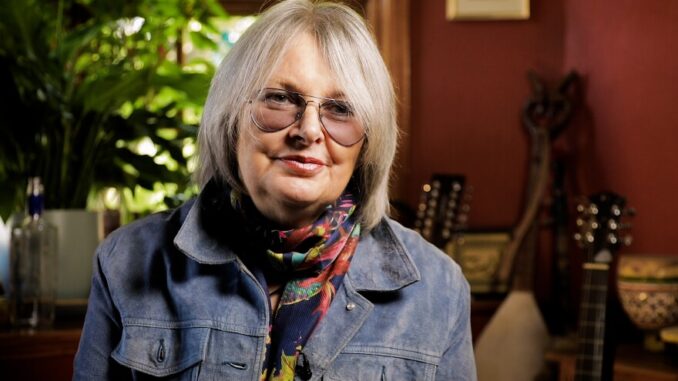
The last year has seen Bob Dylan take the media by storm, something that started with the success of “A Complete Unknown”, a biopic that covered his career between 1961-1965, which was a critical and commercial success, though there were questions on some aspects of the film’s historical accuracy. The film perfectly paved the ground for the latest version of “The Bootleg Series”, which covers the years 1956-1963, “Through the Open Window: The Bootleg Series Vol. 18 1956-1963”, and provides an insight into Dylan’s formative years. Concertgoers to his UK gigs will be able to see how his formative years made him the artist he is in the intervening nearly seventy years. Dylan had a lot of help in his formative years, particularly during his time in Greenwich Village, help that some commentators felt was not necessarily fully celebrated in “A Complete Unknown”. Liz Thomson is a journalist, author, broadcaster and interviewer, who has written what many have called the definitive biography of Joan Baez, edited the latest version of Robert Sheldon’s epoch-defining “No Direction Home”, Sheldon was also a friend and mentor to Thomson, and among her many literary efforts has co-edited anthologies on John Lennon, David Bowie and Bob Dylan. She also launched The Village Trip, a ten-day festival of music, poetry, drama and photography that celebrates the legacy and culture of Greenwich Village. Americana UK’s Martin Johnson caught up with Liz Thomson at her London home over Zoom to get her views on “A Complete Unknown” and a more detailed appreciation of the influence and importance of Joan Baez as an activist. She also shares her views on why the folk revival of the fifties and sixties provided such an effective soundtrack to the political activism of the time. Liz also describes today’s Greenwich Village and what is left from the time that Bob Dylan lived there with a number of like-minded artists and various other free spirits and non-conformists.
Greenwich Village in the ‘60s got a major media push with last year’s release of “A Complete Unknown” which covered Dylan’s time in The Village up to his appearance at Newport in 1965, and this year we have the release of “Through the Open Window: The Bootleg Series Vol. 18 1956-1963” and the man himself will be in the UK in November. What did you think of the Village that was portrayed in the film?
The Telegraph did a major piece about the Village still existing, but as it pointed out, nothing in that movie was filmed in the Village and people who don’t know the village won’t know that. I don’t think any of it was real; it didn’t even show the famous Washington Square Arch, which is really unchanged because the row behind it is 19th-century. They could have done that as an establishing shot, and while the streets have changed, the row houses and MacDougal Street are basically as they were. It’s a shame, really, because they show what is meant to be the junction of Bleecker Street and MacDougal, which is the town centre of Greenwich Village, if you like, it is a huge kind of open junction, and it’s Hoboken, I think. It is nothing like the Village, which has one-lane streets, which is a shame because the Village is a character in the movie, and you should see it. The closest they get is the Chelsea Hotel, I think, which is eight blocks outside the village.
What did you make of the media and social media buzz that the film generated?
I was intrigued by how people identified with different aspects of the film. I read something in The Guardian where someone was talking about her love troubles with her student boyfriend, and how she felt like Joan Baez. All the Dylan people, and I hate to say it because I was sort of one once, but the Dylan thing is now really a cult because they won’t brook any kind of challenge or comment that this concert or that reference wasn’t that good. The discussion was all about Dylan, and how good Timothée 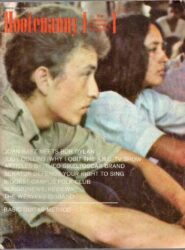 Chalamet is, which he is, and you kind of get swept along by it, but when you listen to the music on its own on Spotify, you think, yeah, it’s good, but not as good as I thought it was. I did see pieces asking who Joan Baez was, so there was an interest in who these people were. The film does play down the women, including the legendary Suzie Rotolo, who was named, but you don’t get the sense that Baez was as big a star as he was. That to me seems to have been specifically played down, she was a big star, something the Dylan people hate to admit, together with all the other auteurs like Peter Paul and Mary, Dylan’s first manager Terri Thal, Judy Collins, Dave Van Ronk, huge numbers of significant people if you know to recognise them in the crowd, including Shelton, oh yeah, that’s Shelton hanging there with a notebook, that’s Dave Van Ronk giving directions, but there’s no Mike Porco. It’s a shame there was not more accuracy, or more credit to the people who gave him a huge push on the way up. I suppose the girls will probably listen to Timothée Chalamet singing, as he’s a big star in his own right, but I do hope people go back to the artists themselves, to the music, absolutely, but also to the story of Dylan, Baez, and the times and that whole period.
I’m 67, and the first 45 rpm single I got was the Highwaymen singing ‘Michael Rowed The Boat Ashore’, which was a huge hit, with ‘Santiano’ on the flipside and with the teal sleeve. That, of course, was the folk revival, and I was too young to experience it the first time around except by listening to the radio. It obviously stayed with me for sixty-odd years, and I hope people will look at the story and the meshing of music and politics, which the film didn’t really show. They show the Suzie character telling Bob about segregation and civil rights, and he clearly has no idea, but she was a huge influence on him. You don’t see Baez talking about politics; you see TV shots of the March on Washington, and there’s a scene where Cronkite and Kennedy are addressing the nation about the Cuban Missile Crisis, and then you see people running hysterically through the streets of New York trying to get out, which never happened. So there is all this recreated history, but I hope it sends people to learn about that; the editor I wrote for the other day clearly didn’t know about the Cuban Missile Crisis. At first, I just liked the music, but it took me into the songs, and I was like, what was that event, why was Dylan here, and then you kind of read about it in those analogue days. I learnt a lot and it took me right into history, which I’m still fascinated with. I’ve got tons of books on the sixties generally, but no one knows the history anymore.
You’ve described yourself as an English obsessive, as Greenwich Village of the ‘60s goes. What was unique about those times that fused music and politics?
I suppose for the first time for quite a while, you had a generation of eighteen, nineteen and twenty-year-olds who were not in the forces and were not fighting, though they could be called up in America. They had leisure time, they were going to college, and we had the beginning of all those fifties ads showing women nicely powdered, and we had all those appliances that made life easy. We were in a new generation, and we had the Kingston Trio and the beginnings of the folk revival in the late fifties and the real burst of it in the public imagination as the sixties went technicolour, Eisenhower into Kennedy, when the sixties exploded and everything seemed to happen. We had television, we had kids buying record players. People were much more interested in music, and there was political awareness. We are both too young, I imagine, to know but I get the sense that in the States they had the political stuff in the fifties like duck and cover and the red scare, while we got our folk music through skiffle and we didn’t have the political stuff early on when America had the political awareness, and it is fascinating that everything seemed to come together in that moment. In the middle of it, we had Dylan, and over here, the Beatles, two kinds of seismic acts who didn’t change anything, but they provided something that everyone could coalesce around. We still listen to them, so they obviously had a great influence on their immediate times and the years since.
My fascination for the Village, which in the sixties and seventies was this dim and distant place, Greenwich Village in New York. I had no real concept of even New York. My dad had been there in the war, and he had hung out in the Village, but in those days, before cheap jet travel, I thought, one day I will go and see all this stuff. Once I was there, and I went to New York as a journalist writing about the book trade, and had really researched it, I had this crazy idea for a festival, and I realised the Village had been a place where non-conformists went for a hundred years or more before the sixties, Walt Whitman went there in search of fairy clubs, the woman who founded the Little Red School House in the 1920s was gay. The opening scenes in that really long movie “Reds” are on the north bit of Washington Square there, and we see Eugene O’Neill, Max Eastman and all these people who were in the Village in 1912, 1913, all these radicals and revolutionaries are in the Village, and in the directors cut Warren Beatty released about ten years ago some of those people were old enough to be still around and be interviewed which is fascinating. John Reed, who wrote “Ten Days That Shook The World”, was amongst that crew, and you see Eugene O’Neill setting up those theatres, writing his poetry and plays and getting in on the radical scene. Greenwich Village had the folk revival, and in the thirties, it had its anti-fascist thing, and in the forties, Russia was the terrible bogeyman. In the fifties, Pete Seeger was exiled from TV and radio, from the airwaves basically, and Paul Robeson was in a similar position, and they went to the summer camps. I know Janis Ian learnt guitar and banjo at Pete Seeger’s feet at one of those New York State summer camps, and if he hadn’t been driven off the airwaves and driven from many concert halls, he probably wouldn’t have been at those summer camps teaching kids banjo and guitar. In the sixties, you had all these kids buying guitars, Martin had this big explosion of guitar sales, and they’ve all learnt from the masters, really.
It’s extraordinary when you think about it, how amazing it was to have been at summer camp and learning from Pete Seeger. Bonnie Dobson, who nobody remembers now, lives down the road from me in Primrose Hill, and she’s 85 and still has a good voice, and she was in summer camp with Pete. She’d lied about her age, and she was a camp counsellor and had Pete Seeger on her team. I just thought, wow. So, you had all these very engaged kids, who realised you could make music and have fun, have folk evenings, sit round a campfire with their wine and beer, and go to a loft in the Village.
The Village Trip festival has now become part of New York’s cultural year, but what is the Village like today? I’ve heard it is very expensive to live there. Is it now more like a theme park?
Not quite, but it is in danger of that. When I first went to the Village in 1995, I was quite frightened by New York, and I was invited by Mojo to go and review Joan Baez recording “Ring Them Bells” at The Bottom Line, which was the beginning of her comeback. I didn’t know The Bottom Line was so 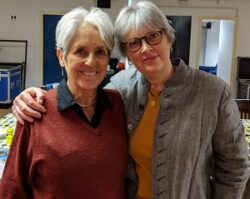 sophisticated, and I had to be in New York for two nights. We stayed uptown in one of those grand hotels that have a TV in the bathroom, and I thought I’d finally arrived. That was my first experience of the Village, and apart from hanging around The Bottom Line, I didn’t spend much time there. I went back to New York three months later as part of my day job in the book trade, and I stayed at that famously crumby hotel in Washington Square, which isn’t crumby any more, and ran around Manhattan doing my day job during the day and the rest of the time in the Village. The first time I walked around it, I was like Wow, here’s MacDougal Street, here’s this, where’s Gerdes but Gerdes was ten years gone by then. The Bitter End was and is still there, and the site of the Gaslight was still there, but now it is a fancy cocktail bar. So you can find traces of the old Village, the famous apartment on West 4th Street, where Bob Dylan lived above a spaghetti parlour, which was a sex shop for a long time, and now it’s something else, probably a coffee shop.
The Music Inn, which is just a few doors along West 4th Street, is a crucial part of the story, and it was founded in the fifties, I think, and it is still there and is a complete time warp. You go into a dusty old shop with a basement, and the guy who’s been running it for the last fifty years makes exotic instruments. It is crammed with guitars and exotic percussion instruments, and it was featured in the series “The Marvellous Mrs Maisel”. They have music gatherings downstairs, and that is the oldest and most extreme example of the old village. There’s a wonderful coffee shop I go to, which wasn’t there in the sixties, but it is where Pete and Toshi Seeger got married and where they lived.
So, you can find these traces of the old village, but it is in danger of becoming a shopping mall with very expensive restaurants. The coffee shops, Café Reggio, which Dylan would have known, is still there and unchanged. It is in danger of becoming a theme park, and the sad thing is that Americans aren’t as good as we are about putting plaques on walls, though there are a few. You hear the tour groups going round, this is where this happened, this is where that happened. Hendrix’s Electric Ladyland is still there. I walked through the park last year, and a dad was introducing his daughter to the NYU campus, and she hadn’t the foggiest idea about anything. You see lots of foreign tourists with their designer carrier bags and their designer gear, and they may be vaguely curious about something, but they quickly move on. To me, that seems to be a great shame, and everyone trashes their heritage, and then they realise they could make a lot of money from it.
Liverpool has the Cavern Club, but unfortunately, it isn’t the original club, even though the Beatles’ heritage has brought a lot of people and money to a city I have loved since the late eighties. I think it’s great what they have brought to Liverpool, and their heritage should be cherished. Will it happen in New York, probably not, because real estate is so expensive there. Those row houses that were damp, cold and incredibly cheap, celebrities bought two of them and knocked them into a mansion, and they don’t spend money in the Village because they summer somewhere else. It is interesting, those ratty apartments that people rented in the sixties, and I’ve been in two of them, and you realise how basic and cold they were. One still had the bath in the kitchen; I think it wouldn’t be legal here. So, you still find tiny old bits, but they will go. I certainly don’t want a place with the bath in the kitchen. As I came to know the Village in the late nineties, I did think that if this was in Britain with this amount of history, and not just the music history, we would have created something. We have Daphne du Maurier country, Shakespeare’s England, and we manage to horribly commercialise these places and make them TV theme parks. I do think you want someone to realise it was an important and unique era. You don’t want to make it into Williamsburg or something, but it will go unfortunately. I don’t think you can even afford to be a starving artist in Brooklyn now, and I suppose that’s true everywhere.
Your 2020 book “Joan Baez: The Last Leaf” is viewed as possibly the definitive biography of Joan Baez. How would you summarise her place in history?
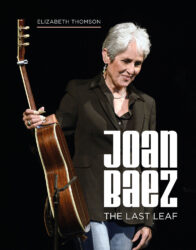 That’s nice, people did say it was a definitive biography, including Mojo, but I think it is too slight to be definitive, but I did deliberately put in a lot of critical apparatus to get you to go off and listen and read more. The thing that attracted me was that I’d been given a guitar in ’68 or ’69, and I had to go off and learn to play it. I found a Joan Baez record in my sister’s collection, and I played it endlessly. I was playing piano, so I knew my way around chords, and she was very easy to learn from in the sense that she had fantastic diction, and songs of that era were quite easy to play. As I explored, I got introduced to Dylan, and other people, whom I vaguely knew through my mind’s ear, and then I heard on “Joan Baez/5” ‘Bachianas Brasileiras’, which is this amazing classical piece, and I was like, wow, she really can sing, this is the most amazing voice. I think that is a thing a lot of people don’t realise about her. She had a remarkable voice, and it is still a beautiful voice despite some weathering now she is 84. If she’d wished, she could have done opera, and I know she recorded more classical stuff than was released. I always thought in my 12-year-old ears that she was a very good guitarist, quite an intricate picker, had the tremolo, and she was much, much better than Dylan could ever hope to be. She did help put Dylan on the map, and that isn’t to say he wouldn’t have made it on his own, but she did record a lot of his songs.
As I explored further, I realised she was at all these significant inflexion points, like the March on Washington in 1963, and she went to jail for her beliefs. She went to Hanoi in the seventies at the height of the American bombardment, not to sympathise with the communists but just to say enough fighting has taken place. She has real principles and moral courage, and there are a number of records that aren’t particularly distinguished, where she has lost her way, and where she spent much more time worrying about political engagement. But that was the environment she grew up in. Her father was quite a celebrated scientist who co-invented the X-ray microscope, Mexican, of course, at a time when Mexicans weren’t really allowed to do anything very much or be very much. She had quite a difficult childhood and came out of this tradition of dissent, the Quakers, with real political commitment and beliefs, and that fascinated me even before I could understand it. Then I started reading around it and found out she was a great friend of Martin Luther King, and she was with him not just on the March to Washington, but also at various points in the South that weren’t all particularly newsworthy, and she was involved in that whole Southern Christian leadership.
I still love that voice, and I admire her political and moral courage. I think I’m drawn to figures, particularly women, because I am a woman who can harness their artistic ability with real belief and not actually duck out of the hard choices and follow their conscience. She has stood by everything she believes in, and I’ve always found that inspirational, as have people like Peter Yarrow. I think she was a serious figure. She did lots of serious political and social work out of the spotlight, which people don’t know about, and she is a crucial figure not only in the music scene. While she was never part of the women’s movement per se, by doing what she did at a time when there were very few solo women artists in the early sixties, she became an example to other young women who copied her, and she’s influenced every other young woman songwriter who has followed. She has played such a huge role in so many movements, social and otherwise, over her long career. She is still politically active and using her art in different ways. She still sings occasionally, and she paints and raises money that way for her causes. She is a really significant figure in our recent history whom people should know about.
You’ve done your bit to help improve awareness of her achievements.
I’ve tried. For a long time, people have said, ‘Who?’ I was getting into all this in the early seventies, which was the era of the Osmonds and Donny Osmond, David Cassidy and all that glitter rock, which I wasn’t interested in. I was a bit weird because through her music I got into Dylan, Judy Collins, Woody Guthrie, Pete Seeger, Leonard Cohen, Janis Ian, and I followed the trail that opened up this great treasure trove of fantastic writers. Judy Collins, who is still singing and has a great voice, in particular, was very adventurous in the type of songs she recorded, and all those artists did magical and inspirational things, though they didn’t all necessarily write their own material. Baez wasn’t fashionable, nor were the others. Dylan wasn’t really fashionable until “Desire”, but Baez certainly wasn’t fashionable when I was doing the book. The recent Dylan movie is the first time that huge numbers of people have heard about her, and my concern is that she isn’t just seen as a cypher and sidekick for Dylan. Pete Seeger is played down. Okay, it is a movie about Dylan, but I hope it does send people back. There have been movies that have sent people back, and the other thing is that these people, maybe not so much with Dylan, weren’t doing it to make huge amounts of money or become famous in a way that kids do today. They were doing their thing; they believed the folk movement was righteous, left-wing, and politically correct in an old-fashioned sense. They weren’t seeking to be stars; they were doing what they did with real craftsmanship and a love for the music and that sense of community.
There is still a folk community in the Village. I’ve been to endless at-home type events with people with guitars making music that comes from all that. I’ve been with people who said they’d played with Pete Seeger and designed whatever, and I’ve had to pinch myself. What is it that speaks to me? I think it is that sense of community of people not just seeking to make money, but are gathering to make music and have fun, and using music as a way to get people active. Music will never change the world, but align it with social action, and it gets people going. Just look at all the big protest marches and the songs they sing – ‘Give Peace A Chance’, ‘We Shall Overcome’ – these songs give you something to cleave to and inspire you.
What message would you like readers to take away?
Dig deeper into that part of history; all of this stuff, however obscure, is available. You can search for Greenwich Village on Spotify and find it. Phil Ochs was another significant artist and someone whom Dylan was vile to, as he was to many people. Phil wrote some really amazing, very politically oriented songs. When I talked to Baez backstage on her farewell tour in 2018, I asked her whether Trump would make it through his first term, and she was like, Yes, it is all about the money, so they are all going to stick with him. There was hope in the sixties, and things did get better despite the Cuban Missile Crisis and events like the use of force against the protesting school children in Birmingham, Alabama. We all thought things had got better, even in this country, just basic justice and fairness for everybody, and that it would continue to get better, and it turns out it hasn’t here or over there. I think we need that galvanising energy and hope you got from the line of folkies from Guthrie, Seeger, Robeson, Baez and their ethic of fairness and justice for all. It is hard to be optimistic about the world’s survival, really, to put it bluntly, and we just need to take hope from something that means things can be changed incrementally. We just have to keep our spirits up.
You can read about Liz Thomson’s current projects here.


