
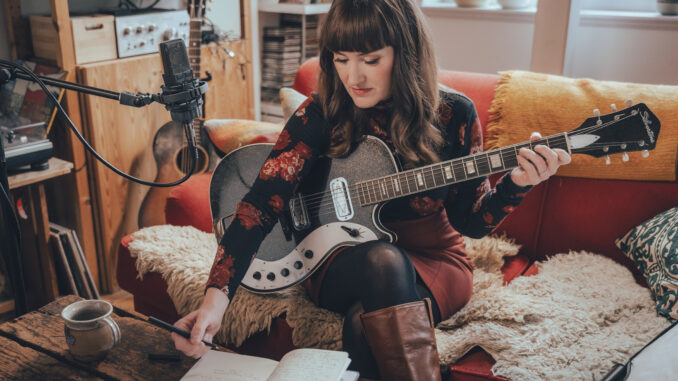
Suzie Ungerleider has just released her second solo album, “Among the Evergreens“, after more than twenty years (and eight albums) under the stage moniker Oh Susannah. Like her first solo album, “My Name Is Suzie Ungerleider” (and indeed many of her previous albums), she has met with significant critical acclaim (Juno and other Canadian music awards). Only last week, our own magazine colleague Sebastian Reyes Turner rated the latest album 9/10. Ungerleider hails from Vancouver (though she was in fact born in Massachusetts), but spent more than twenty years honing her craft and recording her albums in Toronto, before returning to Vancouver, where much of the inspiration for her new album comes from. The album itself is a personal journey through time, and it traces the life events and the dreams of her youth that have resulted in the person she is today, a personal experience that she found difficult to realise earlier in her career, hence the use of a stage name. We had the opportunity to catch up with Ungerleider and discuss her album and the events leading up to it.
Hi Suzie, Is it possible, firstly, to give us a little insight into the individual tracks on the new album, how they came to be the final choices for the album (assuming there were more to choose from that is!)
Hi Fred! For the most part, if I finish a song, it is going to be recorded. I linger a long time on most songs, not rushing the process. The trick for me is to get addicted to thinking about the song and ruminating over the lyrics till it seems right. It works the best if I create my own earworm and then tease out what lyrics ought to be there. Other tunes come fast and furious.
‘The Prize’ – I wrote this one for an old friend that I lost touch with. We were teenagers and tried our best to cultivate a toughness to protect ourselves. For me, I was just trying to be cool, like my idols, and to not get my soft side seen. For him, it was a survival technique to get through an abusive childhood. We both used the shield of toughness to protect ourselves. But we missed out on so much because of it.
‘Cicadas’ – My hometown of Vancouver has a reputation for its natural beauty and gentle lifestyle, but there is a real underbelly there. This is a story of a guy I knew who had run away from home in Newfoundland to Vancouver to seek a better life, but then just got stuck in a life of drugs, addiction and crime.
‘Real Estate’ – A song inspired by my sister, who moved to San Francisco in the late 80s. She hung out at a bar called The Chatterbox and found her people in the loudness of that rock ‘n’ roll joint in the Mission District. Now, many of those artistic spaces have been lost to gentrification and the high price of real estate.
‘Juniper’ – A song written about the early courtship days with my husband/drummer Cam Giroux. He would pick me up in his red Chevy Blazer, and we would cruise around listening to music.
‘College Street’ – Many of my friends who play music think about quitting because it is so damn hard to make it work. This song came out of thinking about that and how ambitious we all used to be, dreaming about being superstars, but then reality and life sets in.
‘Mount Shasta’ – When you are married for a long time, you can have the same fight over and over, dressed up in different particulars. That is what I mean when I say we played all of our “hits”.
‘I’m Sorry and You’re Right’ – This song I wrote to my daughter, who says I freak out a lot. Being a parent for me is a challenge because, in spite of following the so-called recipe, it can go horribly awry. I am someone who likes to follow the instructions, and I get very flustered when the outcome isn’t what is expected or promised.
‘Sirens’ – Sirens is about a very, very tough and fragile time in my relationship with my daughter.
‘Golden’ – ‘Golden’, I wrote about a realisation of mortality that I had. We are fragile, and one day we’ll be gone. It is about trying to get to a place of real honesty and forgiveness in my relationship with my husband.
‘The Wilds’ – I am watching my daughter reach the age where she will be leaving the nest soon. I am full of admiration for her mind and imagination, and am excited about what will come next. The album ends in a full-circle moment because I was once the kid leaving home to find a big, wide world.
What do you see as the progression from the first album, the tellingly titled “My Name is Suzie Ungerleider”, you made in your own name?
Performing and writing under my own name, I think, allows me to go fully into my own experiences and to let those be my muse. My life in music has been a journey from using a shield to express myself to casting the shield aside to express myself more explicitly. I think music has been a way for me to gain more connection within myself and also with people around me. Using my own name is one step in making this connection happen.
You made a number of albums under the name Oh Susanna, and I have read the reasons why you gave up that moniker. Was the change a difficult one to make, and what were the biggest challenges you faced commercially in making the change? Did you get any kickback from friends, musicians you worked with, or family?
Letting go of the moniker was absolutely the right thing for me. Sometimes you know something is right, but it is hard to execute or even to admit that it is the direction you must take. Luckily, my friends and family and team were completely supportive and helped me navigate the change. Commercially, it is a challenge to get the name recognition that I had with Oh Susanna. But then again, I think I am reaching new people, and that is exciting to start fresh in people’s minds. My given name doesn’t necessarily evoke the same imagery that Oh Susanna does, and that is challenging from a branding point of view. But then again, the imagery that Oh Susanna conjures for me now is one of pain and racism. That is the reality of where the song comes from. Old America was once my muse, but that started to fade, and so artistically and politically, I needed to just be me.
Do I get the impression correctly that the ‘unburdening’, if you will, of things in the past, that is apparent in the new album, is more personal, more detailed than it was in the last album, because then you were feeling your feet with your persona? Has it been difficult to open up from the times when you recorded as Oh Susanna, insofar as in those days you were writing as a third person?
The persona of Oh Susanna was actually a way for me to open up and express things I couldn’t when I was just being me. It was my way of being a musical person and giving voice to things I felt, but couldn’t express, in everyday life. Part of it was my inability to reveal myself as a music artist. So making the persona helped me be what I wanted to be and what I was, but nobody knew it yet. But once I became known as a songwriter and an artist, the persona felt a bit grotesque and also unnecessary. I was using a mask to become what I am. Once my identity became one of a singer-songwriter, I no longer needed to dress up as one.
I can’t recall reading so, but was the move back to Vancouver from Toronto also a kind of shedding of, a release from, the Oh Susanna character?
Moving back to Vancouver was a return to the place where I grew up…the place where I was just myself before I was Oh Susanna. I got my start in music in Vancouver, but so many people – my friends and family – are here that knew me from before that time.
I moved to Toronto to be in a place where everyone knew me as someone who writes and sings songs…it is why I felt so drawn to that place – the people I met there didn’t question my identity as a singer-songwriter…I didn’t have to explain. They just got it. But then there was a part of myself that knew I was in exile from Vancouver…happily so.. but then I realized I missed the place and the people that knew me the best.
Do you find that Vancouver gives you a different kind of inspiration than you had before?
There is a kind of longing that is inspirational for me. My old friend and mentor, Fred Eaglesmith, once said to me when I was first starting out that it was good for me to be a foreigner in Toronto because then I could be slightly out of place and therefore always longing for home. He said it was good for the songs.
But being back in my hometown is inspirational because I have stories on every corner of this city. And I now realise that telling those stories is what I want to do.
I’ve read that you said that you were a slow thinker, and that you develop songs over a period of time. How much is Jim Bryson involved in this process, or are his orchestrations developed only in the studio?
I usually bring songs to the studio that are mostly finished. Jim, Cam and I did do a recording of ‘Cicadas’, and then I wrote a bridge afterward because it seemed to need it after listening back. Jim is mostly involved in production, and not the writing, but he is key in giving me permission to be very personal and specific. He was the one who said I needed to write more about myself rather than in character. And this idea guided most of my songs written in the last ten years.
Jim Bryson seems to be a go-to producer for a number of Canadian artists – how long have you known him?
In 2001, Jim and I got to know each other because we climbed into a van to go on tour together. I had met him once before in the late 90s at The Ottawa Folk Festival. He and Kathleen Edwards and I were in a songwriter’s circle, and they were totally misbehaving and being irreverent and silly like kids giggling in church. I thought, “Who are these assholes?” Haha. Then, when our manager put Jim and me on tour together, we got super close travelling in the van together to the East Coast. We felt like old friends after only a week on the road. He has been a dear friend of mine for 24 years and a collaborator for 13 of those.
Does your husband have much influence apart from in the studio?
My husband has huge influence simply because he has changed my life so much. Before I met Cam, I was a much more negative and closed person. Cam is very open and positive and very, very silly. This has made life way more fun. But we also have our issues, and that is good fodder for the songs, too. He is also a great drummer.
The song ‘Golden’ is beautiful and has something of the feel of Jason Isbell’s ‘If We Were Vampires’, I thought. How much do you get inspiration from other songwriters?
I think I am very influenced by other songwriters. I think the influence, musically speaking, is mostly on a subconscious level. I remember thinking that some of the songs on this album felt like Wilco, and I am not really sure why. It wasn’t on purpose.
I think the biggest influence other writers have had on me is the idea that you can write about anything and that I can trust my mind to create something interesting. I think being playful in my writing has come from Joel Plaskett, who loves puns and has a great sense of humour in his music. Joel Plaskett and Sarah Harmer also influenced me to get really specific and to write about my own experiences.
You were last here in the UK in summer 2023. Do you have any plans to present the new album on a UK tour?
Yes, I am planning to tour the UK in April 2026.
Do you do mostly solo gigs, or with a band? Which is your preference?
I do solo gigs, duo gigs and also band gigs. All of them have their charms. Being solo allows for more storytelling in between songs, and the connection is very direct with the audience.
Duo shows have a great feeling of partnership between me and BJ Baartmans, who is my usual guitarist in the UK/EU. We have been playing together a long time now and have a great mutual respect, and I can relax, and he can weave in and out of what I am playing. He totally reads my cues without me being overt about it. And so we can make a song feel different every show if we want.
Band shows can be amazing, too. These are harder for me in the short term because they can be a lot of rehearsing and work, but once they get going, they can be like an incredible engine behind you.
What’s your favourite kind of venue?
Of course, the main thing that creates a good vibe in the room is that the sound is amazing and the audience is listening. I love the variety of what I do, and recently I said to BJ that the upside of playing to smaller audiences is that you are not in generic venues where they mostly look and feel the same every night. When you are famous, you play to huge crowds and that must be a rush, but the venues themselves are pretty samey. The last tour in Germany, we played in old churches, museums, funky bars, folk clubs, community centres, living rooms and as long as the sound is good and the audience is listening, the shows resonate and feel like magic.
Do you notice any difference between UK, US or Canadian audiences?
Yes definitely. The UK audience has a love of language and dark humour, which is absolutely dazzling, because I do too.
With Canadians, it really can depend where you are in Canada. It is so vast and has these little specific quirks in each province. I feel lucky to know what those things are now so that I can tease the audience about their regional clichés. Like in Winnipeg, you can tease them for creating a disruption at the airport by crowding around the TV to see who will win the national Curling championship. Or you can tease the people of Ottawa for being a town of librarians who shush you if you are too loud in a restaurant. Or in Vancouver, you can say, I know you won’t ask for an encore because you want to go home early tonight so you can hike the Grouse Grind tomorrow morning. It makes the shows very specific and creates a great feeling of communion.
I have travelled far less in the US, but from my experience, they are much more overt and expressive than Canadian and UK audiences. They are not shy to show what they feel.
Do you have a favourite memory from a show?
There are so many memories from touring for almost 30 years! Hard to pick one. But one hilarious moment was playing with my band in Newcastle, UK, at a festival near the river just days after September 11, 2001. I was mid-song when all of a sudden the presenter hip-checked me off the mic and started yelling over the PA, “ TEST TEST TEST TEST. THERE I DID IT, I DID IT, I DID IT!” Then he left the stage without looking at me. I was completely mystified and bemused. I just shrugged, and we launched back into the song again where we left off. Apparently, the local police had made the presenter interrupt us to do an emergency test of the broadcasting system. He was mortified, but we all thought it was super funny.
What kind of music do you listen to, and who were your earliest influences?
Growing up, my parents loved jazz, 1950s rock ‘n’ roll, show tunes, and the Beatles. They were always bursting into song. My aunt and uncle had all these Folkways records of Pete Seeger, Big Bill Broonzy, Leadbelly. Then, as a kid, my sister brought home all these Rolling Stones records. I also discovered Kate Bush. We got into the Clash, who wrote incredible story songs, as did Kate Bush. We also loved The Who and Led Zeppelin. I think all those artists told stories in their songs and created that otherworldly feeling. My whole neighbourhood was crazy for music, and we all felt like it defined us and also transported us into a place of deep experience. We were living in the shadow of Woodstock and Altamonte, and we had all wished we had been there. We all wanted to be in a band or become rock stars.
Did you ever feel the need or desire to form or work with a band?
My first dream was to be a rock singer in a band like Mick Jagger. I never really thought about writing songs, but just strutting around and singing my guts out. I think it would be fun to work in a group, but I know it is a lot of work to manage all the personalities and approaches.
Have you ever thought of recording cover versions of songs you particularly admire?
Yes absolutely. I want to do a cover of Marianne Faithfull’s version of the ‘Ballad of Lucy Jordan’. But then again, her version is so good – why bother trying?
Thank you, Suzie, let us all hope for a live rendition of ‘Ballad of Lucy Jordan‘ during the tour next Spring!
In the meantime, “Among The Evergreens” is newly released on the MVKA label.



I’ve listened to Suzie for many years now and seen her many times in Newcastle, including the gig referenced! New album continues her high standards and I look forward to seeing her again next year.