
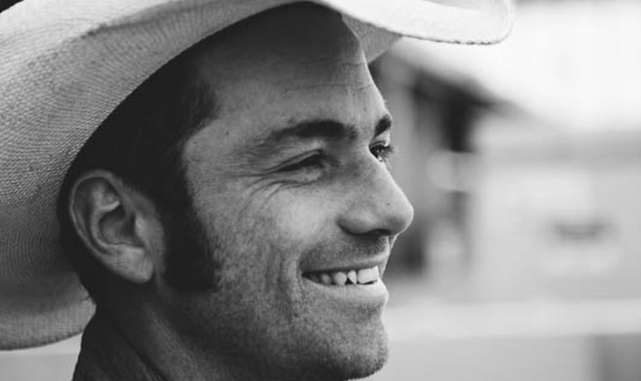
Put simply, it is the quality of Pat Reedy’s blue-collar, rough-at-the-edges, honky-tonk songwriting that makes him stand out so strongly from the crowd. His songs have great, memorable melodies that you want to hear again, even after repeated listens. Coupled with this, his words about his down-to-earth life have a real authenticity. which has caused more than one writer to say that Pat is “the real deal”.
He was originally from Colorado, but then moved to New Orleans. He started busking on the streets of that city, learning his trade there: “It taught me how to really sell a song. How to draw a crowd, too. And, occasionally, how to fend off drunks.” During this time, he formed the street band, Sundown Songs, which was later joined by Alynda Seguira, from Hurray for the Riff Raff, and Sam Doores, from The Deslondes. Pat has since relocated to Nashville.
It was after watching YouTube videos of The Deslondes that I first came across him in his charming video for ‘Down In Pasco’. Shot out in the countryside with the band playing on the back of a truck, it has a real hoedown feel with all sorts of characters either watching or dancing. Glamour is certainly in short supply, but that’s not a bad thing at all.
The song is from Pat’s first album, “Pat Reedy, Ronnie Aitkins & The Longtime Goners”, released in 2014, which was co-written with Ronnie Aitkins, with each of the pair contributing about half the songs. His backing group was the Longtime Goners, who had Dan Cutler on Double Bass and Tony Frickey on drums. Cutler played with Hurray For The Riff Raff and The Deslondes, and Frickey had played with Sam Doores in The Tumbleweeds – it was a New Orleans record. Caitlin Rose provided backing vocals. The songs that Aitkins wrote and sang have a bluesy, yearning Hank Williams feel, whereas Pat’s are much closer to one of his heroes, Johnny Cash. His songs aren’t quite as strong as on his next albums, but ‘Hard Luck Woman’, ‘Tires In The Kitchen’ and ‘That’s Alright’ are good and give a flavour of his future work.
Next up was 2015’s fabulous “Highway Bound”, written by him alone. There were changes to the backing personnel, but Frickey, on drums, and John James, on pedal steel, remained from the first album. The much-missed Luke Bell, who sadly took his own life, was on backing vocals. The album is crammed full of swinging tracks with memorable hooks and choruses, with steel guitar, fiddle and twanging lead guitar heard throughout. There is not a weak track to be heard, with the longest one lasting 3 minutes 36 seconds. Short but very sweet.
2018’s “That’s All There Is (And There Ain’t No More)” was my album of that year. Crammed with consistently great melodies, the songs are again short and so don’t outstay their welcome. Musically, it is similar to his previous work, but with one or two songs at a slower pace. Pat has done hard manual labour all his life- he has worked as a miner, drilling for oil, and latterly as a construction worker, for example, on Nashville tower blocks. He says, “I’ve worked a lot of construction, and it is rough. It’s dangerous, filthy. A lot of guys I worked with were veterans, a lot had been in and out of prison. Construction destroys your body. Many workers get hurt and end up battling pill addiction, trying to treat chronic pain. Those are the people that built the city, gave every city its skyline. Some of them continue to die doing it.”
‘Funny Thing About A Hammer’ shows this life so clearly: “There’s a funny thing I’ll tell you about a hammer / It gets heavier every time you swing / And all your well-meaning politics and manners / Well they don’t mean a goddamned thing / Workin’ for the same old wage / And there ain’t much change and that’s clear / And the sweat runs down in the hours from your brow /
Into days, into weeks, into years”.
Although sceptical about politics, Pat has said that he is closer to the views of his left-wing friends than those on the right. There is also scepticism for the religion he was brought up with, too, on ‘Conversation With Jesus’: “And holy rolling preachin’/ Just ain’t worth a damn/ What matters most in life / is how you treat the least of men”. ‘Nashville Tennessee at 3AM’ looks at the city after the tourists have gone home. It is brutally honest: “Everyone’s an outlaw until the cocaine wears off / The only thing that’s cheap in these bars is talk”.
Throughout his work, Pat writes of his life in a clear-eyed, unromantic way. At times, it is quite poetic: “Whiskey won’t you fill my lonesome/ And the rhythm be my woman/ Well the good ones are too few and far apart”. There is none of the sentimentality or clichés of some country music. He talks of the women he has met and of love lost but with no bragging or self-pitying: “I had me a woman she’s a living saint/ But I am what I am and I ain’t what I ain’t”.
It wasn’t until 2024 that “Make It Back Home” came out. One of my favourites of that year, it is not immediate, and there is no great change in musical direction. However, it grows on you over time and was the album I turned to most that year, just for the pleasure of listening to the music.
Produced by John James Tourville of The Deslondes, and with new personnel in The Longtime Goners, it often concerns life on the road. It starts with the title track, written with thoughts of home while homeless in Ireland for 10 days in between tours. ‘Long Drives and Lonesome Mornings’ was conceived while driving across the country, playing solo shows. ‘Hold On To You’ discusses the difficulties in maintaining a stable relationship while spending a lot of time on the road. ‘Do It Again’ ponders the roaming life he has chosen, with some thoughts of regret. The final track, ‘Traveler On The Plains’, has Pat recalling the pioneers of the past who rambled across the country as he has.
‘Tallest Man In Tennessee’ goes back to Pat’s construction work. He had been working on a Nashville skyscraper and went to the top for a drink with a workmate after everyone had gone home. Looking across Nashville, the workmate raved about all he had given to the industry, including his health. ‘Should You Ever’ was inspired by his friend, the late singer-songwriter Luke Bell. It was written while he was still alive but, struggling with mental health problems, he had shut others out and was not communicating.
I have seen Pat live twice, both times solo. One was at a bizarre diner in an industrial area of Oldham with trestle tables, hay bales and a yellow school bus. The other was in a small room at The Grove Inn in Leeds. playing some covers as well as originals and with some good stories to tell. He was, not surprisingly, lacking an ego and slightly self-deprecating, which we quite like over here in the UK. It was great to see him in the flesh, although I am hoping to see him back over here with a band in the future. belting out all those fabulous tunes.


Pat Reedy is a great artist and a great human being too!
That’s very nice to hear. I thought that he probably was.
My cousin was roomates with Pat Reedy, said he used to write songs on pieces of cardboard to remember them. Good stuff.