
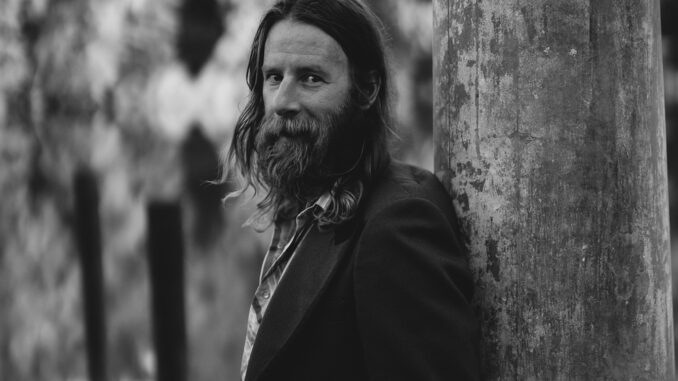
On Singing Machine, Microphone, the final track on David Borné’s 2023 debut Genesis, he sings of the unbridled, innocent joy of making music during childhood for nothing but the pure love of it. It’s a soaring and joyous song that really captures the endless possibilities that seem to stretch out before you in your youth as he reminisces about dreaming under “glow-in-the-dark stars stuck on [his] ceiling”. He may be all grown up now, but one of the wonderful things about his music is how it manages to capture moments in time, be that childhood, parenthood or love, with a visceral emotion that pours through the speakers.
Borné grew up in Baton Rouge, Louisiana; his father, Dan Borné, too had a job behind the microphone, but in his case it’s as announcer at Tiger Stadium – and honed his chops by playing for as long as he was allowed at bars on Bourbon Street in New Orleans’ French Quarter. Like most musicians in the genre, Borné’s path led him to Nashville when he decided to truly pursue a career as a singer-songwriter, but it wasn’t until 2016 that he released his first record: a five-track EP entitled Break My Heart.
The EP features an impressive roster of guest artists, the most star-worthy being Sierra Ferrell, who also happens to contribute to the album’s standout title track. For a song with a title so outwardly negative, there is a huge amount of joy to be found in it, its vibrant horns a subconscious nod by Borné to his Louisiana roots. “Well you can’t buy love / Or so they say / So I rented one / With an expiration date”, Borné opens, resigned to the fact that the relationship will end in disaster, but determined to enjoy a good thing while he’s got it. Ferrell joins him on the chorus for some perfect harmony vocals that really bring home the lyrics: “You’re gonna break my heart / But I’m gonna love you until that day / And every day after / Girl, you know I’ll be a disaster / When you break my heart”.
Despite having such a strong start, it was seven years until Borné released Genesis, his first full-length album (which is, at the time of writing, his most current release). Produced by Jarrad K (who is probably best known for his collaborations with Ruston Kelly) and engineered by Gena Johnson (who has worked with such renowned artists as John Prine, Jason Isbell and Chris Stapleton), the album feels like a condensed, psychedelic journey as he looks at healing, death and rebirth with a pervading sense of cosmic optimism. This sense of otherworldly knowingness is distilled perfectly on Stardust; after citing the love, mourning and change he has experienced in his own life, he goes on to add that he’s seen “skies of every color” and “people risk their lives to save another’s, for no reason” and so, he sings with gentle certainty that “we ain’t all just stardust” and “nothing ever happened just because”.
One of the great things about Borné is that he practices the positivity and giving that his songs so often preach, spending his time working with non-profit organisations that use music as a therapeutic tool. He works with not just CreatiVets, a charity that helps wounded veterans to heal through the power of music, but also as part of the Beyond Bars Collective, a group of seven professional musicians who teach their own curriculum to incarcerated individuals and help to bring them healing through the power of songwriting.
“I remember now how it felt to / Sing for no reason / But for the sake of singing”, Borné recalls jubilantly on Singing Machine, Microphone, but the wonderful thing is, he’s no longer singing for no reason because he’s helping people with his art and has an audience that appreciates his work, and hopefully, that will only continue to get bigger.



We love the David Borné music and commentary. We should, we are his parents. Dan and Lisette from Baton Rouge. Love you and the family David from us and the family!
We love the David Borne’ music and the commentary. We should. We are his parents, Dan and Lisette. Love to the family David from your family.