
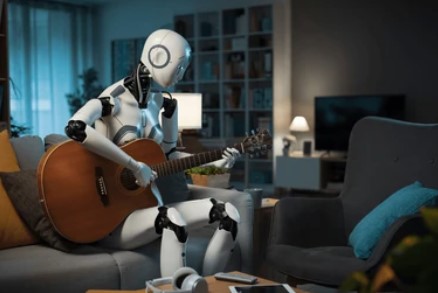
When you know the notes to sing, you can sing most anything. ~ The Sound of Music
The electronic music synthesiser provides a powerful tool for the composer or musician because he can reproduce or create any sound or combination of sounds which have or have not been produced, that may have any musical significance.” ~ Harry Olson, developer of the synthesiser.
They did what? When? How? Are you sure?” ~ Snoop Dogg
The rapper Drake used AI-generated impersonations of the late Tupac Shakur and Snoop Dogg, mocking fellow rapper Kendrick Lamar’s height, among other things, unmentionable in a family publication. The AI voice clones had fans of Snoop blowing up his texts with people alerting him to Drake’s song. Snoop posted a video, asking, “They did what? When? How? Are you sure?” Then, he resignedly said, “I’m going back to bed. Goodnight.”
Granted, the rappers are a whole different breed of musician, infamous for dissing each other and manipulating music. No matter if your lawyers send cease and desist letters, the AI-generated “music” is out there on social media forever. The House of Representatives is trying to pass a NO FAKES bill that is pretty complicated and probably won’t have any significant teeth if ever passed. Reaching out to the Democrat congresswoman, Madeleine Dean from the Great State of Pennsylvania, brought the reply: “One of her aides will get back to you.”
The use of AI to complete or enhance recorded music? The jury is still out on that one. If AI fundamentally changes the ways in which people create music, will the music industry and the copyright system need to adapt? If so, how?
Technology has been used to change and shape music for generations. I’m sure classical guitarists were horrified when the electric guitar was invented. The synthesiser was hailed as the sound of the future, yet many recording artists denied or hid its use. And I remember quite clearly the controversy that erupted when, a year or two after Phil Lynott passed away, the surviving members of Thin Lizzy went into the studio, took some vocal tracks from the files, and produced the hit song ‘Dedication’.
It’s a great song, and they released it as a Thin Lizzy song, despite Phil obviously having nothing to do with its production, being, uh…, dead and probably not grateful. They were honest and completely up-front about what they’d done; they weren’t trying to fool anyone. In fact, they said they’d done it as a final tribute to Phil, which was sort of cool, but a lot of people did not agree.
For the 2023 release “Now and Then,” Paul McCartney and Ringo Starr had AI used to isolate and enhance, uncoupling John Lennon’s voice from a decades-old demo, allowing the final song to be completed. After a stroke impaired the ability of Randy Travis to sing, AI was used to recreate the country singer’s voice from archived recordings for his 2024 single, ‘Where That Came From.’ Ambient music pioneer Brian Eno used generative AI to create an app version of his album “Reflection.” Actually, we suspect Eno himself is an AI creation.
The impetus for this column arrived several weeks ago in an email from a friend announcing that singer-songwriter Joe Ely had recently been diagnosed with Lewy body dementia and Parkinson’s disease. That’s bad. As one who counts several of Ely’s CDs in my collection, prayers and best wishes are sent. What caught my attention, however, is that while going through old files, Ely’s wife Sharon uncovered intimate recordings of Joe’s voice, guitar, and harmonica. These recordings have been re-envisioned in a way Joe never thought possible. A company called Radar Initiative was brought in and, using the power of new AI technology, was able to carefully restore the original tapes and generate orchestral arrangements around them – bringing Joe’s dream of symphonic recordings to life. The first example of what has been generated is in the video below.
That is what makes art – in all of its various forms – so fascinating. I mean, is a sculpture or painting created by a robot “art”, or does art require human input to be considered “art”? What if the Beach Boys make an AI-generated comeback? Granted, the three Wilson brothers are largely deceased, but Mike Love and Al Jardine could obtain vials of DNA and revive the group. If this happens, tribute bands may go the way of the cassette.
Music is fueled by innovation. Do you embrace the can’t beat ’em, join ’em group? Outside of waiting on Congress to take a stand, ultimately, the music industry will have to accept the freedom of musicians to choose to utilise (or not to utilise) AI in the creation of music. But the copyright system should extend value to human contributions over AI contributions. Take a page from the labels tobacco companies were forced to put on cigarette packs. Require a generic label for AI creations. What about: “The use of AI could be hazardous to the health of original music.”

