
 One of the most interesting history books of the last decade or so was Peter Frankopan’s ‘The Silk Roads.’ His premise is that the historical centre of the world isn’t North West Europe, but somewhere between China and Persia, and that if there is a single key event in history, it is the Black Death of the 14th Century.
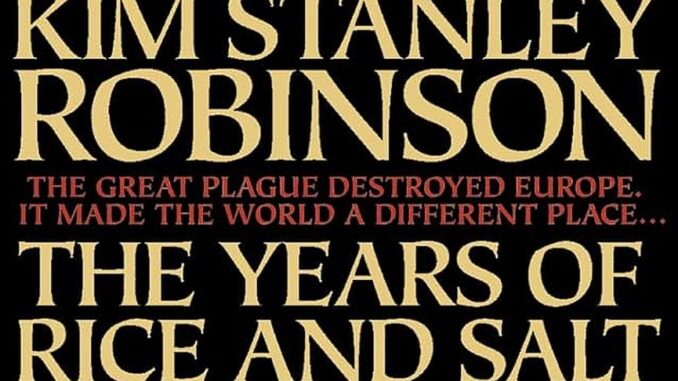
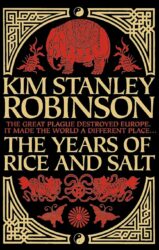
Kim Stanley Robinson’s ‘The Years of Rice and Salt’ was published in 2002 and looks at what might have happened if the Black Death, instead of killing a third of Europe’s population and paving the way for the Renaissance, had effectively wiped out almost all of Western civilisation. So, this edition of Paperback Riders isn’t so much “where America might go next” as what if there never was a Western-influenced USA?
Robinson’s novel examines the centuries following the Black Death, looking mainly at the development of Asian and Islamic cultures, from about 105 to 2045 by our calendar. It does also have some interesting points to make about a “what if” for North America.
Robinson uses an interesting device of following souls who are reincarnated across different times and places. These characters are identifiable by their initial ‘K’ (Buddhist), ‘B’ (Islamic), and ‘A’ (Chinese) names. Through their various lives, we witness how the alternate history unfolds.
Without the European presence, the Americas would eventually be “discovered” and colonised by Chinese and Muslim civilisations. Robinson explores how different cultural values and technological advances might have shaped the interactions with Indigenous populations and the development of the continent. Unlike in our timeline, where European diseases and conflict decimated the Indigenous populations, in Robinson’s world, the Hodenosaunee (the Iroquois name for themselves) form a defensive alliance. They learn about inoculation, which helps them resist disease, and they acquire firearms. This suggests a different potential for Indigenous nations had external pressures been different. The Hodenosaunee’s more communal and matriarchal concepts even spread to influence societies in other parts of the world.
The history of European settlement, the establishment of the United States, and the ideals that emerged from that are key to our understanding of what we call America. In Robinson’s alternative world, these historical and cultural developments never happen. Instead, the lands are shaped by different influences, leading to distinct societies and ways of life. This implicitly tells us that “America” as we know it is a product of very specific historical circumstances. IN Robinson’s world, there never was an “American Dream”
The 19th-century concept of “Manifest Destiny” was a belief that the United States was destined, by divine providence, to expand its way of life across the continent and beyond. While it is no longer formal policy, its underlying ideas continue to resonate in the concept of American exceptionalism and unique moral virtue. The current US regime seems to be slowly reviving Manifest Destiny, in its suggestion that Canada or Greenland would be better off closely tied to the USA. Trade and foreign policy all seem to start from the point of view that America is right because it is America.
‘The Years of Rice and Salt‘ uses the absence of a familiar European-dominated “America” to reflect on the contingent nature of our own history and current political landscape. With the exploration of the Americas undertaken by Chinese fleets, there are entirely different interactions with Indigenous populations. When they discover that they are infecting the native peoples with imported diseases, the Chinese leave.
While the book is not about America, it does have a lot to say about how America has been shaped by its history and what could have been different. If you aren’t familiar with Kim Stanley Robinson’s writing, a word of warning. His books are long and quite Utopian in their worldview. Despite the 67-year “long war,” this is not a military fiction alternate history in the mould of Harry Turtledove, but it does offer a very different picture of where the world could have gone.


