
Deserts, ghosts and burning memories, the Ruen Brothers paint their own brand of Western Noir with aching beauty and quiet fire.
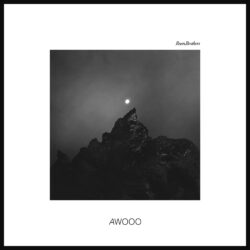 When the Ruen Brothers first appeared with their Rick Rubin-produced debut, they carried the weight of expectation: a pair of young Englishmen channelling americana with striking assurance. Since then, their music has evolved and “Awooo” feels like something different – stranger, darker and more cinematic. The brothers have carved out what could best be described as a kind of “Western Noir”: music that fuses torch-song intimacy with wide-open desert landscapes, ghostly echoes and elemental forces. It is an album that shimmers with longing and loss but also resilience and renewal.
From the opening track, ‘Can You Face the Water?’, we are pulled under by currents both literal and emotional. “Darling, can you weather/A thousand leagues of pressure?” the brothers ask, with tides and shadows circling like depression itself. And the song also illustrates how the Ruen Brothers build musically. It starts with some simple guitar, brushed drums and a beautiful baritone, but then slowly, without you even noticing, different sounds emerge in the background – whistling that sounds like the wind, bells, a pulsating bass, more plucked guitar – and all of a sudden you realise you’re listening to something complex and cinematic.
Water becomes both an adversary and a healer across the album – drowning the singer in despair yet also promising renewal. In ‘Desert Showers,’ rain falls on barren ground, dreams bloom “like daisies in desert showers,” and grief briefly transforms into hope. This push-pull between destruction and redemption runs like a tide throughout “Awooo”: the water that drags you under may also be the thing that saves you.
The desert is the album’s other great landscape – a place of absence, silence, and longing, but also impossible beauty. In ‘Roses in the Desert’ love grows against the odds: “We’ll grow roses in our desert/Pretty roses in our desert.” The song is one of the album’s most romantic, and its promise of resilience feels like a central thread. Even in ‘Transatlantic Nights’, where flight carries the narrator over deserts and oceans, the landscape below becomes a metaphor for distance and wonder. The desert is barren, yes, but “Awooo” insists that it can still bloom. And the music here is so sparse, yet so thoughtful, it allows you to enter the landscape.
If water and desert mark cycles of loss and renewal, fire is the album’s purgative force. ‘Bonfire’ is the clearest statement: “There’s gonna be a big bonfire/Watch my past flicker and shine.” Here, the past is burned as both ritual and release, with the flames promising liberation from memory’s weight. Fire also smoulders in ‘Sticks & Stones’ – “The moon looks pretty cast across the shards” – where destruction is tempered by a plea for gentleness. In ‘The Cabin on the Hill’, bottles smash in the flames as loneliness turns manic. This is the fire that consumes but also illuminates. It is also a song that builds and builds, holding notes and harmonies that come to a crescendo before falling away.
Perhaps the album’s most consistent motif is absence – lovers vanished, calls unanswered, voices reduced to echoes. The station of ‘Sitting at the Station’ is less a place than a state of waiting; the “receipt in the pocket” becomes a talisman of fragile hope. On ‘Poison Down the Wire’, a song perhaps closest to an anthem, the phone line carries both intimacy and poison – love and hate flickering with each late-night call. The haunting becomes explicit in ‘Seeing Ghosts’: “You’re seeing ghosts if you’re seeing me/If I call, it’s just the breeze.” Memory itself becomes spectral, a presence defined by absence. Yet the delivery is tender rather than terrifying; these are not horror-movie phantoms but the lingering ache of what’s gone.
The album is also preoccupied with journeys: trains, planes, and long waits at stations. Distance becomes a metaphor for desire and separation – the endless attempt to bridge a gap. ‘Transatlantic Nights’ captures the wonder of flight with lullaby grace, its “hanging bed, a silver sled” offering a childlike awe at crossing oceans. Yet if distance weighs heavily, rebellion offers release. ‘Mama Don’t’ – a J.J. Cale cover – is a relatively rollicking, tongue-in-cheek number which breaks from the album’s darker tones with humour.
What makes “Awooo” compelling is not just the recurrence of these themes – water, desert, fire, ghosts, journeys – but the way they are woven into an emotional landscape of yearning and catharsis. The Ruen Brothers manage to make familiar americana tropes feel uncanny and dreamlike, reanimating them with fresh symbolism. It’s haunted but strangely comforting in its melancholy. Across its eleven songs, the album builds a world that is cohesive, evocative, and quietly devastating. It is music that lingers like a memory you can’t quite shake, full of shadows and glimmers of light.

