
If there’s something that I really can’t live without, it’s California country rock music. As I’m sure every contributor to Americana UK does, I listen to music endlessly, and most of that sits within the country world. However, there’s something about the individuality of the music that blossomed out of California in the 60s, 70s and beyond that holds a pretty significant piece of my heart. The first thing I’m looking for in record shops is the country-rock, blues-rock or progressive-rock section (if the shop isn’t one to dedicate their space to country). I think this love started with the Laurel Canyon movement in the 60s, songwriters sharing words and melodies to create something entirely personal. As my love for music grew, I wandered a little from Laurel Canyon and over to Bakersfield.
Artists like Buck Owens and Merle Haggard could easily be credited for starting the country-rock movement, the way that electric instruments were used in the twanging honky-tonks that were home to the Bakersfield Sound just fit with what that west coast rock music was to become. In a matter of just a few years, a new sound developed, new bands emerged, and a new branch of country music grew – one that is arguably a world apart from Nashville. I could give a list of California country bands and artists as long as my arm that I simply could not live without. However, for the sake of choosing just one, I’ve gone with The Byrds.
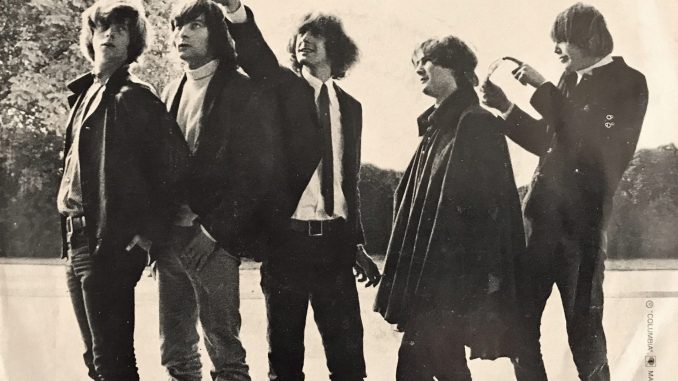
The band that California country-rock grew out of, The Byrds, were rock, they were country, they were influenced by bluegrass, they were ever-changing. It was their independence and commitment to change that made them distinctly Californian. The group formed in 1964 in Los Angeles, initially pioneering the folk-rock movement, they grew and adapted as rapidly as their members did, moving into moments of psychedelic and progressive rock, taking influence from Indian music as they were drawn into raga rock, and ultimately forming that sound that made me fall in love with the group: country rock. Then and now, they posed as a musical inspiration and a defining moment of the soundtrack of the Independent State.
Can’t Live With It: “Byrdmaniax” (1971)
I honestly don’t think I’ve ever found myself on a Byrds kick and reaching for “Byrdmaniax” as my album of choice. Released in 1971, this was The Byrds tenth album and very quickly undermined the new-found popularity that “Ballad of Easy Rider” and “(Untitled)” had brought the group. A strange production method and confusing mix of influences and instrumentation leaves the album… messy. The album was recorded in between tour dates, which meant that the mixing went a little unsupervised when the band had to jet off to their next show; overdubbing of strings, horns and an out-of-place gospel choir leaves most of the tracks both confused, and confusing.
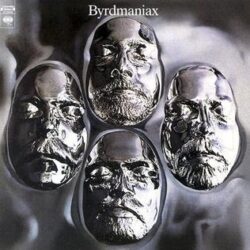
Whilst I’m not typically one to judge a book by its cover, I can’t help but cringe every time I see the “Byrdmaniax” album art. The illustrative western cover of “Sweetheart of The Rodeo” by Jo Mora is often displayed on my wall, in fact a friend recently told me that he thought the character in the middle is “living my dream life” (he’s not wrong). The cover of the album I can quite happily live without, truly could not be more apposite. An uncomfortably “modern” image of the four Byrds’ faces moulded in a silver metal just doesn’t fit their vibe. It feels too new, too experimental, and too weird.
‘Pale Blue’ would have to be the highlight of the album, a possible hidden treasure in The Byrds’ catalogue. It’s folksy and melancholic, with very restrained vocals and gentle instrumentation it feels like somewhat of a classic from The Byrds. It’s a shame it got muddled into the mix of “Byrdmaniax”. A rendition of Jackson Browne’s ‘Jamaica Say You Will’ is a nice moment, but again, the production is just off.
A track like ‘I Trust’ is an example of where things just start to not work. Starting off relatively predictably, the minute a gospel choir comes in is just space for questioning. Inspired by Roger McGuinn’s catchphrase “I trust everything will turn out alright”, this could be a sweet song if it was an acoustic ballad, or a bluegrass style country song. However, if I played this song for someone as an example of one of my favourite bands, I really do think they would look at me like I was crazy.
Between the novelty of the rag-timey ‘Citizen Kane’ and its commentary on Hollywood life, and the upbeat ‘I Wanna Grow Up to Be a Politician’, “Byrdmaniax” feels too whimsical, too disjointed, and too rushed. It doesn’t quite know what it wants to be, and whether this is down to the production, the lyrics or the track-listing is debatable, but when all of those mistakes are combined it comes off as uninspired and trivial. We do at least get a fun bluegrass instrumental on ‘Green Apple Quick Step’ though.
Can I live without this one? Yes. Can I live with it? If I really have to, but it’s not going to get played very often at all.
Can’t Live Without It: “(Untitled)/(Unissued)” (2000)
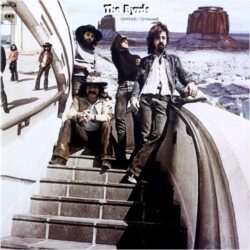
For anyone that knows me and has listened to me endlessly talk about my love for The Byrds, it might come as a shock that my choice for the album I can’t live without isn’t the 1968 cult classic “Sweetheart of The Rodeo”. Whilst this is definitely in my list of favourite albums of all time, I know it back to front – you could say that even if I didn’t have a copy of the record, I’d still never be without it, it’s pretty ingrained in me now. For that reason, I’m choosing the 1970 album “(Untitled)”, but specifically the 2000 remastered version, “(Untitled)/(Unissued)”. The album includes some of my very favourite moments from The Byrds with live recordings of songs from throughout their career, but there’s always something new to hear in it, too.
The first half of the album marks The Byrds’ first official release of live recordings. Captured across two shows in March of 1970 in New York City, the album kicks off with ‘Lover of the Bayou’, a swampy introduction that is almost polar opposite to that classic folky “Sweetheart” record. Some may think it seems a strange concept for this California group to be heading down south to the Louisiana Bayou, after all, there were plenty of southern rock bands hanging around at the same time that would aesthetically suit this song. But somehow, sonically, The Byrds made this work well. Clarence White could quite possibly make anything his own, but his tone on ‘Lover of the Bayou’ stands out with a fierce solo coming in midway through the song.
A sixteen-minute rendition of their big hit ‘Eight Miles High’ sees The Byrds stepping into jam-band territory. This track being one of the main reasons I can’t live without the album, this is just pure confidence from a band that’s seen its fair share of members. At these NYC shows in 1970, the group fit together perfectly, perhaps at their musical peak. Skip Battin had replaced previous bass player John York, and completed the classic lineup of Roger McGuinn, Clarence White, and Gene Parsons. McGuinn and White might shine throughout the track with their conversational guitar playing, but Parsons on Drums and York on bass really push the sound forward, demonstrating just how well that fusion of old and new Byrds was working.
Live renditions of ‘You Ain’t Goin’ Nowhere’, ‘Old Blue’ and ‘Ballad of Easy Rider’ act as reminders of how good some of The Byrds earlier work was. With those calls back to “Sweetheart”, I get the fill I need from that precious album, still sending me back to the moments in my life that have had “Sweetheart” as a soundtrack. When those peaks are combined with the musical skill of this particular formation of the country-rock group, “(Untitled)/(Unissued)” is almost a best-of-the-best album. A cover of Little Feat’s ‘Willin’’ is one I return to consistently, ‘Truck Stop Girl’ is always in my top Byrds songs, ‘Yesterday’s Train’ is a gorgeously simple melodic meditation on reincarnation, and of course there are a few good Dylan covers on here too.
There’s something that I love about live albums that might be giving “(Untitled)” the edge in my difficult choice, unlike the usual sheen of a studio album, live recordings are imperfect. They transport the listener immediately back to the time of recording in the blink of an eye or in the time it takes to put the needle on the vinyl; if I had the opportunity to head back to 1970s California, I would take it. But for now, “(Untitled)/(Unissued)” is the time-machine I need. The one I can’t live without.



Well it was either going to be Byrdmaniax or Farther Along, and with crap songs, crap title and crap cover – Byrdmaniax well and truly clinches it.
Glad you agree – it’s a skip!
I don’t mind the cover to Byrdmanix – it always, to me, fitted with the science fiction / science fact side of The Byrds – CTA 102, Mr Spaceman etc.
There’s not much to pick between Farther Along and Byrdmaniax. The latter does have ‘Absolute Happiness’, but Farther Along has perhaps the last “classic Byrds song” in ‘Tiffany Queen’ and the Skip Battin vocal of ‘Lazy Waters’. Skip is the under regarded Byrd – ‘Well Come Back Home’ on ‘Untitled’ is another great song.
Ohh, interesting point about the sci-fi element. I think it’s just too different for me, there’s not much that can compete with the Sweetheart cover! And you’re so right – Well Come Back Home is a great track
The album cover was a picture of “death masks” of the band members. Usually carried out on dead folk, they had straws inserted into their nostrils, allowing them to breathe while a plaster cast was made of their faces. You can see some pictures of the process in the inner gatefold. Apparently it was an unpleasant process which McGuinn spoke about in an interview, I think, for Zigzag magazine around about the time the album was released.
I disagree. While Well Come Back Home is an interesting artefact, Battin and his co writer Kim Fowley didn’t fit into The Byrds’ sound or ethos.The under regarded Byrd is of course Gene Parsons.
I saw the “untitled” line up live in May of 1970. The Byrds were my favorite group then but the intro song of “Lover of the Bayou” totally blew me away. First time I heard that song and before I learned about White’s B-string bender and him getting that steel guitar edge to the notes. Fantastic.
.
I can’t express just how envious I am! White really was one of the best to ever do it, a phenomenal talent
The first time I heard Turn! Turn! Turn! as a 12 year old in 1965, I was smitten by the sound of Byrds music. 60 years later, still my favorite recording of all time and one to which I listen every day. While critics have never been enamored with that album feeling it didn’t “break new ground” as the revolutionary first album Mr. Tambourine Man did, I find the sheer beauty of the arrangements, the perfection of McGuinn’s, Crosby’s, and Hillman’s musicianship, Gene Clark’s gorgeous compositions and harmonies that CSNY could only dream about too irresistable. As for a live “Byrds” recording, try listening to a recording made more than a decade after they had originally broken up. In 1978, at a venue in the bay area of San Francisco called the Boarding House, Roger McGuinn, Gene Clark, and Chris Hillman were touring where each opened with set of their own songs, followed by a set of Byrds traditional offerings sung together. For that second half, David Crosby joined them and some of the best music they ever made together was accomplished. To listen to that performance’s version of Mr. Tambourine Man (all 4 verses) is a never failing tear jerking experience, even better than the original recording.
I got to see Roger in concert twice last year and meet his lovely wife, Camilla. His prowess on both the guitar and singing have not diminished at all even at 82 years of age. Thank you for a great insightful article.
Hi Ted! Thanks so much for this lovely story, it’s so special to have a song that you can attach so many memories to. I do love McGuinn’s version ‘Ballad of Easy Rider’ on the ’78 record – just too good.
Snap, Ted. That’s exactly when I first heard The Byrds and the same year I saw them live in London, with the original lineup. Turn!Turn!Turn! is such an awesome song.
I didn’t have the Boarding House recording in my extensive Byrds collection until now. Remedied, thanks Ted.
While I consider “Untitled” to be a fine album, it can’t match the trifecta of Younger Than Yesterday (my favourite), The Notorious Byrd Brothers and Sweetheart Of The Rodeo.
VERY understandable, Younger Than Yesterday is a real gem, even just for Time Between if nothing else (but there’s plenty more).
Really good article Daisy. I’ve had a “Paisley Underground week” and was watching a video last night of the various bands on stage together playing an encore of Feel a Whole Lot Better. You just can’t escape the good stuff!
Thanks, Mark! You really really can’t escape it (and I don’t want to)
Great article Daisy, as a confirmed Byrds fan, who squeezes them into AUK whenever possible, Byrdmaniax is my least played album by miles. When Untitled/Unissued first came out about 20 odd years ago the live songs became some of my favourite Byrds work. If you forced me to choose Notorious Byrd Brothers would still be my favourite album, but it’s very close. The version of Willin might swing it back to Untitled/Unissued though…
Thanks for reading, Tim! Their version of Willin’ just gets me every time