
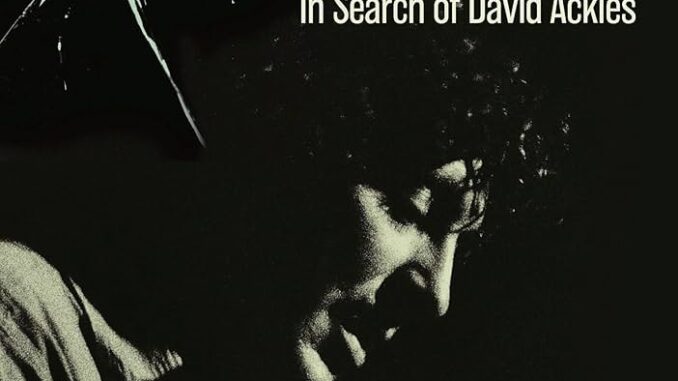
Brend’s detailed and passionate evaluation sheds light on one of the great maverick talents of popular music.
David Ackles’ recording career lasted barely six years, yielding just four albums. Of those four albums, his third, “American Gothic”, released in 1972, received plaudits from the musical press rarely witnessed before or since, declaring it to be “the Sgt Pepper of folk” and one of the greatest records ever made. Should this information come as news to you, don’t despair; it will to most, for despite the fanfare and accolades from everyone from Elton John, Bernie Taupin, Jim O’Rourke and Elvis Costello, the album, like its two predecessors, along with the one that followed, failed to sell, resigning Ackles to the footnotes of popular music, never to record another album.
Music historian, journalist, novelist, and musician, Mark Brend, first publicly declared his passion for the music of Ackles in 1998, whilst working as a journalist for ‘Mojo’ magazine’s ‘Buried Treasure’ feature that focused on Ackles’ eponymous debut album, which saw the light of day in 1968. Now, within the pages of “Down River – In Search Of David Ackles”, he has set about unravelling the myth and the mystique of Ackles’, and better understand the disconnect between his obvious talents and his commercial failure, through to his perceived vanishing act and beyond. Though the book is, in essence, a biography, Brend is at pains to emphasise that it is by no means comprehensive; many of the loose ends eventually became dead ends, as he has thankfully resisted the temptation to fill any gaps with too much conjecture or speculation. Instead, his narrative directs the attention to the process of searching for this missing cult figure, and trying to make sense of the musical journey of an artist revered by almost all who heard his songs, rather than simply telling a life story.
Throughout this excellent read, Brend’s writing betrays a keen eye for detail, particularly around Ackles’ six-year recording period, where he meticulously dissects song structures, analyses narrative storylines, and recording techniques, whilst acknowledging the numerous musical collaborations. Despite earlier claims, Brend has uncovered enough of Ackles’ early years to enable the reader to become familiar with the youthful experiences and passions that would help mould the fledgling artist. From his time as a child actor, and his Presbyterian upbringing that would prove a constant guide throughout his life, to his enthusiasm for Broadway Musicals and in particular musical theatre, mirrored against his total lack of interest for rock ‘n’ roll, all of which would eventually see him evolve into a songwriter unlike any that pop culture had seen before or after. Brend’s undoubted admiration for Ackle’s output does not cloud his judgment, reappraising his work objectively, using the advantage of hindsight to better understand the commercial shortcomings, which proves both refreshing and illuminating. Key to this is recognising that, despite his unique talent, Ackles was much more an actor and playwright than a singer-songwriter, creating songs like one-act plays or short stories in the manner of an author or dramatist. This trait became more pronounced with each passing album, which inevitably would leave him musically on the fringe of everything and belonging to nothing. Forever out of step with fashion and the music industry.
The latter chapters of “Down River” focus on Ackles’ life after his recording career, revealing how music never left him; it just took a different path, possibly the path he was always meant to travel, back to his first love, that of musical theatre. During the final pages, Brend considers the dubious possibility of Ackles achieving similar posthumous recognition as Nick Drake and Judee Sill, drawing comparisons, before reluctantly concluding that within the mythmaking of the popular music industry and the fickleness of fame and cult status, Ackles was never, and never will be, a name to drop. He was never a misunderstood rock star, nor a tortured soul waiting to be discovered; he was just a genuinely nice guy; his music was just a little too challenging for mass consumption.
In a perfect world, one would hope that “Down River” could be the catalyst for introducing a new audience to the talent of David Ackles. However, the likely reality is that Brend’s excellent book will probably suffer the same fate as those four albums, being loved by those of us who already worship at the shrine, whilst remaining aesthetically off-kilter with mainstream popular culture. Regardless of its commercial fate, Brend has produced a book more than worthy of the maverick genius that was David Ackles.
Mark Brend’s “Down River – In Search Of David Ackles” is available to purchase from the 1st August UK & 19th August USA.



I love David Ackles this looks very good thanks
You’re very welcome Keith. I can highly recommend it to any fan of David Ackles, it is a great read well researched and well written. What I’d really like is if the book could introduce a whole new audience to the man’s music. I know his songwriting might not appeal to everyone but he definitely deserves a wider audience.
Whist at Uni over 50 yrs ago a couple of mates had copies of his albums which, as a skint student (now a skint OAP!) I “borrowed.” Didn’t really connect with me … and that was that. Who’d have thought your article would tempt me to revisit him; it could be the same outcome but I’ll give him another crack.
I had exactly the same response when I bought (on recommendation) ‘American Gothic’ in 1972, Alan. Nice album cover, couple of tracks were fine but by and large it didn’t resonate. I’ve never played it since, but still have the vinyl copy (just in case!)
Hi Fred. As I was saying to Alan, American Gothic, (Ackles third album) though his most critically acclaimed probably isn’t the ideal album to start with. Go back to his debut album and give that a try and then work chronologically and things might just make a little more sense. I can wholeheartedly recommend the book as an excellent and informative read even if you don’t quite get the music.
Hi Alan. Your original view of Ackles was, by all accounts, quite common at the time. There’s no getting away from the fact that Ackles was an acquired taste, with his record label (Elektra) struggling to know how to market him, often grouping him in with the likes of Tim Hardin, Tim Buckley and Tom Rush, which was probably the nearest contemporaries and yet, still completely different. I would suggest that if you consider going back and trying to rediscover Ackles music you start with his debut album and work chronologically, as his first is definitely his most accessible, and work from there. If it would help, and you’re looking for a good music biography to read, I’m more than happy to lend my copy the next time we catch up at a gig.
Being a John/Taupin devotee, I bought American Gothic when it came out, and played it to friends at school. A couple of them fell similarly in love with the album. It was marvellous then, and is wonderful now. His other three records are also full of treasures, dark and light. The last one in particular. Thank the heavens for David’s life and work.
Hi Richard. Thanks for getting in touch and sharing your memories and joy for the music of David Ackles. I, like you, was an early convert from back in the seventies, and if you haven’t already got yourself a copy, I think you will find this book something you will thoroughly enjoy.