
Born out of a traumatic period in her life, Australian-born, Nasvhille-based singer-songwriter Emma Swift’s second full-length release (and first album release of originals), “The Resurrection Game” is a strong selection of songs.
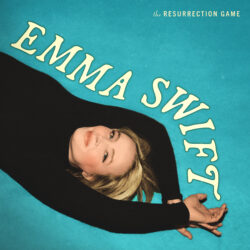 The record follows a seven week “nervous breakdown” that resulted in Swift being sectioned in her native Australia; recovery from this took more than a year and you can see how the making of the album was a therapeutic exercise. Having had a previous career as a radio host in Australia, on americana shows “In the Pines” and “Revelator”, Swift packed her bags in 2013 and left the Southern Hemisphere, bound for Nashville. Inspired by artists such as Joni Mitchell, Sandy Denny and Marianne Faithfull, Swift sought to launch a career as a singer-songwriter. Swift’s first significant output came in 2014 with the release of her eponymous EP. The EP was well received and landed Swift a nomination for ARIA Music Award (Australian Recording Industry Association) for Album of the Year (Kasey Chambers won the award for “Bittersweet“).
Swift’s follow up to the EP was 2020’s “Blonde on the Tracks“, an album of Bob Dylan covers, reimagined by Swift from her own perspective. Recording of these songs took place between 2017 and 2020, straddling the COVID-19 quarantine period.
The bulk of “The Resurrection Game” was created when Swift and her band of musicians headed off to the Isle of Wight (a favourite place of Swift), where recording took place at Chale Abbey Studios, a studio built within a stone barn dating back to the 16th century. Two songs, however, were recorded at The Duck, in East Nashville. Producer Jordan Lehning (Kacey Musgraves, Rodney Crowell, Orville Peck), who also contributed keys and vibes, along with the core band of musicians of Spencer Cullum (pedal steel ) and drummer Dom Billet are members of Nashville ‘supergroup’ Echolalia (who recorded their eponymous debut album at Chale Abbey), augmented by two other musicians who played on the “Echolalia” LP, in guitarist Juan Solorzano (Sheryl Crow) and bass player Eli Beaird (Merle Haggard & Willie Nelson, James Bay, Luke Bryan). The album was engineered by Lehning’s brother, Jason. The songs recorded in East Nashville are played by a different cast of musicians.
The LP opens with ‘Nothing and Forever‘ and the listener is immediately struck by the lush sound of strings, the song’s melody and by Swift’s sweet, breathy vocal. Next is ‘The Resurrection Game’ which is a highlight, telling of Swift’s visit to The Hoffman Institute, a week-long retreat where participants work to identify negative behaviours and ways of thinking that developed unconsciously in childhood; the track is driven by drums and the instrumental break’s interplay between the strings and guitar is sublime.
‘No Happy Endings‘ is the first of the tracks that were recorded in East Nashville and as you’d expect it has a different sound to it; it’s a more straightforward pop/rock song (with no strings), starting with the lines “I’ve come up for air, After years underground, Still got the taste, Of dirt in my mouth, Delicate, delicate as a skeleton, Holding a jar of flowers” and the chorus “The world’s a spinning time bomb, That there’s no denying, There are no happy endings, But baby I’m trying“.
‘Going Where The Lonely Go‘, again has a noticeable absence of strings. It’s a ballad that features a short, but beautifully atmospheric guitar solo played by Juan Solorzano. On ‘Beautiful Ruins‘ the strings are back, with the addition of a horn and glockenspiel. While ‘Catholic Girls Are Easy‘ is the standout cut on the record; it’s a ballad, with a strong, catchy chorus and Swift’s vocals so expressive, as she sings “Catholic girls are easy, Easy to amuse, Easy to confuse, Catholic girls are easy, Easy to possess, Easy to caress“. The song builds with strings and horn really driving the song to its conclusion.
‘Impossible Air‘ is a more uptempo song and has some delightful oboe playing by Grace Woodsworth. The record closes with ‘Signing Off With Love‘ a song that references 20th century poet Robert Low “Is this the low, Robert Lowell was talking about?“. Lowell himself experienced mental health issues and incarceration; he would sometimes explore these topics in his poems. Also referenced is Maggie Nelson “Is this what Maggie Nelson meant, When she said she loved, the colour blue?“. Nelson is a writer who’s work has included 2009 “Bluets” a collection of poems about the colour blue relating to suffering.
This is such a good record; as Swift so eloquently comments on it “Hard times are a part of the seasons of any person’s life. You don’t have to have an acute mental health crisis to understand this. Everyone experiences grief, pain, tremendous suffering, at one time or another. I wouldn’t want to live through that particular season again, but I feel duty-bound to honor it. And so I have.” It’s an album to live with, as it gets better and better with repeat listens.
Swift has an great voice; it’s sweet and expressive but can sound a little breathy on occasions; her voice brings to mind Kate Bush at times. A real standout feature of this record is the range of instruments, in addition to the usual guitars, drums, bass, piano, synths et al, we get a horn, vibes, saxophone, oboe and a glockenspiel, plus the strongly featured string section of violin, played by Annaliese Kowert and Laura Epling, Viola (Betsy Lamb) and Cello (Emily Rogers).

