
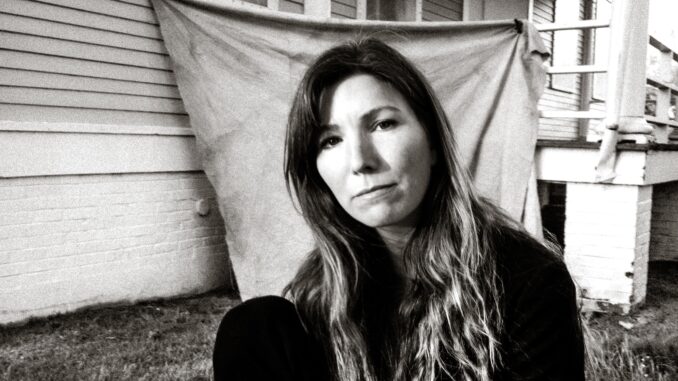
Anna Tivel’s songs unfold like poems whispered across a room—delicate, precise, but carrying the weight of entire lives. She has long been one of folk music’s most poetic voices, a songwriter who makes space for silence, for breath, for the small gestures that reveal everything. With her new record, “Animal Poem,” Tivel pushes even deeper into that territory, crafting songs that feel less like compositions than field notes of the heart, each one alive with mystery and unspoken truth.
Raised in La Conner, Washington, a small town tucked along the Skagit River, Tivel grew up steeped in the quiet rhythms of the Pacific Northwest. She learned fiddle from her grandfather and spent much of her childhood lost in books, captivated by the power of stories to make sense of the world. After moving to Portland, she immersed herself in its thriving folk scene, slowly shaping a body of work marked by its empathy and luminous restraint. Since her debut in 2014, she has released a series of acclaimed albums, each one cementing her reputation as a songwriter’s songwriter, admired for her attentive eye and poetic touch.
“I think of music as a kind of community center,” said Tivel, her cadence as unhurried as her songs. “Every room has its own history, its own energy. You walk in, try to give yourself as openly and honestly as you can, and if you do, people share their energy back. That’s when it feels like being really human together.”
For someone who describes herself as hidden by nature, Tivel has spent the last fifteen years learning to be fully present in that exchange. She speaks of performing not as entertainment but as practice—a daily rehearsal in honesty, in listening, in showing up as you are. Some nights the door opens wide, some nights it stays closed, but the attempt itself feels sacred.
Poetry at the Core
Tivel’s writing begins in fragments: a line overheard, a shadow passing, the sensation of something unnamed. “I try to protect the raw urge to write,” she said. “At first, I don’t worry what it will become. A song with one chord, a poem that wants to be sung—it doesn’t matter. Later, once the feeling feels solid under my feet, then I shape it.”
What she is reaching for is not polish but truth. She describes it as trying to catch “unspoken human happenings”—those half-formed feelings that live inside all of us until someone has the courage to name them. “It’s like when you read a book and it says the thing you’ve felt but never had words for. That’s what I’m chasing.”
Sometimes it takes her nine poems or a handful of half-finished songs before she finds the right vessel. Other times, it comes like a single shiver of recognition. Always, the compass is the same: does the song feel honest enough to draw tears, to bring the small satisfaction of naming what hurts or heals?
Tivel grew up with books as her closest companions. “I was a quiet, strange little being,” she said, “and books were a safe place to feel the world without having to live it all at once. They showed me the great human stories—ordinary lives distilled into something that made sense.” Her earliest music came from a fiddle, played alongside her grandfather. But in her mid-twenties, she picked up a borrowed guitar, and songwriting immediately became an obsession. The instrument was less important than the discovery that songs could speak back, that they could bridge the distance between her and the world. “For me, songwriting comes more easily than talking,” she admitted. “It feels like the truest way I know how to communicate.”
Animal Poem: Songs in the Round
That instinct toward raw communication is written into the DNA of “Animal Poem.” Tivel and her collaborators recorded it live, in a circle, no headphones, no isolation. The songs are what they were in the room—fragile, fierce, imperfect, alive. “No preconceptions, no fixing later,” Tivel explained. “Just living in the emotion of the moment and letting it be captured.” The result is an album that breathes. Each track feels like a fleeting document, a sketch made in real time of love, injustice, tenderness, resilience. For Tivel, records are less about answers than about attempts: “Each one is a grasp at understanding—why people are held down by systems, why relationships fracture, why the world can be cruel and kind at once. Writing is where I reach for learning.”
In this way, “Animal Poem” is not a collection of finished songs so much as a portrait of becoming—an elevated version of the self that emerges through the daily work of attention. “At the end, the album is the sum of all the ways I move through the world,” she said. “It holds the mess, the ego, the hope, the tenderness. There’s deep satisfaction in that.”
Tivel remembers her first open mics as a collision of terror and exhilaration. “It felt awful,” she laughed, “but also intoxicating. To say the realest thing you’d ever said to strangers, and feel—even just for a second—that they had felt it too. I thought, I never want to do this again. I have to do this again.”
Over time, the stage became a teacher. She learned what it meant to show up honestly, to resist the urge to retreat behind performance when the day had been heavy or her spirit tangled. “I’ve spent years trying not to just go through the motions,” she said. “Music asks you to be present. To bring yourself as you are, even if that self is quiet, or angry, or tired. That honesty is the only way it feels right.” She speaks of needing unobserved time between tours, time to refill the well, but when she returns, the practice of being with people feels more easeful, more natural. The songs themselves guide her toward openness.
The Elegance of Attention
At its core, Tivel’s work is about staying awake to the world. Her songs do not shout; they linger, noticing what others pass over—the tilt of a gesture, the shadow of a memory, the tremor in a voice. They are poems set to melody, built not on spectacle but on attention. “Music is the practice of open eyes,” she said. “It’s a way of being alive. Every song is an attempt to say it better, clearer, more truthfully. That’s the goal: to keep saying it better.”
With “Animal Poem,” Anna Tivel has written a book of living poems, songs that carry within them the quiet brilliance of human experience. They remind us that to pay attention is to love, and to name what we feel is to survive it. In her hands, music is not entertainment but devotion—the daily work of looking closely, and speaking with poetic elegance what the rest of us can only feel.


Great article with a solid analysis of her songs. She is a poet at heart (in my opinion) using music to make her message available to the wider world. I would argue that her songs have gotten darker in recent albums as she struggles to make sense of this world’s mixture of beauty and pain. She manages to stir in just enough hope to keep you coming back for more.