
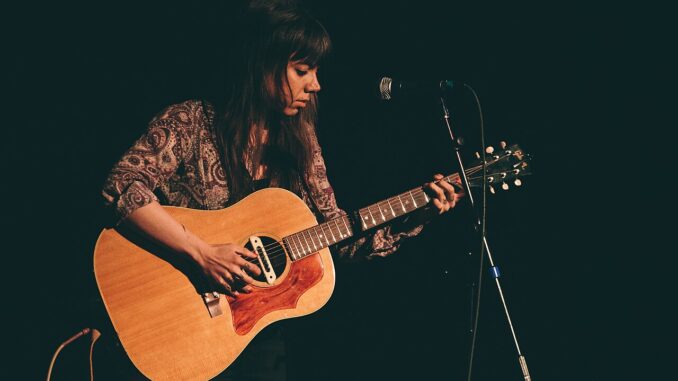
In a nod to Woody Guthrie, a 2014 American Songwriter magazine cover featured Hurray For The Riff Raff with the strapline, “Bound for Glory”. I’m not sure how the author of that article defined glory, yet several albums and years of live appearances later, it appears that Hurray For The Riff Raff are finally getting the recognition they deserve. With nine studio albums to their credit, they have just released Live Forever, their first live album, a celebration of how far this band has come.
The story of Hurray For The Riff Raff is very much that of the lead protagonist, Alynda Mariposa Segarra. A New Yorker of Puerto Rican descent, they left home at seventeen and lived a transient street existence, travelling across the country, living out of trash cans and experiencing a hard life with hard life lessons. Eventually making home in New Orleans, busking with a motley street band called The Dead Man’s Street Orchestra, Hurray For The Riff Raff emerged in 2006. The sleeve notes from their 2011, self-titled album, which constituted Segarra’s favourite songs from their first two self-released albums, start with “Quiet, creepy, hushed, haunting and messy. That’s New Orleans for you and that’s Hurray For The Riff Raff for you, too”. The notes acknowledge the small army of musicians who hustle and struggle to scratch a living and this is where Hurray For The Riff Raff cut their teeth.
Categorising the band is difficult. The early banjo-oriented folksy songs have now given way to a richer Americana vibe. “You know, my plan is eventually to re-record some of my very early songs. They’re great at their heart, but the recordings are too stuck in a certain style”, Segarra observed, acknowledging the strength of the early songs yet also recognising the band’s development. To further complicate the story Segarra once said that “I think so much about Lou Reed, because the Velvet Underground is at the root of everything I do. It’s also just kind of in my DNA, being a New York City kid”. There’s a bit of everything here and it’s probably more instructive to focus on the uniqueness of Segarra as a writer rather than try to over-categorise. Segarra’s songs highlight the struggles of the oppressed and forgotten with a vitality and passion that truly inspires. Segarra has developed a unique musical style and identity which continues to evolve and grow today.
There is much more to say about Hurray For The Riff Raff and maybe at some point a longer article will follow. Much has been written, attempting to analyse and explain the band and Segarra in particular, yet in an interview with The Bitter Southerner, Segarra made this appeal, “So much has been written about me — that I was a train kid, about my running away. I would love for people to focus on my songwriting. It’s why I’m on this earth. Songwriting is why I am”.
Segarra has written some powerful and beautiful songs and picking ten is difficult. These are the ten I picked today even though on another day it would undoubtedly be a different selection. They are arranged chronologically with one exception. The number one song Pa’lante speaks as a beacon of hope, strength and faith in humanity and therefore demands to be in the number one position.
Number 10: Daniella from It Don’t Mean I Don’t Love You (2009)
According to The Times Newspaper in 2011, this track was chosen as a New Orleans essential by the likes of Lee Dorsey, Irma Thomas and Dr John. The tracks opens with Segarra’s laid back clawhammer banjo and a soothing, mellow backing vocal. The singer is telling Daniella that she knows that Daniella knows that the singer knows (keeping up?) that Daniella’s relationship with her man is a pretence and that the singer really understands her. You can read this in different ways of course, but the effect is heartfelt and intoxicating.
Number 9: Young Blood Blues from Young Blood Blues (2010)
Again for aficionados of the clawhammer banjo this is a great song, if a little rough around the edges. This song laments the loss of a good friend and is poignant and well executed. Some reviews of this album at the time it was released seemed less than enthusiastic and one even suggested that the vocals were too dominant relevant to the instruments. What a load of tosh – just goes to show reviewers aren’t always right.
Number 8: Little Things from Young Blood Blues (2010)
Another track from Young Blood Blues (and apparently a different version originally appeared on the previous album) changes things up from the banjo-dominated previous tracks. Segarra’s gothic side comes to the fore. There is loss and a newly found freedom but also emptiness and depression. The track swings and flows. The hopelessness of the loss comes across with the words ‘If I could be anything I’d be a bird with wooden wings/ I wouldn’t fly, but I wouldn’t break”. Its about survival – I can now do anything but why would I? Not exactly uplifting but the performance is riveting and it draws you in.
Number 7: The Body Electric from Small Town Heroes (2014)
Segarra expressed frustration at hearing songs that casually portray murder and misogyny, where the singer feels able to detach simply because the song may be traditional or someone else’s experience. The title is based on the Walt Whitman poem I Sing The Body Electric which affirms the sacredness of every individual. It’s a murder ballad dedicated to a woman murdered by a gang on a bus in Delhi in 2012. The woman’s real name was never released but she became known as Damini, meaning lightning, in recognition that the story rapidly spread, raising awareness of this appalling crime.
Number 6: Small Town Heroes from Small Town Heroes (2014)
The title track from the 2014 album tells the story of people Segarra grew up with in New York. A beautiful acoustic accompaniment allows Segarra’s emotion to come to the fore. There is empathy for all in the song, the dearth of love affecting everyone: “They wanted love/but they just couldn’t get/give enough” tries to explain what drives people to do what they do. It’s bleak, like many Hurray For The Riff Raff songs, but you feel there is always some hope, some consolation buried in the words, somewhere.
Number 5: Precious Cargo from Life On Earth (2022)
As Segarra explained at a recent listening party for the new live album, “I wrote this song based off the story of a man I visited in detention in Louisiana. With community organizing, we were able to help him get a lawyer and get (him) released after being stuck in the system for two years”. There is no ambiguity about the message, and the song highlights the role of ICE (Immigration and Customs Enforcement) and the cruelty and inhumanity deployed. Quite a departure in style for Hurray For The Riff Raff, this song powerfully delivers a real human message.
Number 4: Hourglass from The Past Is Still Alive (2024)
Brad Cook, producer on The Past Is Still Alive observed “I love that Alynda doesn’t know how powerful and vulnerable and confident what they’re putting out there is. I don’t even think they realize how good they are”. This is a mesmerising meditation on the past on how it lives in the present. The obstacles can disappear “Then the moment’s over, and / Suddenly, a boulder is just sand / In an hourglass”. Segarra lays it on the line here, the difficult past and the transition to today, as per the album title The Past Is Still Alive.
Number 3: Buffalo from The Past Is Still Alive (2024)
The haunting refrain of this song speaks of survival. “Two weeks just to catch the buffalo”, refers to recording the sound of the stampede, catching the essence of this once nearly extinct animal. The song moves on to consider how love can survive against all the odds, all the obstacles that life puts before us. In a world where instant results are demanded Segarra appeals to the listener to recognise that, “some things just take more time”. Segarra’s expressiveness is beautifully illustrated in verse three when they challenge “This year tried to kill us baby/ Well good luck trying you can’t catch me”. The listener can’t help but be on their side. This is the version from the new live album Live Forever.
Number 2: Snake Plant (The Past Is Still Alive) from The Past Is Still Alive (2024)
At the previously mentioned listening party, Segarra said her whole life changed when she wrote Snake Plant. “I felt like I suddenly understood my mission as an artist – it all became so much clearer. The first half of this song is memories of me and my Dad, the second part is when I found my traveling street kid family”. The song finishes with the refrain, ‘nothing will stop me now’ and it appears that Segarra is more confident in their identity and ready to take the musical journey as far as it will go.
Number 1: Pa’lante from The Navigator (2017)
This is one of the most incredible tracks to be written for many years. If you only listen to one of these tracks in this article pick this one and watch the video. The song’s title is a Spanish affirmation that means “onwards, forwards”, borrowed from the name of the newspaper published by the Young Lords, a Puerto Rican community activist group that agitated for change in the 1970s. Segarra’s cries of “pa’lante”, the naming of the people and places and the community is electrifying and a hair raising appeal to struggle and to never give up.


