
Texas Cowboy poet breathes new life into legendary American genre.
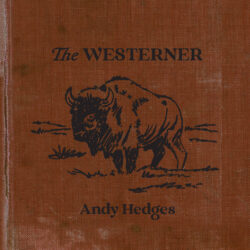 Andy Hedges lives cowboy lore. Born in 1980 to an Italian teacher and a former rodeo clown turned preacher, he grew up in an old farmhouse listening to his father’s cassettes of cowboy songs and tending to a few head of cattle. Hedges was born in Lubbock but raised in the West Texas town of Tokio. Tokio, an unincorporated frontier town in McLennan County, changed to Wiggins, Texas when it became a rail stop on the Texas Central Railroad line between Ross and Albany in 1882, according to the Texas State Historical Association. Somewhere along the way, locals decided they liked the sound of the original, Tokio (named after the Japanese capital) better, and began referring to it as such. Tokio began small and rural – by 1929, it boasted 19 residents, but that number swelled to 125 during Tokio’s boomtown era of the 1940s and 50s. The most recent census data (as of 2024) counts Tokyo’s population at 24 souls.
Hedges is no pretender. He’s devoted his life to the Cowboy Music he loved as a child, to the lifestyle of a Western troubadour, and to preservation. He’s a folklorist and a scholar of the music. His repertoire of traditional Folk and Cowboy songs is vast, and his storytelling preserves a part of the American experience with integrity, with tales and songs handed down for generations. He eschews hagiography, letting the songs of the fabled era speak for themselves. His is not an exercise in nostalgia: there is great romance to his work, but his admiration is true and unsentimental.
Hedges’ latest, The Westerner, collects folk songs, story songs, and blues both contemporary and traditional (Hedges is a master at interpreting his beloved traditional Cowboy songs, and some of these, like Pinto and I’d Like To Be In Texas are the album’s tenderest moments). It’s a double-vinyl epic produced by Rich Brotherton and Chris Ryden, featuring liner notes by fellow Cowboy poet Waddie Mitchell. Brotherton and Ryden’s spare production honours the songs by getting out of their way and letting the words and the musicianship of Hedges’ all-star ensemble speak for themselves.
The album features fellow traveller Dom Flemons, another artist whose repertoire includes songs new and old, and whose approach to folk music and acoustic recording mirrors Hedges’. Flemons, founding member of the Grammy-winning Carolina Chocolate Drops and a 2025 inductee into the American Banjo Music Hall of Fame, brings his talent and his scholarship – the man is a walking encyclopedia of the American Folk Catalogue – to The Westerner, contributing banjo and aesthetic kinship. His picking on Cow Trail Blues livens up the self-explanatory, and somehow celebratory, campfire tune.
Singer-songwriter and fiddle maestro Warren Hood, veteran of The Alejandro Escovedo Orchestra, stepped away from his decade-long Wednesday residency at the Austin Beer Garden Brewing Company long enough to add sweet depth to The Westerner’s sound. His fiddle playing is rich and, at times, mournful, evoking the loneliness of the western plains. Josh Baca’s button accordion playing locates many of the songs squarely in the Texas borderland, as the Conjunto veteran of Los Teximaniacs reminds the listener of the breadth of influences that comprise “Texas Music.”
The musicians who join Hedges on The Westerner are more than “guests”: they are collaborators, who recognise Hedges’ ambition to cross cultural and genre borders, to fully realise a survey of a vital American musical form. Flemons, Hood, and Baca are each deeply invested in preserving tradition and presenting it to new audiences. None, however, hope to create sonic museum pieces or relics of a bygone age. Like Hedges, they celebrate and revitalise traditional genre forms while adding their own generational and artistic flavours.
And then there’s the legend, Ramblin’ Jack Elliott, who, wanting to be a cowboy, literally ran away from his middle-class Brooklyn home at 15 to join the rodeo. His folks tracked him down and brought him back to New York, but the damage was done: he’d discovered wanderlust, cowboy music, and, most importantly, Woody Guthrie. Elliot’s influence on American music can’t be understated and ranges far beyond the purview of this article, but his cherished presence in the folk landscape and his work to preserve and continue Guthrie’s legacy have influenced most of the music this magazine exists to honour. He joins the ensemble on The Westerner’s finale, the Guthrie classic Driftin’ Cowboy, contributing his rich baritone, flatpicking, and characteristic humour. It’s a grand finale worth the entire price of entry, and a song that joyously culminates The Westerner’s warmth and soul.
