
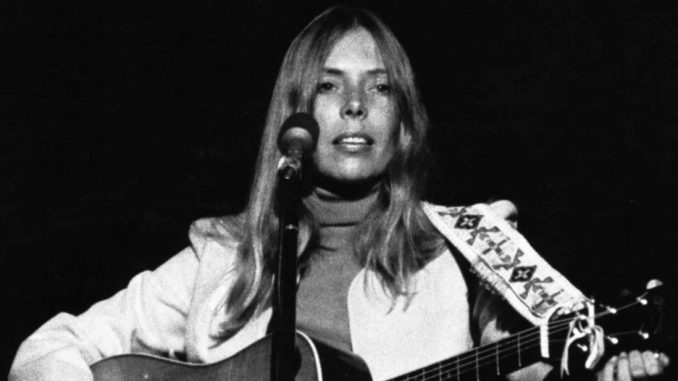
David Jarman’s recent visit to Woodstock in his AUK ‘For The Sake Of The Song’ feature may well have whetted the appetite of Joni Mitchell fans (here), of which I have been one for over half a century. Witnessing footage of her ‘Joni Jam’ appearance at Rhode Island’s Newport Folk Festival in 2022 was all the more poignant for me given the lengthy rehabilitation after her 2015 brain aneurysm. Brandi Carlile played a significant role in encouraging Mitchell’s return to the stage; their friendship is encapsulated in the four mesmerizing minutes of Carlile’s song Joni, from her 2025 album Returning To Myself. In order to determine my Mitchell ‘Can’t Live With and Withouts’, I took a 15 hour journey through her 19 studio albums, from the opening notes of I Had A King (Song To A Seagull) to the final strains of If (Shine). Four of those albums made it into Rolling Stone’s ‘500 Greatest Albums of All Time’ (2023 version): Blue (3), Court and Spark (110), Hejira (133), and The Hissing of Summer Lawns (258). Much time was also spent at jonimitchell.com – both this website and Mitchell’s musical catalogue are beautiful places to get lost.
Can’t Live With It: Both Sides Now (2000)
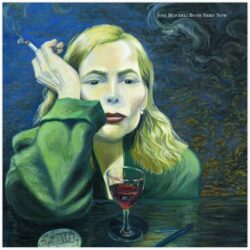 Mitchell’s first studio album of the 21st Century, Both Sides Now, was dedicated to her daughter, Kilauren. The album received the Juno Award for Vocal Jazz Album of the Year and a pair of Grammy Awards (Best Traditional Pop Vocal Album, and, for its title song, Best Instrumental Arrangement Accompanying Vocalist(s)). The album’s overarching narrative charts the course of a romantic relationship from first spark to dying ember. Released the week before Valentine’s Day, there was even a limited edition CD in chocolate box style packaging. The recording features orchestral versions of ten jazz standards, and two of Mitchell’s own songs, Both Sides Now and A Case of You. The combination of Mitchell’s contralto voice and Vincent Mendoza’s exquisite arrangements will appeal to many, and the reimagining of her own compositions is a joy. However, for me it is the original masters, rather than reproductions of the work of others, that bring transcendence to this lonely painter’s music. Given the wealth of her original material, and the multitudes to have recorded compilations of jazz standards, Both Sides Now is certainly a case of ‘Can Live Without It’, if not ‘Can’t Live With It’.
Can’t Live Without It: Hejira (1976)
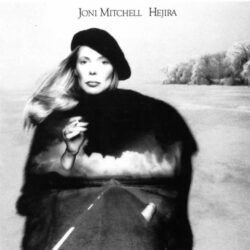 After a photo finish, Hejira beat Blue by a nose. I was sweet little sixteen when Blue was released, and more into football than music. Five years later, with my soccer skills in decline, along came Hejira, sandwiched between The Hissing of Summer Lawns (1975) and Don Juan’s Reckless Daughter (1977). Mitchell’s eighth studio album, now approaching its semicentennial, is a work of both lust and wanderlust. It was named after the seventh century AD migration, or Hijrah, from Mecca to Medina, of the Islamic prophet Muhammad. Mitchell’s odyssey occupied side A of a C90 cassette tape that took up permanent residence in my Sony Walkman during a three month undergraduate medical pathology firm. Hejira was as essential a part of my studies as scholarly tomes such as ‘Haematology for Halfwits‘, ‘Biochemistry for Buffoons‘, and ‘Microbiology for Muppets’. Whilst Mitchell sang of gazing up at heavenly vapour trail hexagrams, I was peering down a microscope at retinal pigment epithelial cells – the hexagrams of Hampstead. Steely Dan’s Aja was on side B of that cassette tape, and it wasn’t until many years later that I realised that both sides featured the guitar virtuosity of Larry Carlton. Carlton was one of several members of the L. A. Express collective enlisted by Mitchell to provide an infusion of jazz for the Court and Spark recording sessions. He also featured on Mitchell’s The Hissing of Summer Lawns, Don Juan’s Reckless Daughter, and Wild Things Run Fast, and his Steely Dan Aja contributions included Black Cow, Deacon Blue, and Josie, as well as the title track.
The transcontinental travelogue that is Hejira required roadmaps for half of the lower 48 states. Lyrically pinned locations include Baljennie and Maidstone in Saskatchewan; Staten Island; New York City’s Wollman Rink; Memphis, Tennessee, a North Dakota crossroads; Savannah, Georgia; the Cactus Tree Motel, at an undisclosed southwestern desert location; and Los Angeles. Mitchell’s pilgrimage, adding some serious mileage to the odometer, is both poetry in motion and inward journey of discovery. The musicians were all exemplars in service of the songs: Larry Carlton (guitars), Jaco Pastorius (bass; also Max Bennett and Chuck Domanico), John Guerin (drums), and Bobbye Hall (percussion), with contributions from Victor Feldman (vibes), Chuck Findley and Tom Scott (horns), and Abe Most (clarinet). The first track, Coyote, is driven by Pastorius’s fretless bass and Mitchell’s rhythm guitar, with splashes of Carlton’s glissando-rich lead guitar. The lyrics describe encounters with both a four-legged predator, near Mitchell’s Canadian hometown, and a two-legged seducer, more canny Lothario than coyote. Next up, bringing to mind the painting attributed to Pieter Bruegel the Elder, “Landscape with the Fall of Icarus”, Amelia finds the narrator in conversation with another who shared her dream of flight, Amelia Earhart. In 1937, that great American aviator’s attempt to fly around the world ended somewhere in the region of the Pacific Ocean’s Howland Island. Earhart and her co-pilot, Fred Noonan, were lost and never found. Furry Sings The Blues introduces a fellow Canadian on harmonica; Neil Young. Drinks and smokes were the cost of admission when Mitchell visited a faded Beale Street for an audience with the apparently curmudgeonly bluesman Walter E. “Furry” Lewis, who was old but not yet on his last leg, having lost the other jumping a freight train in Illinois in his twenties. A Strange Boy recounts a fling with a travelling companion on the eastbound leg of Mitchell’s travels. The title track brings the album’s first side to a conclusion. Hejira’s poetic expositions from the highway reflect on relationships and mortality. They float on a frisson-inducing Pastorius bass line, while Abe Most’s brief clarinet solo evokes the “strains of Benny Goodman”.
Song for Sharon is a lengthy postcard to childhood friend, Sharon Bell, initially concerning the purchase of a mandolin from the Mandolin Brothers musical instrument store on Staten Island. Black Crow is a reminder of the artwork on the reverse side of the album cover: Mitchell getting her skates on for Joel Bernstein’s photograph of her in passerine pose at Wisconsin’s Lake Mendota. In Blue Motel Room Mitchell pauses for thought in Savannah, Georgia. She anticipates tricky peace negotiations with former romantic partner and L.A. Express drummer John Guerin on her return to the West Coast. Her feelings are ambivalent but hint at reconciliation: “You lay down your sneaking round the town honey / And I’ll lay down the highway”. Many have speculated on the meaning of “boom-boom-pachyderm”; if it is in part an anatomical euphemism, it’s certainly not one that I’ve heard used during my medical career. Rounding off the album, Mitchell details advice received from Tibetan Buddhist master Chögyam Trungpa, before she seeks the Refuge Of The Roads that will guide her on the westbound leg of her travels. This may be journey’s end for Hejira, but there is bonus material to be found on disc three of Mitchell’s Archives – Volume Four (1976-1980), featuring Hejira Demos (March 1976), Rolling Thunder Review (May 1976), and Hejira Sessions (Summer 1976).
Hejira’s complex song structures and tuning patterns make for a compelling and immersive listening experience. Once that needle hits the vinyl it’s always a case of “I’ve started so I’ll finish”, as Magnus “Mastermind” Magnusson might have put it. After helping get me past the post in my pathology exams, Hejira has remained a much-travelled musical highway for me, and if you’ve not done so already, I would encourage you to take refuge in those roads yourself.

Spot on Jonathan, Both Sides Now just feels like the unnecessary album in her discography. The “Jazz Rock years” are my favourite part of her work as well. I haven’t investigated her archives series yet but volume 4 clearly needs a look as Shadows and Light is a brilliant album, what a band!
Thanks for the kind words Tim, enjoy the archives. I was fascinated to hear the Hejira demos on volume 4 disc 3.
Great Review Jon, I had no idea that her lyrics were so personal and intimate.Her voice spoke to our generation who were in fear of nuclear armageddon and eternal virginity….and she spoke to us all.Mind you nuclear armageddon still remains a concern even if the sex arrived eventually!
Thanks for checking this out and taking the time to comment Alan – despite the Doomsday Clock’s proximity to the midnight hour, I hope you continue to thrive in sybaritic splendour!