
A raw, live recording with all the in-the-moment feel of the best performances.
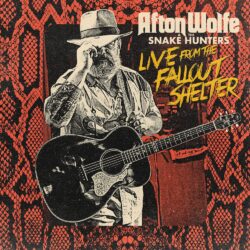 Recorded at the Fallout Shelter venue in Norwood, Massachusetts, there is no denying the intensity of the live performance from Wolfe and his band: Madison George on drums, Bassist Connor Quigley, Alan Bailey, keyboards, and Seth Fox on a variety of woodwinds. However, this is exactly the sort of record which divides lovers and haters of live albums.
It has the immediacy of a show captured in the moment, with audience reactions kept audible throughout, while keeping a decent mix in the music. So, it sounds “live,” rather than the rather sterile feel which too many albums of this sort end up with, to try and overcome the prejudices of people who say they don’t buy live records.
Crooked Roads, which opens the set, offers the immediate thought that Afton Wolfe has heard of Tom Waits, and that does persist throughout the album. A listener with a low tolerance for the Waits style would be best off picking another song to sample first. The song itself is about his wife’s brush with illness, which disrupted the tour that led to this album. It is dedicated to her and her neurosurgeon. By the time we get to Last King of the Blues, he has hit his stride, and the difference which Seth Fox makes to the interpretation of the songs is obvious. Written with Irakli Gabriel and Welsh singer/songwriter Hywel John, it started with a story which Wolfe told to Gabriel, who relayed it to John, who then asked Wolfe to contribute to the writing, without knowing the tale from Clarksdale, Mississippi had originated with Wolfe. The folk process in action.
Songs like Slingshot have a loose jazzy feel, again mostly courtesy of Fox, but with the driving backbeat which Waits seldom manages to do well. Wolfe included it here because he felt that the recorded version from his 2008 album Petronius’ Last Meal didn’t “really capture the panic as much as the live frenzy.” And frenzy is a good word for the band’s approach to their work. Everything seems to be always teetering on the edge of chaos, with the screams and howls which end this song butt up against the rasping Alto sax. The rhythm section keeps it all pointing in roughly the right direction until the song hits the buffers.
The cover of Edie Brickell’s What I Am is an intriguing choice, but he credits the line “Philosophy is a talk on a cereal box. Religion is a smile on a dog” as one of his primary influences to get started writing lyrics. Other discernible influences include John Prine and, especially, Randy Newman at his wry and cynical best. What I Am is almost rapped rather than sung but has the incendiary live power that is this album’s calling card. Fox’s flute solo makes a great alternative to Kenny Withrow’s Garcia-style guitar solo on the original.
Wolfe is a fine interpreter of other people’s songs. New Orleans Going Down was written by LH Halliburton about Hurricane Katrina. Wolfe spent his youth in the city and says it “was unrecognizable in the worst way” after Katrina. An unsettling, twitchy arrangement supports the words, which show Public Enemy how a song of rage about that time should have been written. As Wolfe says, “it’s so messed up how bad that situation and how every one of our “leaders” let that great city down.”
He closes with Paper Piano, a tune best described as “rollicking.” Wolfe’s thoughts on the album are summed up in his notes on this song. “Even if we’d played every note perfectly (and we definitely didn’t), I am just naturally pitchy in my voice; I’ve been told I’m basically impossible to autotune, because my wavelength is wider than the channel it is supposed to fit in. No, it’s a perfect album for a few reasons. The performance and songs are top-notch, if I must say so myself. But it comes down to, in my opinion, the concept of “replicability,” which I think is the most important thing in art. And it’s even more important in the new era with “Almost Intelligent” technology. AI can’t replicate what we did that night. In fact, we couldn’t even replicate what we did that night.”
And that really does explain this record: it is raw, chaotic at times, with some magic and some places where it gets close to falling apart. If you love live music, this is an album to pick up. For those who “don’t do live albums”, try it; this could be the one to change your mind.
