
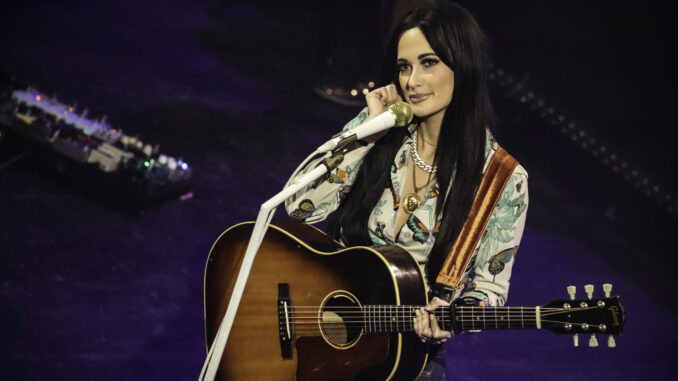
When she played the Royal Albert Hall in 2015, Kacey Musgraves grew emotional when she realised her entire town of Golden, Texas, could fit into the room. She was promoting her second album “Pageant Material”, which included a song where she advised people to “mind your own biscuits and life will be gravy”. She had already made an impression with ‘Follow Your Arrow’, a song bravely sent to country radio despite lyrics about kissing people of the same sex and rolling up a joint – “or don’t” she added cutely. It was no surprise she gained a foothold in the UK, with a Country2Country appearance in 2018 and a Roundhouse show in 2024 following that filmed Albert Hall set.
Here was a confident singer/songwriter with a strong brand that set her apart from every Nashville artist, not just the female ones, whom one radio consultant referred to as “tomatoes in the salad”. SpaceyKacey was her social media handle, and she boasted of taking psychedelics and spending time in gay clubs. She told Billboard magazine in 2018 that, though she loved roots music, “it feels like there’s a contest sometimes with how country or how traditionalist you can prove yourself to be”.
The organic sounds of her first two records gave her a wide audience. I thought ‘Merry Go Round’ was an extraordinary and melancholy song, particularly when she delivered it on Later…with Jools Holland with acoustic guitar accompaniment. “Just like dust, we settle in this town”, she sighed, which makes her career a refutation of a life she might have chosen.
Musgraves is now seven albums into her career, with two of those being Christmas sets, and topped the Hot 100 with ‘I Remember Everything’, a duet with Zach Bryan. But which of those seven albums can I do without, and which is pivotal to understanding her craft?
Can’t Live With It: “Star-Crossed” (2021)

Looking back on Musgraves’ fourth album, it seems more like a pivot point to 2024’s “Deeper Well”. The title track, which opens the album, starts with layers of vocal harmonies; “then the darkness came”, she sings, making it clear that this is her divorce album, written in the wake of her separation from husband Ruston Kelly. There is not much lightness across the lyric sheet, which is unusual for a Kacey Musgraves album.
The production has become more experimental, now far removed from the twang of her debut. Heavy autotune saturates her vocals as she sings the title of the song ‘Good Wife’, but the musical bed overall is, to me, uninteresting. On ‘Cherry Blossom’, the vocals across the entire song are unnaturally thickened by being double- or perhaps triple-tracked, and a synthetic pentatonic riff underlines how “Tokyo wasn’t built in a day”. ‘If This Was A Movie’ is dinner-party chillout music with a mordant line about “the darkness that’s inside both of us”.
This is confessional music where Musgraves dwells on the past, but the music doesn’t welcome me as a listener, even when she warns me of the kind of man who “wants a breadwinner…until he ain’t hungry anymore”. The album’s single ‘Justified’, written with pop writer Ilsey Juber, centres on how “healing doesn’t happen in a straight line”. Her dad’s old advice to “keep your head in the clouds” is accompanied by finger-click percussion on “Keep Lookin’ Up”.
Otherwise, ‘Easier Said’ falls back on the simple truism of how “it ain’t easy to love someone”, and on ‘Hookup Scene’ she dwells on the lack of connection in no-strings fun that prompts her to tell the listener to “hold on tight” to someone you love. Such advice is much less striking than to “follow your arrow wherever it points”.
By the time Musgraves complains that “being grown up kinda sucks” on ‘Simple Times’, it becomes clear that this is a pop album which aims to drift by pleasantly without leaving too lasting an impression. Few rhymes and punchlines leap out in the way they did on previous albums: “chronological order and nothing but torture” on ‘Camera Roll’, which is crying out for a piano ballad arrangement; “what doesn’t kill me, better run” on the wispy ‘What Doesn’t Kill Me’; and a comparison of the “shadow of doubt” with the “light at the end of the tunnel” on ‘There Is A Light’, which is at least enlivened by an insistent drum track and several daring passages of flute which ultimately outstay their welcome.
Musgraves closes the album with a song she heard while ingesting magic mushrooms, the old Chilean folk ballad ‘Gracias a la Vida’, written by Violeta Parra. It acts as a sort of lullaby and, in tune with her psychedelic experience, she opts for different vocal production settings for each verse. “Star-Crossed” is an album to be admired and endured rather than enjoyed, and one that Musgraves had to make at that particular point in her career.
Can’t Live Without It: “Golden Hour” (2018)
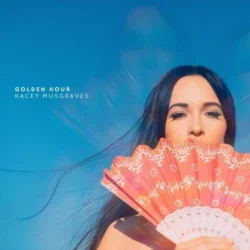 How quickly her relationship went awry, but how lucky for us that she could capture the bliss of love on “Golden Hour”, a perfect album that does a better job than “Star-Crossed” of letting us into Musgraves’ world.
Over and above her strong first album, “Same Trailer, Different Park”, “Golden Hour” is the most successful distillation of Musgraves’ sound. She curiously imagined what it would be like for Sade to make a country album, and to achieve this, she worked with Dan Tashian and Ian Fitchuk rather than her usual team of Nashville A-Listers: Shane McAnally, Luke Laird, Brandy Clark and Josh Osborne. However, ‘Space Cowboy’, a grown-up and melancholy tune, was written with some of those old cohorts; on it, she offers someone freedom because “sunsets fade and love does too…there ain’t room for both of us in this town”.
It’s one of the only tracks on the album with explicit rural imagery, and there’s a surprise key shift for the final chorus. The cosmic country sound is best expressed on ‘Wonder Woman’, a song about the beginning of a relationship, with some mellifluous harmonies, on which Musgraves complains that she doesn’t know “how to lasso the love out of you”. She is uncertain and vulnerable, which increases the empathy she has with a listener like me.
She curses how nervous she gets when she’s having fun on ‘Happy & Sad’, whose gentle arrangement masks an adorable, relatable neuroticism. It also has the album’s best middle section, which prompts another key change. There’s always something interesting going on, either in the music, the lyrics or both. “I don’t wanna come down”, she sings at the end of each chorus, aware that for every up there is a down.
From the wry opening declaration that she was “born in a hurry, always late” on ‘Slow Burn’, Kacey turns the lens on herself rather than the world around her. The opening verse is sung without percussion, which, like ‘Wonderwall’ by Oasis, makes it more emphatic when the drums do come in; the chord choices are unusual and ear-catchingly pleasant. I love the brightness of the arrangement of ‘Lonely Weekend’, which hits a really melancholy chord on “it’s alright to be alone sometimes”. Given that this is followed by a gentle melody from a compressed keyboard, it sounds like the singer is mocking herself and how besotted she is with her new beau.
By the time she offers the title track, she has dispelled any hint of sadness for the “paradise” of her beloved’s eyes. The resonant guitar solo reminds me of ‘Wichita Lineman’, and there are some of Dan Tashian’s patented major seventh chords throughout to give the song a classic songwriter feel. It also demonstrates how brilliant a singer Musgraves is, as she allows her voice to flutter, rather than deliver punchlines as she did across her first two albums.
The piano-led interlude ‘Mother’ was written while Musgraves was on mushrooms. As opposed to the monochromatic songs on “Star-Crossed”, she sings of “the music in me and all of the colours” without any extra vocal stacking. You can hear the unbridled euphoria in her voice on both ‘Love Is A Wild Thing’, which has some magnificent vocal runs up the scale, and ‘Butterflies’. The latter’s lyric sheet, emphasised by a banjo riff, includes “chrysalis” and “untangled”, and the cooed line “now I remember what it feels like to fly”.
She is similarly wide-eyed on ‘Oh, What a World’, whose opening and closing choruses pass through a vocoder, in a delightfully bold production choice that makes the love extraterrestrial and works with the “magic all around us” which she hymns. ‘Velvet Elvis’, which is a great image, sounds like a cousin of Miranda Lambert’s ‘Priscilla’, given that the songs share a writer in Natalie Hemby. Musgraves chooses to double-track her vocals here, something she does less often than on “Star-Crossed”.
At the O2 for Country2Country, she brought out a disco ball for the acerbic ‘High Horse’, with its memorable “giddy-up” hook and driving bass-and-drums rhythm that underscores a lyric about a buzzkill of a guy. The album ends with Musgraves’ career song, the superlative piano ballad ‘Rainbow’, which has been taken up as a gay anthem even though anyone can relate to the sad person to whom she is singing with a great degree of empathy. It sounds vaguely like a song from a Pixar movie; it may have led Musgraves to be chosen for the closing number of the Disney movie “Frozen 2”. Kacey throws her voice slightly on “everything is alright now” and delivers the closing line “it’ll all be alright” with calm certainty.
The album “Golden Hour” must always be described as the Grammy winner for Album of the Year, something that popped into my head as soon as I finished listening to it for the first time a year before it won that award. I was impressed how excellent and how eclectic it was, and how musical the songs were, with defined middle sections and modulations in key. She had taken the charm and sarcasm of her first two sets, rationed it to when it was needed and worked her own wonderment of the glory of love into her art. She could also use her instrument, her voice, more effectively than ever to transfer emotion to me as a listener.
Perhaps this is why I was so disappointed with “Star-Crossed”, in the time-honoured manner in which a singer’s new album failed to grab me as much as the one I had been blown away by. Not every album can be a classic, but seven summers after I had it on repeat, “Golden Hour” stands up as a Kacey Musgraves album I will never be able to live without.


