
The Tulsa Sound, with its twin figureheads Leon Russell and JJ Cale, and its blend of rock and roll, country, blues, R&B, and a little jazz, is a key part of the foundations that americana is built on. While Tulsa has had a vibrant nightclub based music scene for a long time, Bob Wills made Tulsa’s Cain Ballroom his base in the 1930s, the significant black population added to that musical base, the oil industry brought many migrant workers with their own musical preferences, Russell and Cale made the basis of their reputations in Los Angeles in the ‘60s, with Cale moving to Nashville at the start of the ‘70s. Tulsa musicians, including drummers Jim Keltner, Jimmy Karstein, and Chuck Blackwell, bassist Carl Radle, guitarist Jesse Ed Davis, and others, followed the trail blazed to California by Russell, meaning that the Tulsa Sound of the late 1960s and early 1970s was effectively created and recorded mainly on the West Coast.
Leon Russell returned to Tulsa in the mid-‘70s and opened The Church Studio and later his Paradise Studio which meant that Tulsa was no longer just a centre for live music but also a major recording centre, attracting the leading artists of the day such as George Harrison and Eric Clapton looking to soak up some of the Tulsa Sound, plus providing facility for such local acts as The Gap Band and Dwight Twilley. While the stars of the day may have been attracting headlines in the Tulsa press, the next generation of Tulsa Sound musicians were developing their chops in the local venues. One of these musicians was Jimmy Byfield, who led the bar band Rockin’ Jimmy and the Brothers of the Night. Byfield gained a degree of notoriety on the Tulsa scene when Clapton recorded a version of Byfield’s Little Rachel’ on his “There’s One In Every Crowd” with a band comprising mainly Tulsa musicians.
Peter Nicholls, the UK engineer at The Church Studio, formed the Tulsa-based Pilgrim label in the mid-‘70s to record local acts, and Jimmy Byfield tracks were included on two label samplers before Rockin’ Jimmy and the Brothers of the Night’s “By The Light Of The Moon” was released in 1981. At the time, the band included Gary Gilmore, who had played bass with Taj Mahal and JJ Cale, Walt Richmond on keyboards, who had played with Bonnie Raitt and Rick Danko and who was later a member of The Tractors, Steve Hickerson on guitar, Chuck DeWalt on drums, and Debbie Campbell on backing vocals, who toured with Bonnie Raitt.
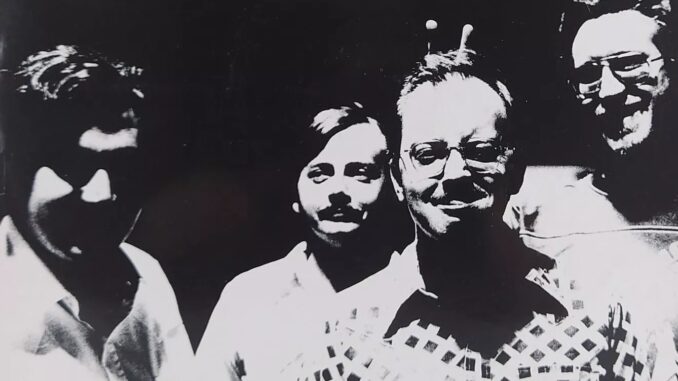
The Swedish Sonet label picked up “By The Light Of The Moon” for the European market and released the album in the UK. It caused a bit of a stir with fans of roots music and the London pub rock scene of a few years earlier. Alexis Korner championed the band on his BBC Radio 1 show, and the band made it over to the UK and Europe to promote the album. Image was not a big thing with the band; Jimmy Byfield could have been mistaken for a bank manager even in his stage clothes, but what they lacked in image, they more than made up for with the groove they brought to their performances. The groove is the epitome of the Tulsa Sound, and Rockin Jimmy and the Brothers of the Night’s groove is laid back and open, allowing for plenty of guitar and keyboard fills. Jimmy Byfield has a pleasant voice, and he writes songs that are great with ensemble arrangements, so there is no flashy musicianship or grandstanding. The band released their second and last album, “Rockin’ Jimmy & the Brothers of the Night”, in 1982, with Gary Cundiff replacing Gary Gilmore on bass. Both albums were produced by Peter Nicholls, who produced a natural sound that sounds as good today as it did in the early eighties. Apart from the hint of probably digital horns, there is nothing on both recordings that suggests they were recorded in the early ‘80s.
Tulsa Backstage was a Tulsa-based music show, and this clip of what is probably Jimmy Byfield’s signature song is from the show’s pilot. It’s clear from the performance that the band are more than comfortable playing live and that the audience is fully behind them. For his own reasons, Jimmy Byfield never really liked touring away from Tulsa, though he maintained his popularity there, and because of this, he never built anything like a meaningful fan base in America or Europe despite the promise shown in 1981. To compound the problem, the band’s two albums weren’t released on CD and don’t seem to have made it to any of the legitimate streaming platforms, unfortunately. This means that YouTube is the place to hear Rockin’ Jimmy and the Brothers of the Night, with album tracks and a handful of live performances being the only evidence that the band existed. It seems futile to wonder why the band aren’t better known; best to simply search out what is left of their legacy and recommend them to friends and family if they like music that is timeless and groove-laden with great ensemble playing.
If you like this clip, you could do worse than seek out Casey Van Beek and the Tulsa Groove’s “Heaven Can Forever”, which features Walt Richmond, Jimmy Byfield, and Steve Hickerson from Rocking Jimmy and the Brothers of the Night and provides clear evidence that the Tulsa Sound is still alive and well.



What a great track and vibe! I’ll definitely search out what there is on Youtube. Thanks Martin.
I’m glad you enjoyed the track, Alan. Good hunting.
A big fan of Rocking Jimmy, I’ve got both the albums, bought after hearing Alexis Korner playing them on his radio show. Never saw them live mind you but I treasure the albums.
Sonet Records released some pretty good records back in the day in Europe. It would be nice if there was some form of reissue program but I suspect it would be too difficult legally and not a big enough demand to make it worth someone’s effort.