
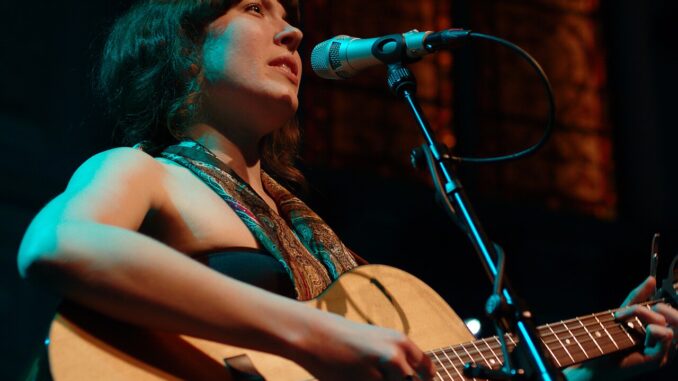
Back in December 2017, Alela Diane shared on Facebook the official video for a new song, commenting, “I wrote Émigré about the international refugee crisis—no one should have to risk their life or the lives of their children for safety”. The Portland-based singer-songwriter’s sixth studio album, Cusp, from which Émigré was the first single, was released a couple of months later. The songs for Cusp were conceived in early 2016, a few months before her second daughter, during an artist residency at Caldera Arts in Sisters, Oregon. Most of them concern motherhood; Never Easy, Song For Sandy, Buoyant, Ether and Wood, So Tired, and Wild Ceaseless Song, as well as Émigré. My radar first detected Diane in 2009 with her To Be Still album, particularly the ethereal White As Diamonds. I was spellbound by her performance at Bristol’s Louisiana venue in July 2013, shortly after the release of her fourth studio recording, About Farewell. AUK’s Andrew Raw recently glowingly reviewed her latest release, Who’s Keeping Time? She briefly visits these shores from September 30th to October 4th (Dublin, Glasgow, Manchester, Bristol, London), before crossing the channel to Europe.
The Merriam-Webster Dictionary defines an émigré as “a person who emigrates for political reasons.” Diane’s Émigré is driven by a hypnotic fingerpicked acoustic guitar ostinato. The chorus, sounding half sea shanty, half nursery rhyme, precedes the first verse: “Seabirds fly the salty wind / East to South – North to West / See us go, as they go / Across the borderlines”.
Drawn in by that guitar motif, a sense of restlessness and foreboding emerges with the first verse: “I can feel the fear hang heavy on the water / Glinting sharply with the pale moonlight / Mothers hold on tightly to your children / As the waves are breaking violently tonight”.
A swelling drone from the string section ramps up the tension. The chorus offers temporary respite from the perilous situation, but concern increases as ‘see us go‘ is replaced by a questioning ‘can we go‘. As bass and percussion fall in with the surging strings in the second verse, worst fears are confirmed: “I hear yelling, I hear crying, I hear praying / As the ocean threatens us on all four sides / The water rises deeper every minute / This vessel cannot bear the burden of our load”.
The next chorus merely prolongs the suspense, before the final verse’s chilling conclusion: “One by one the children have grown silent / From their mother’s arms, they float away / The roaring sea will wash our quiet bodies / Upon the foreign shores, but our souls will find a way”.
The chorus becomes a mantra, repeated several times, like waves rolling in on a beach, fading out to leave the song hanging by Diane’s fingerpicking.
The inspiration for Émigré was an image taken by Nilüfer Demir, a Turkish photojournalist with the Doğan News Agency. Her photograph, distributed rapidly and widely through social media, of the body of two-year-old toddler Alan Kurdi, washed up on a beach near Bodrum, became a symbol of humanitarian disaster. Galip, Alan’s five-year-old brother, also drowned, as did their mother Rehan, when the overcrowded rigid hull inflatable boat they had boarded sank off the Turkish coast during an attempt to reach the Greek Island of Kos in September 2015. Alan’s father was amongst the survivors. According to UNHCR, the UN Refugee Agency, since 2015 there have been over 2.8m refugee sea arrivals in Europe from Turkey and Africa, with over 34,000 dead and missing. Over 200,000 migrants have crossed the English Channel in small boats since 2018; of 2025’s 41,000 arrivals, 76% were men, and 12% each women and children. The small boats keep coming, including 15 metre ‘mega-dinghies’ carrying up to 125 migrants. The people smuggling gangs are thriving, putting the vulnerable in harm’s way for financial gain, and the current US/Israel-Iran War is likely to further increase forced displacement.
With her maternal gaze towards the Mediterranean, Alela Diane’s profound and powerful Émigré is a stark reminder of ongoing global humanitarian crises. On a personal level, Diane’s second pregnancy propelled her to the cusp of life and death. Her antenatal course took a turn that risked both her and her child’s lives. She was diagnosed with HELLP syndrome in the third trimester of her pregnancy. The syndrome, which occurs in less than 1% of pregnancies, can be life-threatening for both mother and baby. After an induced labour, daughter Oona was born at 34 weeks. Up to that point, with Cusp at the stage of being mixed, neither Émigré nor Oona were out in the world. Five years later, Diane described her traumatic postnatal course in an Instagram post: “Shortly after she was born I descended into a 36 hour Hell-scape of haemorrhaging half of my blood, having life saving procedures in the Operating Room, and getting blood transfusions. I was in and out of consciousness and [did] not know if I would survive to see my daughters grow”. She went on to say that she was advised that she would not survive another birth; were she to become pregnant again, she would need an abortion. “The stories that illustrate the need for abortion are abundant and varied. This is just one. I’m heartbroken and angry today.” Her words were an impassioned response to the conservative majority US Supreme Court’s vote, two days prior to her post, in favour of overturning the 1973 Roe v Wade ruling, thus removing the federal constitutional right to abortion.
Émigré is a thought-provoking emotional roller coaster ride, as relevant today as it was in 2017. Too many leaders today are building walls and blowing up bridges. Compassion seems in short supply, but it shines through in Diane’s voice, as clear as the waters of Oregon’s Crater Lake, her mesmeric fingerpicking, and Ryan Francesconi’s sympathetic string arrangement. Oh, to see us go, free as seabirds, “Across the borderlines”. Truly a song for the ages.

