
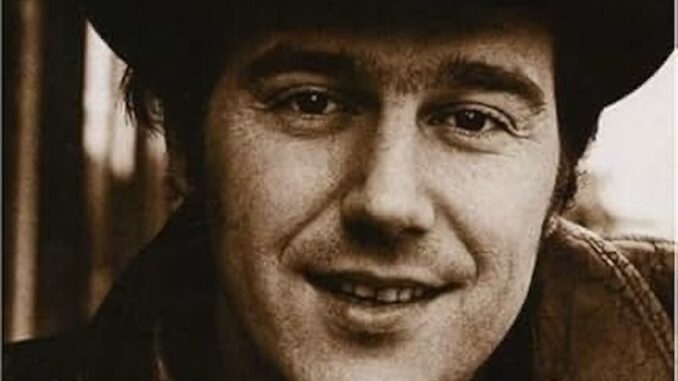
Ronald Clyde Crosby was born in 1942 in Oneonta, a small city in Otsego County, New York, but to you and me, and the rest of the musical world, he was better known as Jerry Jeff Walker. After high school, he joined the National Guard, but his thirst for adventure led him to go AWOL, and he was eventually discharged, from where he continued to roam, busking his way around the country. He spent time around the folk clubs in Greenwich Village during the mid-sixties, before forming the band Circus Maximus, which recorded two albums and had one minor hit single. On the band’s demise, Walker, who by this time had legally changed his name, continued with his solo career, recording his debut album in early 1968 at the historic Phillips Recording Service in Memphis, Tennessee, established in 1960 by the legendary Sun Records founder Sam Phillips. That album’s title track would be “Mr Bojangles”.
Walker always claimed he was inspired to write ‘Mr Bojangles’ after an encounter with a street performer in a New Orleans jail, having been arrested for public intoxication sometime in 1965. The homeless man in an adjacent cell, who called himself Mr Bojangles to conceal his real identity from the police, had been arrested as part of a police sweep of indigent people that was carried out after a high-profile murder. The story goes that the two men, along with others in the cell, chatted about all manner of things, but when Mr Bojangles told a story about his performing dog that was killed by a car, the mood in the cell turned heavy. One of the cellmates called for something to lighten the mood, and Mr Bojangles obliged with a tap dance. Legend has it that the homeless Mr Bojangles, who was white, was an obscure but talented alcoholic tap-dancing drifter who had taken his pseudonym from Bill ‘Bojangles’ Robinson (1878 -1949), a black entertainer.
Having initially recorded the album with the help of multi-instrumentalists and singer-songwriter David Bromberg, along with other Atlantic recording artists, Walker returned to the studio and re-recorded the song for single release with Bobby Woods, Charlie Freeman, Sandy Rhodes, Tommy McClure and Sammy Creason. The song by this time had already been covered by Austin performer Allen Wayne Damon in 1967, while Walker’s single was released on Atco Records on June 20th 1968.
From here, the song became one of the most covered tracks of the time, with Bob Dylan originally recording the song in 1970, while working on the album “New Morning”, though his version would not be released until it appeared on the album “Dylan” (1973). By this time, it had been recorded and released by Harry Nilsson on his album “Harry” and Neil Diamond on his album “Touching You, Touching Me”, both released in 1969. The following year, John Denver recorded the song on his album “Whose Garden Was This”, but it was the Nitty Gritty Dirt Band’s recording that same year that would eventually take the song to No. 9 on Billboard Hot 100, in November 1971.
Like all great songs, ‘Mr Bojangles’ transcended musical genres, being covered by Big Band crooner Frankie Laine, Calypso singing legend Harry Belafonte, and jazz icon Nina Simone, while the song became the signature tune for legendary American singer, dancer, actor, comedian and musician Sammy Davis Jr, who first recorded the song for his 1972 album “Portrait Of Sammy Davis Jr”.
Therefore, it goes without saying that though this popular song is probably known to most, the source from which we heard it first is vast and varied. Other than the original, my favourite cover comes from an artist who wasn’t just massively influenced by Walker, but someone who would become one of his best friends, Todd Snider, and earlier this year Snider released a live EP entitled “Best Of All My Songs” that included a version of the song, along with one of the funniest and most poignant introduction stories (as long as you’re not too easily offended) ever put to tape.
After the singles success, Walker moved to Austin, Texas, recording a string of albums for MCA and Elektra, becoming highly influential on the next generation of singer-songwriters, before he gave up on the mainstream music business and formed his own independent record label, ‘Tried & True Music’ in 1986. During his time in Austin, Walker became associated with the ‘Outlaw Country’ movement that included Michael Martin Murphy, Willie Nelson and Waylon Jennings, while his recording of Guy Clark’s ‘Desperados Waiting For A Train’ and Ray Wylie Hubbard’s ‘Up Against The Wall, Redneck Mother’ gave both artists some much-appreciated exposure.
We sadly lost Walker on 23rd October 2020, a year in which we lost so many of the great songwriters, but his legacy lives on, through classic albums such as “Viva Tealingua”, “Riding High” and “It’s A Good Night For Singin'”, and of course his tale of ‘Mr Bojangles’ a song that would be covered by so many, reach the ears of millions and give him the financial security to make the albums he wanted to make for the rest of his career.
This article was written before the heartbreaking news of Todd Snider’s passing, and we send our sincere condolences from all at AUK to his family and friends. He was truly one of americana music’s finest singer-songwriters.



Great song, and the article is a nice reminder of a great artist.
Hi Martin. Glad you enjoyed.
Someone, somewhere in this world must have made a (VHS) recording of Jerry Jeff and his band playing at dance in Luckenbach in 1991/1992 or thereabouts. For unknown reasons I only had the first 15 mins taped from when it was shown on the BBC, now converted to DVD, (Luckenbach Texas intro (Waylon), Mr Bojangles /Getting by/ Navajo Rug). Only Mr Bojangles seems to exist on YouTube. Anybody out there?
Hi Les. Sorry, I can’t help you with the Luckenback performance shown on the BBC. In truth, I wasn’t even aware it existed, but hopefully somebody out there in Americanaland will be able to help.
Hi Graham, me too. I even emailed Luckenbach once. Smashing article about a “great”, IMHO. Got lots of his stuff on vinyl from markets, second hand record shops etc before online sales took away the thrill (but increased the collection considerably!). Cheers