
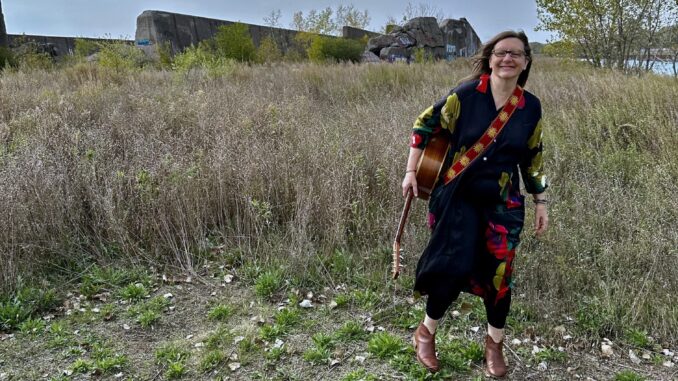
In 2022, with her second studio album, Flesh and Bone, Cynthia Marchant explored spiritual truth and depth, and the magic of connecting with self and others in the many stages of life. Three years later, she’s back with something even better: a dramatic, cutting collection of americana songs called In the Afterglow, her third with producer and guitarist Steve Dawson, that wraps her plucking in spacious, rootsy arrangements. It begins with Marchant finding all the parts of life “In This Small Town” (Out just a watching life go / now and then a pick up passing by / a finger lifting off the wheel to say hi), or yanking hope out of a vacancy with sparse chords on “Trying to Let Go,” (You’re trying to let go of regret / that sticks like stones and skeletons and bones / in closets from that broken home).
Most of the songs on this album are not full of solitude but rather the desire to connect with friends, family, loved ones#, or simply her own roots in the Arkansas Ozarks, where she felt lucky to have spent time as a kid. Marchant has lived in Chicago more years than not, with stays in New Orleans, California, Idaho and Nevada, but in many ways still thinks of Arkansas as home. She takes you to the Ozarks, where she was lucky enough to spend a lot of time as a kid, and vividly remembers hearing and seeing a huge tornado as it passed by. “Moments like that are a reminder that life is a miracle and, in the end, we are all just passing through, a stormy day, a cloud, a sky of blue.” In “Flowers and Bones,” she celebrates her musical foundation there, where her brother taught her a few guitar chords and left a guitar behind for her to play as he went to serve in the army.
Her music feels intensely present. The emotions never relent as “Across the Galaxy” chases something to touch that’s just out of reach, and “The Light” quakes in hushed rejection and loss while celebrating (And I would choose the same / I am glad I took your name / And I’m happy for our son / we sure had ourselves some fun). “In the Afterglow” is all of that: We can share a bed, Marchant sings. I can take you as you come / and not get too far ahead. You wonder where “Tennessee Dream” is going to end up until the lines drop in: I think of you and my heart stands still / hoping you will come after me/we can let ourselves fall/falling free.
Though Marchant never sounds like she is itching to burst, her expulsions find an outlet in “Happy to Be Alive,” when her entire band jumps in with vigour. Her vocal flirts with a certain rootsy je ne sais quoi that sounds as in-your-ear as it does homespun. It’s the kind of bare-boned, singer-songwriter composition that you’ve probably heard a thousand times before, but with Cynthia Marchant holding the mic, it’s a piece of a still-growing canon that becomes as crucial as anything that’s come before it.
Similar to an at-home dance party with someone you love, In the Afterglow has that bright and sunlit tint to it, and it feels like Marchant’s passion is bursting with every lyric. As she noted, “I’m more focused than ever before because I’ve come to realize that when I die, anything I’ve written that hasn’t been recorded will also die. I’m making up for lost time, and everything is just fine.” There is an argument to be made that this is the best album of her career. In fact, every new album finds her embracing more and more of herself, and this little gem is no exception.
AUK asked Cynthia to tell us more in a series of questions she answered by email.
Americana UK: Your musical origin story …. what got you started playing music?
Cynthia Marchant: I was 13 when Mom bought me a junior-sized guitar from Sears and Roebuck. At around that same time, my brother gave me one of his guitars and taught me three or four chords before he went into the army. He was a very talented, self-taught multi-instrumentalist and had surely gotten mom’s gift of playing music by ear. Her instrument was piano, and I recall good times around the piano singing “Tennessee Waltz” and similar songs as a child.
AUK: Tell me about this tornado from “In This Small Town.”
CM: I spent a lot of time at my granddad’s house in Calico Rock, Arkansas, when I was 9 or 10. The entrance to the cellar was out by the garden, and I remember going down into the cellar because of stormy weather a time or two. On one occasion, the tornado came so quickly that we didn’t make it to the cellar. We heard a sound like a freight train and saw a huge tornado gracefully move across the sky, way beyond the trees, so that we didn’t see the damage being done. As a child, I was fascinated by that event, but I saw that my grandad was visibly upset.
AUK: Isn’t it impossible not looking at falling in love through rose-colored glasses?
CM: Oh, the rose-colored glasses… if only they never came off…
AUK: You’ve lived in several different places. Have you wondered what it would be like to take your career to Nashville?
CM: I’ve dreamed of Nashville many times over the years for many reasons, and music always played its part. My music doesn’t follow a standard hit formula for country music, so I’m not sure how well it would be received on its own. I always write for myself and don’t care to change that process, but I love the idea of co-writing in Nashville. I’ve just recently co-written two songs with a very talented Chicago musician, Gregg Mandel.
AUK: Light plays a leading role in your lyrics from “Elevating” to “I Saw You There” to “The Light,” and “You Shine” from the Flesh and Bone album. Does being in the light have meaning for you?
CM: As a visual artist, I’m very sensitive to my surroundings and love the subtle changes in the quality of light throughout the day, inside and outside, and I love the changing skies. My heart spins with gratitude that I’m alive and able to experience these spiritually elevating moments, and as a songwriter, I want to take you there.
AUK: You have an ongoing working relationship with producer/guitarist Steve Dawson. What is it about him that brings this rapport?
CM: He is down to earth, patient, kind, supportive, and fun to work with, and Steve and I go back many, many years. We met at Old Town School of Folk Music in Chicago in one of his many songwriting classes, and I’ve taken a few. For the record, my favorite is “Finish Your Damn Songs”!
Steve is a highly educated musician and a skilled multi-instrumentalist and producer who is also very intuitive. We were working on a song once, and just as I was thinking the Wurli would be nice, he suggested the Wurli would work well. Some of the earliest songs we produced when I was getting to know myself musically, and as Steve and I got to know each other, happily remain in the vault. I believe “Ima” is the first song we did together for Heart Cracked Open Wide, and I remember simply saying “more down home,” and Steve nailed it.
I will show up with my guitar and a song at Steve’s studio, Kernel Sound Emporium. As I’m warming up, he’s setting up, and by the time I’ve recorded my parts, he has a concept that embraces the essence of the song and takes you to the heart of the matter.
AUK: Talk about the story behind “Flesh and Bone.”
CM: I’ve had a few different types of cancer over the years that thankfully have always been completely treated with surgery. Prior to one of my surgeries, before really understanding the outcome, I wrote a song for my son. I’d never written a song for him before, and I wanted to let him know my love would always be there for him, even if I wasn’t.
AUK: Were you working in health care when you became ill, or did you enter the field after getting healthy?
CM: I was working as a massage therapist in a cancer treatment center when I got one of my cancer diagnoses. I had already started nursing school at that point, for what would be my third or fourth career, depending on what you count. One of my greatly admired aunts had been a nurse, and when I graduated from high school, I had moved from Arkansas to New Orleans to go to nursing school. I was into the second semester of a four-year program when I dropped out after being sick for a week. At that time, I discovered life had other plans for me if I followed my sense of adventure, and I went with the flow.
AUK: What’s the story for “Buddhist Wedding Song?”
CM: I was invited to sing at my dear friend’s Buddhist commitment ceremony. Her partner and her met while in Hawaii and were having the ceremony in their backyard overlooking Lake Ontario in Rochester, NY. I wrote the song for the ceremony, and it was really a premonition of a beautiful day in a season when the weather could have easily gone the other way.
AUK: You seem to favour red vehicles – the Beetle in “Heart Cracked Open Wide” and the bright red jeep in “Tennessee Dream.” How do you get around Chicago?
CM: I loved my red VW with the sunroof. I made it out to California from New Orleans and lost a cylinder while going over Spooner Summit in the Sierra Mountains, where I ended up staying for many years. In Tennessee, there really was an off-roading experience in a bright red Jeep, and I did buckle up and hold on! I had a bit of a heavy foot for many years and avoided red cars after the VW, since they do attract a bit of attention. Nowadays in Chicago, I walk, take buses and trains, and drive a very sensible graphite Toyota when I need to drive.
AUK: Did your dad really change his name to John Wayne? The song “Ima” describes when you lived in Arkansas.
CM: Ima was my dad’s cousin, and she and I had a very special relationship. She sat next to me at my dad’s funeral and told me dad was named Joseph Wiley when he was born. He was always known as J.W. there in Culp, Arkansas, where he grew up. After leaving that tiny town in the Ozarks, he was known as John Wayne. I have no idea if he changed his name or not, but I love the story so much that I don’t want to prove it wrong.
AUK: What is your most controversial pop culture opinion?
CM: At its best, I see pop culture as a relaxing, entertaining diversion that may transport and elevate the human experience, and at worst as a ploy that numbs and dumbs as it pacifies and creates societal addictions and marketing bonanzas. There, I said it.
 AUK: Has anyone expressed that they liked your music that surprised you, not necessarily another musician?
CM: I don’t recall being anything except very happy when anyone expresses to me that they like my music. I love hearing the different ways that people relate to the music, and I am often very pleasantly surprised by the different perspectives that I hear.
AUK: What is an important life lesson you recently learned, and how has it affected your connection to music?
CM: I’ve had many life lessons, and some have been on repeat. One of my recurring lessons is that going with the flow is a way of deciding without necessarily deciding, and you may end up with surprising results. Happily, I believe it’s the journey that really matters.
AUK: How do you determine which songs will go on an album?
CM: For the projects, I don’t always consider and consciously decide ahead of time which songs to put on the albums. I have a large body of work and continue to write. When I get to the studio, I may pull out a brand new song that I can barely play because I am excited about it, or I may pull one out of the catalog because it feels right for that moment. The albums could have been more cohesive. As an example, Flesh and Bone could have been only family story songs. The name would have fit very well!
AUK: Who were some early influences that made you want to pick up a guitar and become a songwriter? And out of those artists, are you still a fan of their work, or do they seem dated now?
CM: Really early influences that made me want to write songs included Carole King, Rickie Lee Jones, Bob Dylan and Melanie. I still sometimes listen to and love Melanie’s “Yankee Man,” “Lay Lady Lay” and “Tangled Up in Blue” by Dylan, Rickie Lee Jones’ self-titled album, and Carole King’s Tapestry, which was also the first songbook I purchased.
AUK: If you could interview or pick the brain for advice from any musician, who would it be, and why?
CM: Jason Isbell, Lucinda Williams, Ray Lamontagne and Neil Young all come to mind as individuals that I would love to spend some time with. These are some of the artists that have influenced my work, and it would be an honor to meet and discuss music with any of them.
AUK: Where does music fit in a list of the top five things you enjoy about being alive? The other four?
CM: Top five great things about being alive:
1- people – including family, friends and my music community.
2- music – including writing, producing, performing my own music, and exploring and immersing in others’ music.
3- being outside in nature – including walking by Lake Michigan, biking, swimming, sky gazing.
4- good health – which might actually rate as #1 on the list.
5 -exploring – including adventures in town and out of town, near and far.
You may notice that in naming five, I have really named many!

