
Oklahoman Ramsey Thornton’s debut album explores the liminal space between action and inertia against a mellifluous musical background.
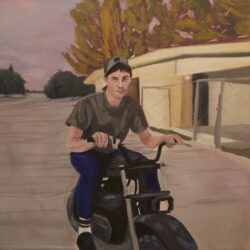 Ramsey Thornton’s I Called It! is an album preoccupied with the moments where something should happen but doesn’t. Across its eleven tracks, characters hesitate, replay, misread, withdraw, or simply sit still while the world moves around them. It is an introspective record, built on swirling, finger-picked guitars, light percussion and soft synth textures, that never quite resolves its tensions. Instead, it lingers in them. The result is a collection of songs that feel less like statements and more like suspended thoughts.
The opening track, Riverside, establishes the emotional terrain. It recounts a fleeting but life-altering moment, seemingly an accident or sudden loss, that the narrator cannot stop revisiting. The repeated line, “Now all I wanna do is just pull over”, captures both a literal and psychological paralysis. There is a quiet devastation in the admission that “Slam on the brakes / That’s all it would’ve taken”. The music, gentle and unobtrusive, guitar at its most hypnotic, contrasts with the weight of the subject matter, reinforcing the sense that trauma often arrives without spectacle.
Dripping Coffee follows with a more abstract unease. Built on repetition, both musically and lyrically, the song evokes a feeling of surveillance or control, as if the narrator is caught in a system they do not fully understand. Lines like “I’m the puck in a game of hockey” suggest a lack of agency, while “Automatic ten per cent” suggests a rejection of expectation. The domestic imagery of the title becomes oppressive: the drip is both mundane and inescapable. The music mirrors this. On the surface, this is a lovely acoustic track, but there is a clever soundscape in the middle of the song that suggests something darker.
There is a fuller sound on Chase After You, a song that captures a conversation at the point where it risks becoming futile. There is a striking clarity in the central metaphor, “I wanna build a bridge between you and I / You wanna build a dam and stack it high”. The narrator’s desire for connection is continually undercut by resistance, yet the song resists melodrama. Instead, it focuses on the quieter question, “If we’ve gotten to the place where we don’t try / What are we doing this for?” The repeated insistence “I don’t wanna go” feels less like a powerful plea.
On Home Base, Thornton explores the loss of emotional stability that follows such fractures. The “home base” of the title is not a physical place but a shared understanding, something eroded through the absence of “talking face to face”. The song drifts, and again the music reflects this, into broader questions of happiness, faith and self-sufficiency, never settling on firm conclusions. Backyard turns to memory and the quiet disorientation of change. The cutting down of a tree becomes a symbol of altered perspective, a small but irreversible shift. “Now the porch view looks different to me” is a simple line, but it carries the weight of lost familiarity. Musically, this is another swim in a beautiful sea, but this time with some surprising sing-along moments.
Window reflects on creative and emotional stagnation. “It begins and ends, and begins again” encapsulates the album’s broader sense of repetition without resolution. The song is one of the more accepting moments on the record, acknowledging that “hitting a wall” is not catastrophic but part of a natural rhythm. Even so, the underlying restlessness remains. Rocking, a song with a great lead guitar sitting above the drifting guitar parts, introduces a more overt tension between personal identity and cultural background. A lighter, though no less pointed, moment comes with Tony’s Song, which sketches a character dismissed as irrational but treated here with a degree of empathy. The surreal details: aliens, asteroids, non-functioning internet blur the line between delusion and alternative perspective. Perhaps the line “I called it” contains a wider hope that, whatever our weirdness, we might be a “pretty great guy”.
Oil Capital looks outward, offering a more explicit social critique. Referencing environmental anxiety and consumer identity, it questions the values embedded in modern life. On Hotshot, the focus returns inward, examining inadequacy and comparison. The song captures the frustration of recognising your own passivity without quite being able to change it.
The closing track, Fourth of July, brings many of the album’s strands together. Set against a backdrop of celebration, it depicts a profound sense of disconnection. “Hey everyone, I’m fine / But this is harder than usual” encapsulates the tension between outward appearance and internal state. The repeated attempts to step away, to “go outside” or “find anything else to do”, suggest a search for grounding that remains elusive. Even the symbolic weight of the holiday cannot provide resolution, “Not even the Fourth of July”.
I Called It! might not grasp you viscerally on initial listening, but it will seep into you and occupy that space between consciousness and unconsciousness, the space between sleep and wakefulness, the space where the emotion of the album can be absorbed and processed. It is a journey worth taking.

