
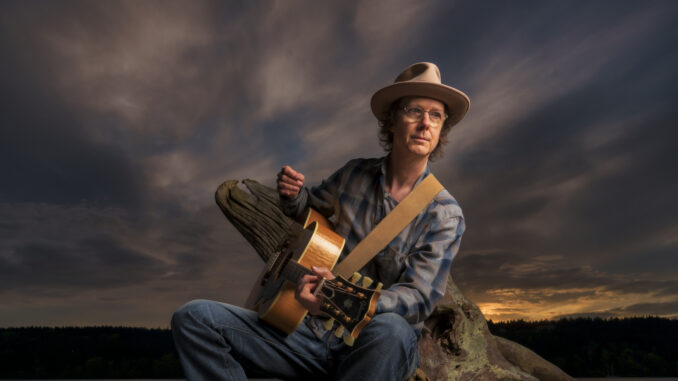
Pete Droge has been making music now for over thirty years, since making his debut album, 1994’s “Necktie Second”. His early music mixed the grungier rock sound that Seattle was famous for, but his music has progressed, and his sound has mellowed, and he’s about to release his new album, “Fade Away Blue”. It’s a magnificent record with a fascinating and quite traumatic, and dramatic backstory.
Sixteen years ago, Droge went looking for his birth mother and instead found her obituary. This devastating event unexpectedly started an amazing journey of personal growth and healing for him, which would find him reuniting with long lost relatives, battling a mysterious illness and finding himself in the process.
Droge has had an amazing career to date and worked with some stellar musicians over the years. So Americana UK spent some time chatting candidly with Droge from his Oregon studio, and in the process talked about working with Grammy-winning producer Paul Bryan (Aimee Mann); making his early albums with legendary producer Brendan O’Brien; meeting and touring with the likes of Neil Young, BB King and Tom Petty; becoming a label mate and meeting Johnny Cash; working with Dave Stewart; making a film with Oscar winning director Cameron Crowe; being part of an americana supergroup with Shawn Mullins and Matthew Sweet; having one of his songs covered by Warren Zevon; and the emotional impact of making his new album having experienced so much drama in recent years.
Americana UK: So, Pete, we’ve got a new album, “Fade Away Blue”, out later this month. Your first new album, I think, for nearly 20 years. This must be quite a momentous time for you.
Pete Droge: Well, let’s see, it is a momentous time for sure. I’ve had my 10-year anniversary with chronic fatigue in September, so that slowed things down quite a bit. In that time, I did have a side project called The Droge & Summers Blend with my partner and fellow musician, Elaine Summers. We released an EP in 2009, another EP in 2014, and then “Volume 3” was kind of a collection of alternate takes and demos. But as far as like an actual ‘Pete Droge record’, it’s been almost 20 years. So, yeah, it’s been a while since I’ve had my name on the front of a record, and it feels really good.
AUK: Good. And this album is a really personal album for you. Can you explain the slightly unique background, because there’s lots of different, quite emotional elements that are coming into the making of this?
PD: Yeah. So, the cornerstone songs of the album deals with my experiences as an adoptee. And I’ve been referring to the latest single, that came out on July 24, ‘Song For Barbara Ann’, as sort of the keystone song of the album, and that addresses the ‘ambiguous grief’ that I experienced when I unearthed the adoption stuff and started to look into what all that meant for me in my development as a child.
And eventually it came to the point where I decided I wanted to search for my birth mother, and when I did, I discovered that she had passed away just months before, and that was really heartbreaking, a devastating experience. But it came with an amazing silver lining in that I did get to connect with my birth family in Appalachian, Ohio, and have been welcomed into that family with open arms. Through that experience, I wrote two songs, ‘Song For Barbara Ann’ and ‘Lonely Mama’, which both address missing meeting her.
There’s another song, ‘Gypsy Rose’, that’s sort of a biographical song about my birth mother, Barb, that I put together from stories that I’d gathered from her friends and family. And at one point, I thought, you know, maybe it’s a whole album all about adoption. But I just felt like I didn’t have a concept record in me. So the rest of the songs were chosen based on the fact that they could live alongside the adoption theme song. Then the rest of the album has sort of an autobiographical thread that drops into different periods of my life. So, we experienced sort of my wild, drug-fuelled teenage days in ‘Sundown At Francis Nash’; we enter the gruelling touring of the nineties on ‘Fading Fast’; and we address some of my issues in the past with substance abuse on the song ‘Taking Leave Of My Senses’.
Then, another thing that’s sort of interesting about this record was the way that it was made, based on the fact that I was dealing with chronic fatigue at the time. So normally, I would like to go into a studio with a band and get five warm bodies on the floor and click the drumsticks four times, and start playing. At the time I was recording the album, my energy was just so low that that wouldn’t have been possible. So, I was able to record all my tracks, the guitars and the vocals, and my partner Elaine Summers’ harmonies, here in my studio at my leisure.
And I then found a great co-producer in Paul Bryan, who’s best known for his work with Aimee Mann. I was able to send my files down to Los Angeles to his studio and then have this amazing cast of musicians contribute from there. I could sit in my studio and I could listen in real time with high-quality audio. That was another thing that’s a little bit different for me about this album: being able to sort of work on it over time, doing a few songs at a time. And you know, I couldn’t be happier with the results. The collaboration with Paul was just a dream. And then these musicians who play on it are incredible. (These include guitarist Rusty Anderson, drummer Jay Bellerose, pianist Lee Pardini, pedal steel player Greg Liesz and fiddler Gabe Witcher.)
AUK: But these songs come from a particularly personal perspective. How did you find that writing process compared to what you had done historically?
PD: I think getting to the finish line on a song most of the time is challenging. Every now and then, they fall out of the sky. Nobody knows how that happens, but most of the time, the inspiration, and what I call the seed, the original seed for the song, often comes in a flash. And then the work begins. Six out of the ten songs on the album were written with my wife and collaborative partner of over 30 years, Elaine Summers. So, I can’t overstate the importance of having her as a sounding board and as a collaborator, especially on the lyrics. Definitely, you know, in the past, I’ve been content to have lyrics that are more cryptic and vague. With this album, it was a choice, a deliberate choice, to kind of go – let’s make the songs clearer, so you know you can get in. You can listen to it. You can understand what it is, rather than like ‘I Am The Walrus’, or some kind of poetic, surrealistic journey, or whatever.
In a sense, I think it was easier to do that because, as an example, a song like ‘You Called Me Kid’, if ever there was a ‘three songs and the truth song’, that’s it. Literally, it’s three songs, three chords, the same order over and over again that never changes. You know a simple ‘cowboy chord’. Actually, it’s an F sharp, because I tuned the guitar down a half step. I originally had the title first. I knew I loved that title after my dad had passed away. I came up with that title because it’s true. He used to call me ‘Kid’. So the title kicked around for a while. And you know, once I struck upon the chorus lyrics: And I can’t thank you enough for what you did. You called me, kid. Never in this life could anybody find a more generous or precious gift to give. It’s just that’s true, that’s how it is.
So, I think I could answer that question both ways. I could say yes, it’s easier to write when you’re being more truthful and honest. But at the same time, sometimes it’s easier just to kind of come up with a bunch of words that rhyme, that sound cool. And you’re done, you know, so really trying to stay true to the story and to hone in on the emotion behind the song.
Elaine and I worked really tirelessly on the lyrics. I don’t know that I’ll ever go back to the cryptic path now that I’ve sort of discovered this more sort of honest and truthful way of writing. I think part of what inspired that is, as I would look back on my catalogue, as we started to play live shows again, those songs were more connected to a truthful, honest, more direct story. Those were the songs that have resonated and stayed potent for me as a performer. And so as I’ve been moving forward as a writer, I’m like, okay, let’s focus in on that.
AUK: I don’t want to get too personal, but I don’t think anybody who hasn’t experienced what it’s like to try and find a birth mother fully realises the complex and emotional difficulties and joys and all the mixture of emotions you go through. So, can you just explain how you reacted to what is definitely a surprising rollercoaster of emotions in trying to find your birth parents and all that goes with it?
PD: Yeah, it was a really, really intense period of my life. When the adoption issue first arose, I had never in my life given much thought to how being adopted would have affected my development. As a child, I always felt like I had great parents. I was grateful for that, you know. I had a nice upbringing, although I did always wrestle with issues of substance abuse, and there was anxiety and over the years, some depression. There was always this perplexing question as to, ‘what’s going on here, like, why, why am I this way?’ My parents were very even-keeled, and didn’t have those issues.
There was always a little bit of cognitive dissonance around some of those issues that I experienced. Around the time I turned forty, I did a lot of soul searching and looking within. And it’s a really long story. But through a flurry of coincidences and a computer glitch, I basically had this epiphany – oh, my adoption! There was a file that I had saved, that the date was set to 1969 instead of the year that it was, and in that moment, I flashed on myself as an infant, and it was like a light went off. It’s like adoption, yeah, that’s kind of a major thing, like I should look into that.
And when I did look into it, I learned a little bit about adoption trauma. There’s a woman named Nancy Verrier, who wrote a book called “The Primal Wound”. She believes that the separation of a baby from the birth mother is trauma, and that has an impact on your early childhood development.
I also learned about ambiguous grief, which is this perplexing grief around what never was – sort of pining for what could have been. And so I started to unearth and unpack a lot of these issues and decided to enroll in therapy. After a few weeks, I kind of felt, ‘okay, I’m ready to connect with my birth mother’. And I was. I was ready to make that connection and applied for the birth record in the State of Oregon, where thankfully, they have open adoption records. They told me it would be a few months before it would arrive, but it arrived three weeks later. Immediately, I searched the Internet for her name, and that’s when I found her obituary, and it was devastating. If I had anticipated how much that would have been emotionally just seismic, I couldn’t have predicted how intense the suffering was around that. It was really intense. And for a period of time, I kind of had to pull the plug on work. I had to back off from everything and just focus on healing and unpacking what all that meant.
The silver lining was connecting with my birth family. That was really healing. You know, I was on the phone that very night with my grandmother, who’s now 98. We talk all the time and also with my uncle, who is just eight years older than me, who feels more like a long-lost brother than a long-lost uncle. He played in punk rock bands in the eighties in New York, and we have a lot in common musically. We get along really well, and connecting with them, and sort of seeing myself mirrored in them and understanding where I came from was powerful and really healing.
Speaking of the trauma piece, learning about trauma through the lens of my adoption experience, I also was able to work around some of the other childhood traumas that I experienced. I found a great therapist who practiced something called EMDR, which I highly recommend to anyone who’s had any trauma in their past to look into that therapy. It was amazingly transformational for me, and you know it’s been a really long journey.
I feel like I’m at peace with it. At this point, there was a long period of time where that idea of quote unquote ‘separation from my birth mother’ was painful for me. But I’ve come to a place where I feel more whole about it all. There was an interesting talk by Thich Nhat Hanh, the Buddhist teacher. He talked about this analogy of just a droplet of water that’s part of a waterfall, but then separates from the waterfall, but it’s still part of the waterfall. For whatever reason, that epiphany struck me in my relationship with my birth mother, like I’m still part of her. There’s a continuation there. And I’ve been given the opportunity to live our life collectively.
AUK: Amazing. The chance for you to be able to work with your musical and life partner, Elaine Summer, must have been integral to cope with all these emotional challenges you went through in the making of this album.
PD: Absolutely. I just can’t overstate the importance, even in that first weekend, when all the adoption stuff came up. We just sat in bed all weekend, drinking coffee and playing what we called ‘Psyche Detectives’. Unravelling all this stuff and kind of going, ‘Oh, and then there’s this’, and ‘okay, that kind of makes sense’, you know, through that lens, things started to make more sense.
She’s just a great soulmate and a very wise person as well, with a lot of deep insights. It’s so important to have somebody to share all this with and to be completely open with, and then to be able to have that flow into the work, to be able to sit down. It was a couple years before I was ready to write about the experience with my birth mother. And again, speaking of the cryptic thing, we actually did write a song called ‘Unsinkable’ from the “Droge & Summers Blend Volume 2 Ep” that is vaguely about that relationship with my birth mother.
But to take it head-on, it was a couple years after all of that when, okay, let’s write that song, and it was very collaborative. You know, I remember the point that we came up with the line; I just wasn’t part of your plan. It’s like, you know, I was crying, heavy, primal tears. In that moment, it was a really heavy experience, and to have Elaine there to support me through. That was just incredible.
AUK: It’ll be really interesting for you to imagine what it might be like for you to listen to these songs in fifteen or twenty years’ time, when this emotional impact has eased slightly.
PD: Well, it’s already interesting, and that’s already happened to where I have a much different tone, emotionally, in relation to these songs. For ‘Song For Barbara’, we recorded the basic tracks in 2013. So that was originally intended to be part of the Droge & Summers Blend project. And then ultimately I decided to hold off and save it for a solo record because it was such a deeply personal song, and we wanted to build a record around that song.
So already, I was emotional as the video came together. But I’ve already just found this peace with it all, to where there isn’t this gut-wrenching sadness and suffering around it. And I’m content in the ability to share the music in this way and to share the story. When I shared the video with my uncle, he had a very emotional response to it, and he was really curious. He was like, ‘You know, how is it for you?’ And I was able to tell him. You know I’m okay with it. But I’m not. I’m not just a blubbering, crying mess. As I watch the video, I feel, ‘yeah, I just need to keep repeating myself.’ I feel at peace with it. It doesn’t have that emotional, heavy-duty, painful weight that it that it had years ago.
AUK: You’ve made three very different videos for songs from the new album. These must be integral in telling the stories behind these songs.
PD: I’m really pleased with how the videos turned out, and credit where credit is due to John Jeffcoat, the director. There was a team at a company in Seattle, called the New Blank, that did the animation and compositing work for ‘Song For Barbara’. It was really his vision, like with the ‘You Call Me Kid’ video. He had the idea to do crowd-sourcing to have fans submit photos of themselves with parental figures. So that was completely his brainchild, and his execution was so skilfull on that. Just to take a bunch of old photos and sort of bring them to life. His craft was just incredible.
Speaking of the emotional impact of the songs, backing up a little bit to your previous question. With the ‘You Call Me Kid’ video, when I got the first batch of photos submitted, and I was just clicking through them on my computer, even without the music playing, I started crying. I mean, it was just so beautiful to see these pictures of folks with their parental figures that were significant to them.
Another thing I would say changed about ‘You Call Me Kid’. The timbre of the emotional impact of that song is, my mother died three days prior to the song being released as a single. So in the couple weeks leading up to that, she was in hospice. It was a very smooth, peaceful, quick transition. I was with her in the hospice and was able to sit by her side and play almost a lullaby, finger-picked, gentle version of the song at her bedside. So in a sense, that song carried a much more intense emotional resonance. It’s incredible.
AUK: You mentioned earlier that you have a highly talented producer in the form of Paul Bryan. Can you let us know how you came about working with him?
PD: Yeah, I first met Paul when I did a short little mini tour with Aimee Mann, who he’s played bass with forever, and has produced her records since, I think, 2006. I actually rode on their bus for a few days and hit it off with him. Just thought he was a great guy. I always enjoyed the production on Aimee’s records and think her records sound incredible.
So, I took note of his production skills there, and then one day I was listening to a new Susanna Hoffs record (“Bright Lights,” 2021). And I just thought, man, this record, the production and the mixes are fantastic. I went and I looked at the credits and sure enough, it was Paul. At that point, I wasn’t really in the market for a producer, but I just sent him a fan email. ‘Hey, Paul just heard this record, and I thought it sounded great. Saw it was you, kudos’.
So, we kind of reconnected then, and originally I wasn’t sure that I was going to enlist another producer. I thought maybe I would do the record, have Elaine and I produce it together without an outside producer. At first, I reached out to him about doing a string arrangement for ‘Song For Barbara Ann’. Again, evidence of his string-arranging chops on the Aimee Mann records. So, we talked about that first, and once I learned the price tag of doing it right, I was okay, ‘Well, that might not be in the cards after all’.
A while after that, I was speaking with my friend Jennifer Condos, a great bass player, who’s married to the drummer Jay Bellerose. He plays on the record, and I was talking about how I would go about making the record, and she really encouraged me to consider Paul.
We started that journey with just a few songs, and then we did another few, and then we did the balance of the record. We did it in stages. So, with ‘Lonely Mama’, that was recorded on a cassette 4-track that was originally just a sketch, not even a demo. It was like I had just finished the song, and I sat down in front of my 4-track, recorded the song and then doubled it. I was so casual about it that there’s even a drum machine playing over the speakers in the background that’s bleeding on the vocal mic, like I wasn’t thinking about it being a record at all. But the track had a lot of vibe and mojo. And so I sent it to him, and was like, ‘What do you?’ And there’s noise, you know, because it’s a cassette, 4-track. And he dug it. He was like, Let’s do it. Let’s use this as the record, and his instincts were to really not complicate it with too many layers of instrumentation, to try to keep the arrangements as simple as possible. And that flies against my general instincts. I’m happy to throw the kitchen sink at it, and just overdub for days and layers and layers of little ear candy and little treats for the kids on pot wearing headphones, or whatever.
That was a nice shift in another direction, especially after the Droge & Summers Blend project, where there’s lots of layers of ambient things that are just barely in the distance. So, to go for a simple approach without a lot of added layers, that was his input. And again, speaking to his arranging skills, he was really good at honing in on what to add. Another example would be on a song called ‘Fading Fast’, which was one of the first ones that we did together. We had my acoustic guitars, the vocals, the drums and percussion, and the bass, and then he had the idea to use a little bit of a ratty Wurlitzer piano, just kind of a thin, ratty whirly sound. We got this great keyboard player, Lee Pardini, who used to be in Dawes and is now out touring with Chris Stapleton. Incredible musician! He came in and laid that down, and it’s like a little percussion in the bridge and the record’s done. So, just like that instinct to know where the space is sonically, to add one element to make it complete, that’s a real gift of someone who could honestly put ‘arranger’ on their business card. You know, there’s a lot of producers and mixers that are not technically arrangers, and he studied music in school.
AUK: The music you’ve been making recently has a lovely cinematic feel to it – a somewhat far cry from some of your earlier, rockier material. Is this down to your recent health issues, or are there other reasons for this change in pace?
PD: I don’t think it is linked to my health. I think it’s just kind of my natural evolution as a musician. I definitely I enjoyed cranking it up, and I think a lot of that was informed by the band at the time. I was playing on the road a lot with The Sinners (Droge’s original band), and when you have a guitar player like Peter Stroud, who’s since gone on to be Sheryl Crow’s guitarist and band leader for the past twenty odd years, and a great bass player like Dave Hull, who’s filled in for Aerosmith and has played in the Joe Perry Project – he used to play with Buddy Miles – and then Rob Brill, amazing drummer. With an arsenal like that, if you’re out opening for Neil Young and Crazy Horse in hockey arenas across Canada, you tend to crank it up. That was a part of my musical upbringing, for sure, just as much as I was into Dylan and Simon and Garfunkel and Gram Parsons and all the sort of what we now call americana singer-songwriter music. I was also hugely into AC/DC and Black Sabbath, The Stooges – I liked loud, distorted music, too.
It was fun to do that, and I’m glad I had the chance to make records like that, blessed to be able to make some rock records with Brendan O’Brien, who’s as good as it gets on that front. But when I started making the shift to producing myself with the ‘Sky Watching’ record, which came out in 2003, I just couldn’t do that if I wanted to. It’s more conducive to kind of drying up the room and getting more of a seventies kind of tight sound than the bashy kind of nineties, alternative, splashy live sound. And so I sort of moseyed that way, and I would say ultimately my real internal clock and kind of my true sensibilities are the more laid-back mellow stuff.
AUK: What’s been the most surprising thing that you found from making this new album?
PD: I’ve been pleasantly surprised with how it’s landing and resonating with people. When ‘You Called Me Kid’ came out, within twenty-four hours, honestly, I said to myself, whatever happens with this record moving forward, as far as the metrics and sales and all the external measures of success, it’s a success. Already, the emails and comments have been so touching. And it’s continuing with ‘Song For Barbara Ann’ as well. It’s really moving. And it’s helping me to stay rooted in what really matters and be reminded that music is fucking amazing.
I heard an interview on the Bob Lefsetz podcast recently with Don Was, and I’ll paraphrase. He was like – we get to do this thing. We make music, and it makes people feel things. And that’s incredible. So you know, I mean, if I had a nickel for every time somebody’s emailed or commented that these songs, both of them, ‘You Called Me Kid’ and ‘Song For Barbara Ann’, have moved people to tears. and they’ll say ‘good tears’.

AUK: Just going back to square one, I can remember in 1994 being really impressed with your debut single ‘If You Don’t Love Me I’ll Kill Myself’. It’s a genuinely catchy and memorable song. What are your memories of that song?
PD: It’s a lot of work to write a song, and every now and then they fall out of the sky. ‘If You Don’t Love Me…’ fell out of the sky. Well, I should say it fell out of the “American Comprehensive Rhyming Dictionary” actually. And what I’ve said over the years is: It’s a three and a half minute song that took me three minutes to write. It’s very simple. I was honoured that Warren Zevon used to cover it in his live show. One night, I got a call from the bass player, and his band invited me to come down to a gig in Seattle and sit in with them on it.
The thing that Warren said to me that he loved about the song was: ‘I like songs that have simple chords put together in unexpected orders’. And so that’s the thing. It kind of goes one way, and then it comes back the other way, and then it goes back the other way, and then it comes back the different way. And so it’s just got that little twist. I don’t know where the lyrics came from other than the rhymes and the verses.
The record is a ‘one take Suzy’ as my producer, Brendan O’Brien, said. Most of what you hear on the record, we cut just in two hours. So we cut the basic track, and then he runs upstairs and grabs that crappy Silvertone guitar off the wall. I went and got it, tuned it up, and then I played the acoustic parts, and he’s like double that part, and then says ‘go grab that Les Paul, Jr’. We then cranked it up, and he says, ‘Okay, go and do your vocal’. So I did a vocal really quick. And then he did a rough mix. That actually what’s on the album. So later we added the cowbell and the little faint background vocals in the outro, and then Brendan mixed it proper and ultimately determined that the rough mix was better than the proper mix. So, we ended up using studio trickery to fly the cowbell and the background vocals onto the rough mix.
It’s just one of those, I mean, if it’s immodest to say so, but it’s just kind of a lightning in a bottle track. It’s just got that thing, and I actually experienced that even before we ever recorded it. The first time we ever played it live, we were opening for BB King in Eugene, Oregon, at this big outdoor amphitheatre. Even with BB King’s blues audience, you know, when you play a song and it kind of feels like a hit. You get it – the molecules in the air change. You can feel it, and that would always happen with that song.
AUK: It’s timely we talk about this, as the album this track is taken from, the mighty ‘Necktie Second’, is getting its first-ever vinyl release soon. For your debut album, you managed to have Brendan O’Brien producing it. That must have been amazing.
PD: So Brendan was producing Pearl Jam’s second album, “Vs”, and I had made my demo a few months prior with Mike McCready from Pearl Jam. Mike paid for and played on my demo, and then Pearl Jam’s manager, Kelly Curtis, along with his partner, Krisha Augerot, took me on for management around that time. We were shopping the tape around, and in the process, Mike gave the tape to Brendan, who had just acquired signing power at American Recording, and I was the first person that he signed.
It was amazing to have an A & R person who’s also your producer, because, how many stories have you heard about A & R? People meddling in the making of the record and saying, ‘I don’t hear a single’ and all of these kind of cliché stories and the extra blessing it is to be on Rick Rubin’s label. You couldn’t find a more artist-friendly label, so I was really blessed in that in that sense, that I was protected, and I was allowed to just make the record. Brendan and I made the record we wanted to make, and there was no interference from anyone. There was no meddling of any kind.
AUK: It shows.
PD: Brendan, I mean, I could rant about him all day. I’ve been listening to that record recently, getting ready for the reissue, checking the test pressing and stuff. I mean, great producer, mixer, but his contributions as a player are just amazing. We kind of split the duties between additional guitars and keyboards, and I don’t use the word lightly, but he’s a genius. He’s just a really outstanding player and a super-sweet, funny, amazing guy. We ended up making four records with him in total. So we did the three solo records in the nineties (“Necktie Second,” 1994; “Find A Door,” 1996; and “Spacey and Shakin’,” 1998) and then we did “The Thorns” (the americana supergroup where Droge joined forces with Shane Mullins and Matthew Sweet). He co-produced that album as well.
AUK: So, as a young newcomer, on an amazing label like American, you met early in your career some superb musicians. You’ve mentioned Neil Young and BB King, but you were also able to meet one of your heroes as well – Johnny Cash.
PD: Meeting Johnny Cash was incredible because I had just signed with American at the time, so we were label mates. I was able to say, ‘Hey, Johnny, we’re label mates, you know.’ He shook my hand. He looked me in the eye and said. ‘Hello! I’m Johnny Cash, you know,’ and I was like, ‘of course you are!’
Meeting Neil was amazing. That first year the record came out, I was invited to perform at the Bridge School Benefit (an annual charity concert usually held in Mountain View, California, every October from 1986 until 2017, but not 1987). I got to go to a party at Neil’s house, and he was sharing pearls of wisdom with me. He was saying, ‘You know, there’s nothing more exciting than where you are right now, the beginning. It’s like you never know what’s going to happen’. I mean, this is the most exciting time ever! That was also the first time I met Tom Petty, because they were on the bill as well.
AUK: Tom Petty was a really important influence on you, wasn’t he?
PD: Oh, yeah, big time, for sure. So Mike McCready from Pearl Jam, they were also on the bill at the Bridge School, and he knew and was friendly with Tom. And so he says, ‘Hey, you want to meet Tom?’ I’m like, ‘yeah’. So I got to meet Tom and then he came out to see us play at the Viper Room in LA (a nightclub and live music venue located on the Sunset Strip in West Hollywood, California, which opened in 1993 and was originally co-owned by Johnny Depp).
That was essentially my audition for the tour, I think, because shortly after that, we got offered the opening spot on Tom’s tour. Tom and I stayed friendly after the tour, and he would invite me to come down to the studio and hang out and be a fly on the wall. There was a great experience where I got to meet Carl Perkins and watch him and Tom Petty do a duet vocal with Bob Johnston producing the song (legendary producer who in the sixties worked with Bob Dylan, Simon & Garfunkel, Johnny Cash and Leonard Cohen. The album was “Go Cat Go!”). So, getting that validation from my heroes is something that I value really highly. That really means a lot to me.
AUK: Another highlight for me is the gorgeous track ‘Beautiful Girls’ from the film soundtrack of the same name that you worked on with Dave Stewart. How did that come about?
PD: That was the very end of the Tom Petty tour. They sent me a VHS tape of the rough cut of the movie and asked if I would co-write the song. Dave Stewart had the beginnings of the song and had a demo of it. And they asked if I would finish the song and consider recording it for the soundtrack. I was told that through Dave’s connections, they’d reach out to Bob Dylan, but Dylan passed. They reached out to Tom Petty, and he also passed.
There was maybe another name or two that they mentioned, but I suspect that there were a lot more names before they arrived at me. In any event, eventually, thankfully, they called me, and I went home. That was literally the end of the whole year-and-a-half-long tour with “Necktie Second”, and I came home to a little rented corporate apartment and watched the movie, finished writing the song, and then went in a local studio and recorded our demo of it with Matt Cameron, who was Soundgarden and Pearl Jam’s drummer. We submitted that to the powers that be, and they all liked it enough that they gave me the gig to record the title track, and we went to a great studio called Bear Creek, up north of Seattle, and Dave Stewart flew in to produce it. We knocked it out, and it was a dream working with Dave. He was just so eccentric in like the most beautiful way, super creative. This guy has creativity just flying from his pores. I mean, he was incredible.
We did fun stuff on that record, old school tape flanging, which is a lost art. Another highlight of recording that I remember when we finished and were working on the file. Well, actually, when we finished the tracking, we were just putting down the rough mix. He was saying, ‘You know what, I’m getting the same buzz and the same excitement, and the feeling that I did when we finished ‘Don’t Come Around Here No More’ with Tom.’ That was a really cool experience, and it was great timing. We had just finished the cycle for “Necktie Second,” and then “Beautiful Girls” came out. We had some pretty nice visibility on MTV.
AUK: Films have been a really important part of your musical life, haven’t they? You got involved with the Cameron Crowe movie “Almost Famous” in 2000. How on earth did that come about? Because that wasn’t exactly a small project, was it?
PD: It was amazing. I originally read for the part of the bass player in Stillwater, the band in the film. They flew me to LA. They sent me my lines. I had acted as a kid and was pretty serious about it, but you know, music took over. But I felt reasonably confident that I would be able to do it. I had just finished an acoustic tour with John Doe, and John had acted in films, so I called him up and asked for his advice. He told me to buy a book by Sanford Meisner called “On Acting”. I read the book and prepared and went to LA and completely choked the audition, just tanked it miserably. There was no doubt in my mind that I would not get the part. And sure enough, Cameron called shortly after that and told me that I didn’t get the part. He had mentioned that it was because of quote ‘visual chemistry’, and you may remember the plot line in the movie where Billy Crudup is too good-looking. ‘Your looks have become a problem.’ And so I like to think the ‘visual chemistry’ was that I was too good-looking!
So that was that. It might have been two or three weeks later, he called back and asked if I could write a song, sort of in the spirit of Gram Parsons and Emmylou Harris. And it’s interesting to me now. I didn’t really roll up my sleeves and treat it like a homework assignment and think, ‘Okay, what is this going to be?’ It’s just like the next song that happened to pop out was ‘Smalltime Blues’, and I sent it to him. I recorded it on a cheap half-inch 8-track analogue machine, made a little demo, sent it to Cameron. He loved it, and we were cast in the movie to perform that song, Elaine and I, and originally we were going to lip sync to the demo. On the day that we showed up for the shoot, he’s like, ‘Hey, what do you think about performing it live on set?’ And we’re like, ‘okay’.
And so we did. It was just an incredible experience all the way around. I mean, I could go on and on about the day that we shot it. We got to play the premiere party with Peter Frampton and Ann and Nancy Wilson (Heart), and just to be involved with a movie that is a certified, bona fide classic film that’s going to be around forever is just amazing. I’m beyond honoured that we could be a part of that. It’s truly one of the great rock and roll movies.
AUK: So, back in 2002, you had the opportunity of being in a supergroup – The Thorns – with Matthew Sweet and Sean Mullins. It’s a magnificent album. How did it come about?
PD: It ended up being the better part of two years of my life, but when it was pitched to us, it was kind of like, oh, this is going to be sort of a small side project. It’s on Aware Records, which was an imprint of Columbia. It initially appeared as quite a modest project, no videos or any of that stuff. But, sure enough, the demo started to make the rounds up the food chain at Columbia. Next thing we knew, the President of Columbia (Records) was beating on the desk, going. ‘This is going to be the biggest record of the year.’ Suddenly, we were at Southern Tracks studio (based in Atlanta but now closed) with Brendan O’Brien again in the producer’s chair, and Jim Keltner on drums, which was a dream for me. I mean, it’s one thing to play with Jim Keltner. That’s a dream. But then to hang out in the lounge and listen to stories with him was incredible. Roy Bittan, from the E Street band, came in to play piano. We enlisted Paul Buckmaster, the legendary string arranger, to do the strings for the song ‘No Blue Sky’, and we’re on a private jet from Atlanta to Nashville to record with a 22-piece string section! It was just like suddenly this modest little record really blossomed into a lot more.
AUK: How was it for you, working as a trio with two other really good and obviously celebrated musicians?
PD: It was a real joy working with them. You’re sitting in a room with an acoustic guitar, and then either Matthew Sweet or Shawn Mullins opens his mouth and sings. I’m used to hearing that on the radio or on records, but there it is coming out of their faces. You know, there’s no studio trickery there. They just have amazing voices. They’re both great guitar players. You’re not going to see them on The Top 100 Guitar Players Of All Time list because they’re not flashy, and they’re not playing leads. But as far as rhythm guitar goes, they’re both amazing players. It was a great time.
Then the writing process happened really smoothly. We would usually start with an idea that one of us would bring in, and then that person would play the acoustic guitar, while the other two would work on the harmonies. And we actually wrote the harmonies while we were writing the songs. So all the songs are completely tailored for harmony singing, and one of Matthew’s bits of input on the project was suggesting we go with wall-to-wall harmonies. Let’s not do it like Fleetwood Mac or the Eagles, where one person sings the verse, and then there comes a chorus, harmony, or whatever. Let’s make it a harmony band, and that was a great call on his part.
I’ll also say, from the minute we sang together, we all felt it, that we had a really good blend. You know you’ve got Shawn’s rich, textured baritone, nice, low, rich voice, with a lot of range and then you have Matthew. I guess you’d call his a kind of a high, reedy sound, and then I sort of slot it in right in the middle, the more challenging position to be in.
It all kind of flowed and came together quickly, and then we had great opportunities on the touring front. We did Europe and the UK with the Dixie Chicks, with our full band, and we got to do two nights at the Royal Albert Hall. Then we went down as a trio with them to Australia, which was amazing. And we had a big, long tour around the US, co-headlining with The Jayhawks. This was at the time that they were supporting the “Rainy Day Music” album, which was a high point in their career. So, yeah, it was quite the experience.
AUK: So the new album “Fade Away Blue” is coming out soon. Any thoughts on being able to play some dates in the UK and Europe?
PD: I want to really badly. And I have a new booking agent. They’re great, and we have the connections over there. So it is something that we’ve talked about, and that I really want to do. I’m just so excited to play again. I didn’t play for many years, but recently I’ve been easing back into playing live, and I am so fulfilled by it and motivated to do as much of it as I can. So, we really want to get over there.
AUK: So the new album is imminent, and the vinyl release for “Necktie Second” is due to be released mid-October, I believe.
PD: I have a Substack newsletter for anyone who’d like to get the late-breaking news. That’s the best place to go for that kind of stuff.
AUK: Thanks so much for your time, Pete and best of luck with the new album.
PD: A pleasure – thanks a lot.

