
Music for the heart and the head celebrates the challenges of being human.
 Imagine you’re in a watering hole somewhere, the English Midlands or the U.S. Midwest. The bar is in a strip mall, but perfectly fine. Perhaps it’s called the Trysting Place or a name with the word ‘lounge’. Maybe you’re alone nursing an old-fashioned, or you’re with somebody you want to get to know a little better.
In the background, there’s a group playing. You can hear the lead guitar. It has a jazz tinge, a little bossa nova, maybe a hint of blues. There’s a real steady bass underneath the lead. And a drummer who is right there, he’s present, an important part of the sound, but you haven’t paid a lot of attention. Then the guitarist starts singing. He sounds a little like Roy Orbison mixed with Jon Hendrix. You go back to your drink, or your conversation.
And then, for a moment, you stop. And listen. And you hear the lyrics. “So it shows, yes it showed, it showed me the way. And so it goes when the trouble grows. Let nature show me the way, when I need to ease the strain.” You set your drink down and turn towards the stage. As you listen, you realise that he is singing to you, about you. You realise that this is music for each of us and for all of us. You just discovered Ivan Moult.
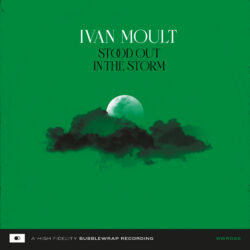
Moult’s fourth album, “Stood Out In The Storm” is both from another time and for all time. The sound is reminiscent of when Ted Joans and the Beats portrayed their world in a merger of jazz and poetry. His lyrics are poetic and intense. This is neither the generic emotions employed by pop ballads nor the dramatic clichés used by country music. This is dangerous music. It dares to deal with the big issues we all face, and as Moult notes, try to avoid.
The opener, ‘No More Lies’ , is not a love song but about trust, which is an essential element of love. “Come home to me my love. I feel it come alive, when we trust, in one another.” The title track describes the redemption you can find in the elements, which some might see as a key insight, one that can free you from the worst of yourself. “So I stood outside in the storm, and the howling wind. I think it did me good to be out in the natural order of things. To define my love and defy my blood, for what I’ve seen could kill a man or could make him mean.”
‘Losing It All To The Blues’ explores emotional inheritance. “Does a father’s mistakes turn his son into the same man?” The song also addresses the need to exorcise emotional baggage; “Yes, for our child, I’m gonna sort myself out & get my head seen to. Or it’s too predictable. I’ll end up alone. Losing it all to the blues.” ‘Did You Think That I Was Lost?’’ confronts the anger many men allow themselves because of traditional masculinity; “Now I know. I chose anger when I could’ve consoled. I chose fear when I should have been bold. I feel poor after all of the love that it stole. I was so hot in that rage when you said that I was cold. Baby now I know.’”
This isn’t easy listening. Every song is demanding. It makes you think and feel. But the album also recognises the redemptive power of love, and celebrates the difficulties and rewards of being human.
Lyrics as personal as these tempt you to think you’re getting to know the writer. That may or may not be the case. What is true is that you’re getting to know yourself.


