
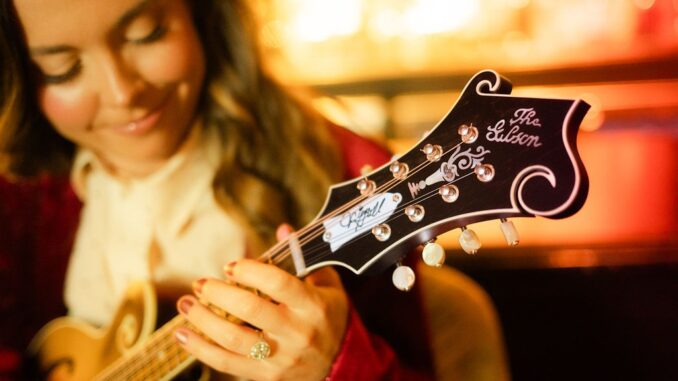
The Mandolin Finds Her
On Friday nights in Pickett County, Tennessee—the smallest county in the state, tucked up against the Kentucky border—you could find a young Sierra Hull squeezed into a crowded community centre, mandolin in hand. The room smelled of hamburgers and hot dogs from the concession stand, and local bands played while neighbours filled the folding chairs. Hull, barely tall enough to see over the microphone stand, was already a fixture on stage.
“It didn’t matter if you were eight or 80—the bluegrass community just welcomes you in,” she remembers. “Some of my best friends back then were adults at those jams. I learned so much from them.” That welcoming spirit shaped the foundation of Hull’s life in music. Today, she’s a celebrated mandolinist, singer, and songwriter, acclaimed for her technical brilliance and adventurous artistry. Yet even as her career carries her far from those Tennessee jam sessions, she carries with her the same sense of wonder that first fuelled her playing.
Hull’s story with the mandolin began almost by accident. One Christmas, her parents, Stacy and Brenda Hull, gave her a full-sized fiddle, which was far too big for her nine-year-old arms. But the mandolin, tuned just like the fiddle, was close at hand. Her father, who had just started learning himself, showed her a simple tune. “Something about those first couple of tunes on the mandolin, I just fell in love with it,” Hull says. “There was no turning back after that.”
By then, her father was regularly driving her and her brother to nearby jams in Jamestown and beyond. The venues weren’t glamorous—rundown schoolhouses and community halls—but for Hull, they were magical. Each weekend brought a crash course in the language of bluegrass, played by locals who were eager to pull her into the circle. “It was such a gift,” she reflects. “That generosity—the way people nurtured my love for the music—meant everything.”
Hull’s early devotion wasn’t limited to picking. She filled sketchbooks with drawings of herself performing alongside heroes, or with homemade “album covers” featuring imaginary song titles and label logos. At just five years old, she discovered Alison Krauss, who quickly became a north star. “Alison was one of my biggest heroes from nearly the beginning,” Hull says. “And then, of course, I was listening to people like Sam Bush, Ricky Skaggs, Chris Thile, Adam Steffey, Tony Rice. I was just soaking it all up.”
Stacy Hull, recognising that Sierra’s talent was quickly outpacing his own knowledge, sought out teachers. That search led to Carl Bergeron, a local mandolinist who, despite never offering lessons before, opened his home to the Hull family. “He never charged me a dime,” Hull says, still awed by his generosity. “Looking back, I realize how much that meant—just people going out of their way to help me learn.”
Like many young players, Hull fixated early on the mandolins her heroes played. When she first unwrapped an Epiphone starter model with “Gibson” stamped on the truss rod cover, she felt she’d touched something legendary. “I thought that was the coolest thing,” she laughs.
By 12, her world shifted again when she received an Adam Steffey Signature Gibson mandolin, an instrument her family could never have afforded without extraordinary support. It was, she says, a pivotal moment that set the course for her career. Later, in 2009, Hull acquired a Gibson Master Model, which has since been her constant companion. “I’ve played that mandolin on pretty much every live performance and recording since,” she says. “After 15 or 16 years of hauling it all over the country, it’s still an incredible instrument.”
The Gibson Signature Series
This year, Hull’s story with Gibson came full circle with the release of the Sierra Hull Signature Series mandolin. For a girl who once daydreamed about sharing stages with her idols, seeing her own name on the headstock of a Gibson instrument is almost beyond belief. “I’d been asked by other companies about collaborations, but I always knew that if I ever did one, it would have to be with Gibson,” she says. “It’s not something I expected, but definitely something I dreamed of.”
Hull worked closely with Gibson’s luthiers to make sure the instrument lived up to its legacy. Each mandolin is hand-signed by David Harvey, the same craftsman who signed her Master Model back in 2009. “Mandolins are expensive, and I don’t take that lightly,” she explains. “If my name was going to be on something, the quality had to be exceptional, something that could stand the test of time. Those original Lloyd Loar F-5 mandolins from the 1920s turned a hundred years old, and they’re still pristine. That’s the level of craftsmanship we were aiming for.”

Tradition and Innovation
Though Hull cut her teeth on traditional bluegrass, she’s never been afraid to stretch beyond it. Her music now embraces songwriting, genre-crossing collaborations, and explorations that push the mandolin into unexpected spaces. “That’s the beauty of music,” she says. “You can never learn it all. There’s always something new to be inspired by. These days, I might sit down and learn a solo from an instrument that’s not even a mandolin. It’s about finding ways for the mandolin to shine, whether it’s leading, supporting my songs, or blending into something completely different.”
For Hull, tradition is not a boundary but a foundation. The lessons from those Friday and Saturday nights in Pickett and Fentress Counties still echo in her playing, even as she takes the mandolin into new territory. From the small-town stages of Tennessee to the global bluegrass spotlight, Sierra Hull’s story is one of talent nurtured by imagination. And now, with a Gibson Signature Series of her own, she steps into a role once reserved for her heroes.
“So for this to finally be a reality feels a little surreal,” Hull concluded.
For story ideas and suggestions, Brian D’Ambrosio may be reached at dambrosiobrian@hotmail.com

