
Everybody loves a list, except perhaps the person whose job is to write it in the first place. Picking the top 10 songs in a genre that is known for the quality of its songwriting is a monumental task, particularly if you let the sense of history and sheer volume of great songs by exceptional songwriters get to you, so I’ve decided to side-step such an objective approach and rely on my own subjectivity, informed by my experience, preferences, and prejudices with only a soupçon of critical objectivity.
I’ve been a fan of what is now called americana long before it was a formal genre, and before I had any real understanding of the historical background to American roots music. I wanted the songs to reflect my own journey of discovery and exploration of roots music. Looking at the final list, I was horrified by the artists that I hadn’t included, where, for example, is a song from a Tulsa sound artist, but you can only do so much with ten songs, and there comes a point where you have to stop adjusting any list. This is why lists can be so much fun for readers and listeners; it doesn’t really matter whether you agree with the selection and order or not. Everyone will have an opinion, and it is with the sharing of these opinions that the fun really starts. So, don’t be shy, please share your thoughts, whatever they are, positive or negative, supportive or frustrated, or possibly even angry.
Number 10. T Bone Burnett ‘Driving Wheel’ from “Truth Decay” (1980)
As a producer and songwriter, T Bone Burnett has had a massive influence on americana, from championing the careers of Los Lobos and Gillian Welch, to producing Robert Plant and Alison Krauss, and his long-term relationship with Elvis Costello, together with producing seminal soundtracks like “O Brother, Where Art Thou” and “Cold Mountain”. He was part of Bob Dylan’s Rolling Thunder band, which led to him forming the Alpha Band. “Truth Decay” was his first solo record and has been described as rockabilly for the ‘80s. The songs on “Truth Decay” were simpler than those of the Alpha Band, which meant it was perfect for its time when established and new artists were more aware of musical history and its roots. ‘Driving Wheel’ is pure rockabilly and was co-written by Burnett and Billy Swan. It was Burnett’s take on an Eddie Cochran-type tune, and was inspired by what he heard on the R&B radio growing up in Fort Worth, Texas, and the lyrics reflect his experiences of New York in the late ‘70s. The song’s lyrics use a metaphor of a driving wheel to show the determination to find love and freedom; it is also a great road song that invokes the flat dusty plains of Texas. Robert Gordon and Emmylou Harris recorded their own versions of the track. While Burnett continued to release great solo albums, he never focused solely on his solo career, which meant he never built a significant fan base for his own recordings, but his production activities and soundtrack work are a completely different story.
Number 9. Dave Alvin ‘King Of California’ from “King Of California” (1996)
Through a combination of available venues and bars, the liberating ethos of the can-do do-it-yourself attitude of punk, plus the influence of the jingle-jangle sounds of The Byrds, the folk and country roots of the psychedelic sounds of San Francisco, and even the folk rock of the UK’s Fairport Convention, something was happening in Los Angeles at the end of the ‘70s. The Blasters, led by Phil and Dave Alvin, were at the centre of this reaffirmation of American music, with Phil on lead vocals and Dave’s songs and his rock and roll electric guitar. Dave left the Blasters in 1986 and, after a stint with X, started his solo career in 1987. However, the real Dave Alvin didn’t appear until 1994’s “King of California”, when he became the performer and singer who could do justice to his already great songwriting. Not only is this probably Alvin’s best album, but it is a cornerstone of americana with its mix of folk, country, blues, and a rock and roll attitude. With the help of Greg Leisz, Alvin recorded a mix of his earlier songs, new songs and a handful of covers in a more stripped folk-oriented way that allowed him to develop his vocals and performance to become a great storyteller. The title track is a great story song about an immigrant who travels across the country to the California Goldrush, and Alvin has written the perfect tune and arrangement to bring the story to life.
Number 8. Brinsley Schwarz ‘Don’t Lose Your Grip On Love’ from “Nervous On The Road” (1972)
Nick Lowe is one of the UK’s greatest songwriters, who has influenced the development of music not only in the UK but also in America and Europe, with his songs covered by a whole range of country, americana, pop and new wave acts. The first time Lowe registered in the public consciousness was as a member of Brinsley Schwarz, mainstays of London’s pub rock circuit of the early ’70s. They released what is probably their best album, “Nervous On The Road”, in 1972, and while it included two classy covers and opens with a great Ian Gomm song, it is full of sublime Nick Lowe songs that show a maturity beyond his 23 years. ‘Don’t Lose Your Grip On Love’ is a great country-rock tune, but what sets it apart are the lyrics that manage to bring a darkness to what was seen as essentially a good-time genre. It was to be another twenty years before Lowe was to reinvent himself as a middle-aged crooner and sophisticated emotional songwriter with 1994’s “The Impossible Bird”, and ‘Don’t Lose Your Grip On Love’ is an early glimpse of that sophistication. The Brinsleys were always going to be a cult band in the ‘70s; they were London-centric, playing music, country rock, that they loved, but that was only just beginning to register in the public consciousness. Punk and new wave brought Nick Lowe out of the shadows, but that doesn’t mean he didn’t write great songs with the Brinsleys.
Number 7. Gram Parsons ‘In My Hour of Darkness’ from “Grievous Angel” (1974)
There is no doubt about the significant influence that Gram Parsons has had on country and rock music over the last fifty or more years, despite leaving a very small recorded legacy when he died tragically young in 1973. That legacy only included two solo albums, with “Grevious Angel” being a posthumous release and probably the best representation of Gram Parsons’ art, and while his work with the Byrds and the Flying Burrito Brothers laid the foundation for country rock and subsequently americana, Parsons was a member of a band and not a solo star at the time. While he almost single-handedly re-established the link between country music and rock & roll, he was not always fully focused as a musician and was not above self-mythologising. The irony is that Gram Parsons was at his most focused when he was recording the tracks for what would be “Grievous Angel”, again using members of Presley’s TCB band as on “GP”, despite him still fighting his addiction to drugs and alcohol. Parson only wrote two new songs for the sessions, ‘Return of the Grievious Angel’ and ‘In My Hour of Darkness’, which became the opening and closing tracks on “Grievous Angel”. ‘In My Hour of Darkness’ pays homage to three friends of Parsons who had died recently, Brandon De Wilde, Clarence White, and Sid Keiser. The country gospel track, co-written with Emmylou Harris, who arranged the background vocals featuring Linda Ronstadt, has a verse celebrating each friend and shows a mature Parsons’ reflection on loss and the fleeting nature of life. The song gained added poignancy with Parsons’ own death, particularly the second verse that celebrated the life of Clarence White, which seemed to reflect Parsons’ own life. The fact that ‘In My Hour of Darkness’ is the last track on Parsons’ last album and is one of the last songs he wrote just adds to the sense of what if he had not died.
Number 6. Grateful Dead ‘Ripple’ from “American Beauty” (1970)
There have been many Grateful Deads, which is why they are such a great American music band, changing styles and genres at will and making it all a seamless musical gumbo. The Grateful Dead of the early ‘70s were essentially an improvisational country rock band following the release in 1970 of “Working Man’s Dead” and “American Beauty”. This pair of albums explored the pre-psychedelic roots of the band members in the folk revival of the early ‘60s, particularly Jerry Garcia and lyricist Robert Hunter’s bluegrass and country influences. “American Beauty” was the more folk-oriented of the two albums, featuring more of Garcia’s pedal steel guitar and Garcia’s friend David Grisman’s mandolin on two cuts, including ‘Ripple’. The songwriting partnership of Garcia/Hunter was special because of their deep knowledge of traditional music, plus their inquiring minds and attempts to create something new out of the past. The song works so well because Hunter’s metaphysical lyrics about life and existence question any of the assumed certainties passed down through religion. The lyrics use pan-religious imagery to question what the future should hold, and these may seem to be big questions, but the lyrics have their own simplicity and beauty. As with any great song, the lyrics are only part of the magic, and Garcia’s tune, with its gospel feel, fits the lyrics like a glove. The arrangement is largely acoustic, featuring Garcia’s acoustic guitar and Grisman’s mandolin, with just the right support from the other band members. Garcia’s vocals are heartfelt and both understated and passionate, and with the background vocals from Phil Lesh and Bob Weir, put a lie to the old rumour that the band couldn’t sing.
Number 5. Gillian Welch ‘Revelator’ from “Time (The Revelator)” (2001)
For all roots-based artists, there is an inherent problem they have to address. How do you keep in touch with the music that inspired you and also create something new and your own, because if you don’t manage to do this, your music will simply be a copy of earlier music, and as everyone knows, copies are never as good as originals. If anyone doubts this, just remember that bluegrass was a construct crafted by Bill Monroe from old-time music, blues and jazz in the 1930s. Gillian Welch, with her life and musical partner, guitarist David Rawlings, managed to invoke the sounds and spirit of the rural music of the 1920s and 1930s, while still finding room for the influences of rock & roll and the lessons Welch and Rawlings learnt from their time at Berklee College of Music. Their first two albums were produced by T Bone Burnett, and Dave Rawlins took over the controls for “Time (The Revelator)” which was recorded at Nashville’s legendary RCA Studio B, and was issued on Welch’s own Acony Records. Rawlings went for a stripped-back sound featuring only him and Welch on guitars and banjo, but he managed to capture performances that reflected the musical history, with a good dose of rock & roll, that inspired the music. Historically, John the Revelator was John of Patmos, author of the Book of Revelation, with its apocalyptic imagery and ultimate message of hope. This book of the bible was particularly influential on the black slaves in America, and Blind Willie Johnson’s 1930 recording of ‘John the Revelator’ with its call and response arrangement brought the black view to a wider audience. Welch and Rawlings’ ‘Revelator’ is a meditation on time, and while Welch’s voice couldn’t be more different to Blind Willie Johnson’s, the interplay with Rawlings’ guitar brings an edge of dissonance to the recording that adds gravity while maintaining the inherent beauty of Welch’s voice. It may also be the best example of Rawlings’ guitar playing.
Number 4. Dan Penn ‘The Dark End of the Street’ from “Do Right Man” (1994)
Southern, or country, soul is a genre of music performed and recorded by southern musicians that peaked in popularity in the late ‘60s. The recording centres for the music were Muscle Shoals and Memphis, and generally featured black singers backed by white musicians and backroom boys. While the sound has become classic with white singers picking up on the style, the mix of black and white musicians recording together went into decline with the black record-buying public after the assassination of Martin Luther King Jr. in 1968. Dan Penn was born in Alabama and played in R&B bands around Muscle Shoals, which became part of the foundation of Muscle Shoals as a recording centre, having his first hit as a songwriter in 1960. After more success as a songwriter and producer, he moved to Memphis to join Chips Moman in 1966, and scored an immediate hit when James Carr recorded his and Moman’s ‘The Dark End of the Street’. Early on in his career, Penn worked out that being a producer and songwriter was preferable to being an artist, despite having one of the best blue-eyed soul voices in the business. He has released a handful of albums over the years, the majority of which were not much more than collections of his song demos performed with his musical friends, mainly in his home studio. 1994’s “Do Right Man” was different in that it had full production values on a collection of Penn’s greatest songs, sung by him, backed by an all-star band of Muscle Shoals and Memphis studio legends. ‘The Dark End of the Street’ is a song about the pain of forbidden love that has appeal across genres and generations, and can lay claim to being the greatest country soul song of all time. There is just one more thing to say, and that is that Dan Penn didn’t agree with his music being called country soul, to him, it is simply soul music.
Number 3. Guy Clark ‘My Favorite Picture of You’ from “My Favorite Picture of You” (2013)
Americana would not be the genre it is without the influence of Guy Clark, the songwriter’s songwriter and a storyteller par excellence. Starting his career in the folk clubs of Houston, he released his debut album, “Old No. 1”, in 1975 after his songs were covered by artists like Jerry Jeff Walker, Rita Coolidge, and Johnny Cash. Clark immediately won plaudits for the quality of his songs, but it wasn’t until a move to Sugar Hill Records in 1988 that he established his own sound on record. Up to that point, his record companies had marketed him as a country artist rather than the folk artist who was also influenced by country blues artists Lightnin’ Hopkins and Mance Lipscomb. Clark was one of those rare artists who managed to maintain the quality of his songwriting throughout his over forty-year career. A highlight of his recording career is 2013’s “My Favorite Picture of You”, which was a difficult album to record due to Clark’s increasing health issues and the fact that his wife of forty years, Susanna, had died in 2012. It also proved to be not only one of his best albums, but also sadly his last. While the quality of the songs on the album was exceptional, the standout track is the title track, which is probably Clark’s best song. He co-wrote it with Gordy Sampson, and it is a song for his wife based on an old Polaroid of Suzanne, which is also featured on the album cover. After he had written the song, Clark played the song to Susanna, sitting on her sickbed, while he played. Once you know the background, you don’t need anything else to truly appreciate how well the song is written. If you need an example of a perfect song, this is it.
Number 2. Gene Clark ‘Train Leaves Here This Morning’ from “The Fantastic Expedition of Dillard & Clark” (1968)
Chris Hillman is on record as saying that Clark was the best songwriter in the Byrds, and he was also able to mix his genres while retaining a pop sensibility. He out-country rocked the Byrds with Doug Dillard on “The Fantastic Expedition of Dillard & Clark”, contributed to the emerging singer-songwriter genre with “White Light” in 1971, provided a template for Fleetwood Mac’s later world domination with 1974’s “No Other” and gave a road map for how country rock could develop with “Two Sides To Every Story” in 1977. All this artistic success was achieved without the corresponding commercial success because he stubbornly refused to play the music business game. His dislike of flying limited his ability to effectively tour in support of any latest album; he also built a reputation as a difficult artist due to his increasing drug and alcohol dependencies. His knowledge of bluegrass and country music was learnt first-hand in his home state of Missouri, which helped in his developing relationship with banjo player Doug Dillard, who left the Dillards in 1968. Clark’s lack of success after leaving the Byrds in 1966 had affected his self-confidence, but this was addressed when he got a recording contract with A&M in 1968. Dillard & Clark came together organically out of jams that Clark and Dillard enjoyed with a young guitarist and banjo player, Bernie Leadon. A&M let Clark record what became “The Fantastic Expedition of Dillard & Clark” the way he wanted, and this freedom resulted in what is possibly Clark’s best album, and a foundation album of country rock and later americana. Why it worked was that Doug Dillard brought real bluegrass and country roots to the record, which Clark understood, and which were adapted to the new sounds that Clark and Dillard were hearing. ‘Train Leaves Here This Morning’ is a song about uncertainty, an emotion that Clark’s lyrics and vocals encapsulate perfectly. It is also probably Clark’s most well-known song, as it was included by its co-writer Bernie Leadon on the Eagles’ debut album.
Number 1: The Band ‘The Night They Drove Old Dixie Down’ from “The Band” (1969)
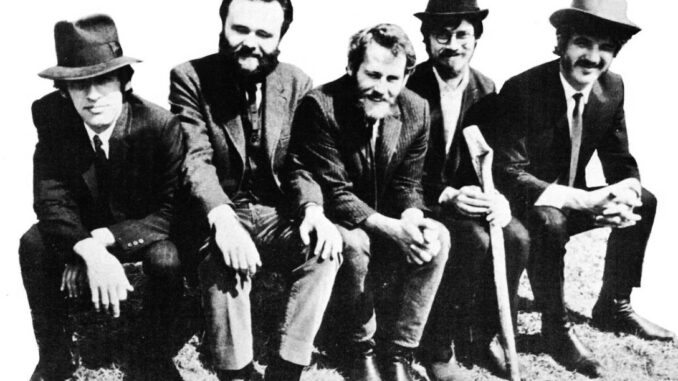
There was definitely something in the air in the late ‘60s that meant that certain musicians started looking back to a simpler, maybe more honest musical time. Their eponymous second album appeared in 1969, and everything was in place for a true classic, from the cover, which reflected a sepia rural vision of The Band, with not a paisley print or a pair of flares in sight, to a peerless set of songs. The songs for the first time were all written or co-written by Robbie Robertson, something that became an increasing point of tension within the band over subsequent releases. While the songs and album cover invoked a sense of the rural and Southern culture of America, the album was a construct written by a Canadian with limited personal experience of what he was writing about, and who has said he saw his songs as movies, invoking images and sounds for listeners. Robertson had been working on the melody for ‘The Night They Drove Old Dixie Down’ for some months with no clue as to what the song was about. Levon Helm, as the only real American Southerner in the band, helped Robertson develop a song about the impact of the American Civil War on rural Southern white families. While this fit very well with the ethos of the album, it was also a radical step given the impact of slavery on American history and society, and the then-current civil rights movement. The song, with a little latitude towards the hard historical facts, managed to shine a light on a white southern experience that didn’t involve slavery. It was the same sentiment expressed by Patterson Hood with his concept of “The duality of the South” a few decades later.



And it’s “Stoneman’s cavalry came ” and not “so much cavalry came”.
Also see Dixieland and Ben McCulloch both by Steve Earle , two more great songs about the Civil War. Signed Steve the Civil War enthusiast.
The lyrics do refer to Stoneman’s cavalry, Steve. A lot of lyric sites automatically download lyrics from the actual recording, which can lead to transcription errors. While America lauds itself on its democracy, it has been a divided society for most of its existence.
it’s Susanna Clark, not Suzanne.
Oops. You are so right, Jerald.
A really interesting list with some outstanding tracks. No easy task.
Cheers, Mike. I’m glad you found the list interesting. You are spot on about the challenge of drawing up the list in the first place.
Great to see the Dave Alvin here although surely must be at the top of this list. The most important songwriter of the last 25 years.
That’s the challenge, Andrew. There are too many great songwriters to be covered by only 10 songs. Glad you were pleased Dave made the list even if you thought he should have been listed higher.
A list with nine songs I’m unfamiliar with. It’s a great way to learn something
Thanks, Dave. That was also part of the overall objective to not just go for the obvious songs.
Want some REAL Americana? Listen to about anything from Tom Russell!
Hi Mitch, agreed a great artist.
Where is John Prince?
Hi Becky, if John keeps doing his thing no one knows what the future will bring.
When I think of Americana , I think Junior Brown and Jimmie Rodgers Blue Yodels. My number 1 Americana song is Muleskinner Blues
Hi, Edward. Jimmie Rodger’s is a true roots musician who was able to create his own take on the blues. Bob Wills was similar with his mix of swing, blues and fiddle music that influence musicians across genres. I can remember the stir Junior Brown made with his first recordings.
Ripple is a lovely song, and it was nicely covered by Jimmie Dale Gilmore. However, there has long been a suspicion that Robert Hunter may have picked up the tune when he saw Joseph and the Amazing Technicolour Dreamcoat on trip to London.
Hunter did write the lyrics in London in the same afternoon he wrote those for “Brokedown Palace” and “To Lay Me Down”, not a bad afternoons work. Garcia wrote the tune which is indeed similar to “Any Dream Will Do” as is the gospel tune from 1971 “Because He Lives”. While I’m not aware of Garcia confirming the inspiration for the tune he never denied them. As they say Michael, there is never really anything new in music just artists different reuse of previous sounds, just ask Dylan about his tunes. My take is the lyrics are a marvel and the tune fits them like a glove.