
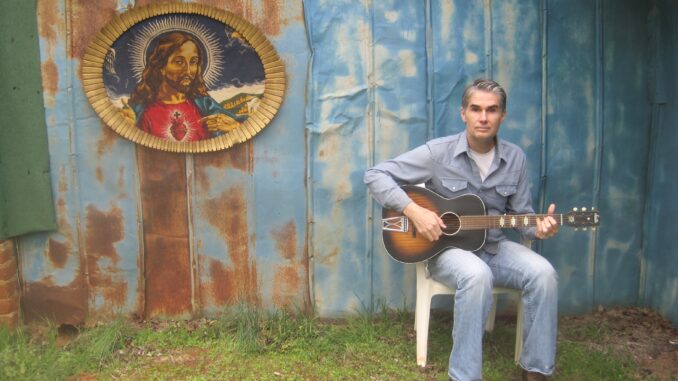
If you’ve heard anything about Jim White, you’ve probably heard about the surfing, the modeling, the cab driving, and the unlikely way David Byrne changed his life with a record deal. You’ve heard about the junk and Jesus: the Jesus who saved him, the Jesus he left behind, and the Jesus who drives a camper van. You may even have heard that there’s something magical about him. And there is.
But contrary to what you may have heard in “The Man Who Shot Liberty Valance,” in Jim White’s case, the story, and the man, are more remarkable than the legend. The story is one of existential grace, of a mortal man finding redemption in kindness and compassion. It is, as White himself might call it, a story of “Musical Magical Thinking.” His new album (Precious Bane, Fluff and Gravy Records, 2026), a collaboration with Trey Blake, is testament to those qualities, or to put a finer point on it; the story of how the album, which White calls “a true labor of love,” came into being is the testament.
Following a gig in London, White was selling merch and signing autographs when he was approached by a timid woman with a book: a lyrical, romantic 1924 novel called “Precious Bane,” (written by Mary Webb) about a young woman living during the Napoleonic Wars in Shropshire. She is ostracized by society because of her penury and a physical deficit, a harelip, she can’t do anything about. She overcomes, finds meaning in nature and in the strength of her will. White didn’t think much of the meeting until he was flying Stateside and devoured the novel on the plane. He just had to know more about the “Wicca-looking” woman who had given it to him, and who’d left her email inside the back cover.

Her emails struck him. “Her words, they just leapt off the page,” White said. “You know when you’ve reached someone who is wildly gifted, and you think ‘How did those words get next to each other? This is really strange.’ She said she’d written some songs, and I said, ‘Well, please, you know, send me a couple.’
“Little by little, I found out about her life,” White said. White learned that Blake is autistic and “lives in complete and utter desperation.” She lives on the dole with her schizophrenic child, who’d been dismissed by the National Health Service for being too dangerous, according to White. “The fact that she took a train from Brighton, all the way up to London, then a subway from there to a venue to see me, I started understanding the intensity of her need to be heard. She sort of had a feeling that I would get her, and I did.”
She sent White a memoir and some lyrics, and they were striking. “It was just like if Patti Smith never got discovered.” White said. “Like, if you met Patti Smith now, and she was 50 years old and a barista.”
Time passed, six months and more, and Blake sent him rough demos of her songs. He was two-thirds of the way through recording a new solo album, and he didn’t have the resources to properly master the songs. Then, providence intervened once again. Blake said she’d met a guy who was willing to help her record. White was skeptical. Blake told him that the guy was in a band, but couldn’t remember the name.
“When we talk about grace, Grace was at hand there.”
“She said, ‘I don’t know, it’s called stereoBob, or stereogum, or something,’” White said. “And I said, ‘Stereolab?’ And she’s like, ‘Oh, yeah, that’s it. Have you heard of it?’ When we talk about grace, Grace was at hand there.” Suddenly, Stereolab’s Joe Watson was on board. Watson recorded Blake’s songs, and now there was a CD white could play in his truck.
“I was going in the mountains in North Carolina, toward Asheville, and there’s a tunnel, and I thought ‘that’d be a good place to start listening to Trey’s music – in the tunnel,’” White said. “It’s a long tunnel, like, two, three miles long. It was just her and an acoustic guitar, and Robert Exon singing harmonies. He has a really lovely sense of harmonies. And, you know, I got to the end of the tunnel and felt like I’d just been reborn with a new purpose, ’cause that music just sang, you know? Like, it sang in the best of ways.”
She’d sent White six songs, and he suggested they do an album together: half his songs, half hers. “I had to write songs that could float next to them, songs with a similar buoyancy,” White said. “Those songs of hers, they are deep, and yet they have light at the top.” White called in favors for art direction, a cover photo, and invested his own money. His record label, Loose Music, agreed to release the album. Now it was time for a tour. White called Blake and asked if she could meet him in Antwerp, Belgium. Blake was intimidated by travel, having never left the U.K., but agreed to try. They met in the subway station.
“When she was coming up the escalator, I could see that she was totally freaked out,” White said. He hadn’t realized the strength it took for Blake to overcome her Autism and function. Even crossing the street was overwhelming for her. “I told her ‘just hold on to the back of my coat when we’re walking in a crowd.’ But I thought, ‘Huh. I wonder how that’s gonna work with touring, you know?’
“We finally got through a rehearsal, and the next day, we had to play a show, and I thought, well, what’s gonna happen here? We got on stage and I took the first song to get her comfortable with us being on stage, and then we segued quickly into the next song. And she was fucking Patti Smith. That great. As soon as she got on stage, something triggered in her mind, and she was this magical being.”
White tears up at the memory. “I didn’t ever say during the show that Trey was autistic. At the end of the show, I said, ‘Now, I just want to thank you all for coming tonight, and just thought I’d let you know that this is quite a remarkable thing you’re getting to see, because Trey is autistic, and normally can’t function much in society.’ There were gasps from the audience, and Trey was crying, and she ran back to the dressing room and couldn’t talk to anybody, ’cause it was too much.”
They did sixteen shows, including shows in London and in Brighton, Blake’s hometown. The London show was sold out. Audiences were transported. Since the tour, Blake has returned home, but the story continues. He arranged for her memoir to be published. Their email conversations continue.
White remains in awe of Blake’s fierce determination to be heard, and of her artistry. “Some folks create their art,” White said, “And their art, you know, the people who are really plugged in, their art grows in resonance, and somehow there’s synchronicity. It speaks of some organizing principle beyond my understanding.”


Great writing and very interesting article! What a story.
Saw them when they were touring together last year. Intense, fragile and lovely is how I would describe the experience.
The reason I’m reading this article (which is in truly execrable English) is the reference to the book entitled Precious Bane, by some female called Mary Webb. I know that book. Some misguided person gave it to me when I was about 8. Of course at that age I thought it was bloody awful. Although I was (and still am) an avid reader, that book was too much for me. Dreary and gloomy. Even worse than Thomas Hardy. However now I might give it another pop if it’s still in print, which I doubt. I wish Trey Blake all the best. What does the name Trey signify, by the way? Never heard it before. Is it a contraction or abbreviation?
‘Awaiting for approval’ does not by any stretch of the imagination, constitute correct English. Didn’t you people learn proper English at school? Or possibly English is not your L1?