
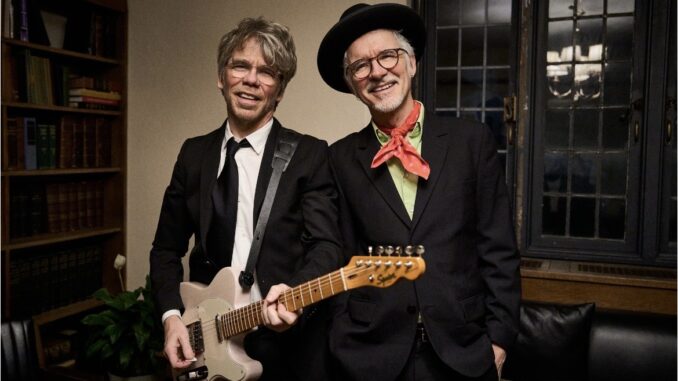
Brothers Dan and Warren Zanes revel in the glory of performing live again after decades.
The Del Fuegos are one of the pioneering US americana acts who burst onto the music scene in 1985 and were quickly signed to the Slash record label, with fellow label mates including The Blasters, X, Violent Femmes, Los Lobos, BoDeans and Dream Syndicate. Revolving mainly around brothers Dan and Warren Zanes, they released three albums with this core lineup before Warren left for their fourth album, Smoking In The Fields. There was also an EP Silver Star in 2012, which saw the band back in sterling form. Both brothers then went on to record well-received solo albums, with Dan finding a sound creative theme with a series of children’s records. In recent years, the band has reformed for a select number of gigs in America and Europe, and in June, the band comes to the UK for the first time in decades to play a one-off gig at The Lexington in London. Paul Russell caught up with Dan, on the line from Baltimore and Warren, who was at his home in New York, and they discussed a wide range of topics including the thrill of playing in Europe early in their career; the impact of being signed to Slash; how getting back to play together again has been a dream giving them a new perspective on how the band works, and the reality of being brothers in the same band.
Americana UK: Okay, guys, so, you’re playing live in the UK in London on the 20th of June, for the first time, we believe, since the 1980s. How has this actually come about?
Dan Zanes: We were invited to play some shows in Boston, and there was no reason not to; it just sounded like it would be fun. It was just purely for the thrill of reuniting, and it felt like we were at a place where there wasn’t a lot of baggage around, and I think we were able to see the music differently. We’ve always been in touch with each other, and it just felt like one thing led to another. Then Warren reached out to Chuck Prophet, and Chuck introduced us to a great promoter he works with, Chris, who said he would bring us over. It seemed like some adventures, and then come to find out we have some fans that are still alive and kicking.
AUK: I know you’ve done a fair few gigs in America recently, and a fair few in Europe. So, is this incredibly exciting to play in London?
Warren Zanes: It’s very infrequent, so we did a show in Barcelona last year, and then we did three in the States; in my town, Montclair, New Jersey, in New York, and Boston. But if you look over the years since we last played London, there are very, very few shows. Mostly because we all have these lives that are full. You know, for me, I think there’s a point in everybody’s life where they circle back to the things of their youth. And that may be sitting in a dark room with a bottle of bourbon, watching Happy Days. It may be looking at family scrapbooks. It may be, you know, buying a car on eBay from your youth. It’s just part of the human experience. You understand the later stages of your life by returning to the earlier stages. And here’s where we’re very lucky.
When we get to go back and do this, as this collective, the Del Fuegos, it’s a different mindset. We’re not looking at making the next record. We’re truly going back to feel the stuff we felt then and see how it feels now. So there’s a tremendous privilege to being able to do this innately human thing, on a stage with people who were there then. It’s remarkable memory work; it’s remarkable human work. And when you remove that feeling of, gosh, I hope our next record does well, when you can take that out of the picture, you are way closer to the music you’re playing.
AUK: I’ve done some good research prior to this, and I found it fascinating watching you play live back in the 80s. It shows you as a band who were literally playing as though this was the last day on Earth. And clips of your recent shows see you in a different mode but still as passionate as ever. Are you still getting that thrill from playing live? Has it ever become a bore or a chore?
WZ: If it was a chore, we would definitely not be doing it; this is offering us something substantial. You know, again, it’s back to my earlier point, there’s something about returning to youth. In this particular space vehicle called the Del Fuegos, to go back in time, you can’t say from the outset what it’s going to give you. But we’ve dabbled enough to know it’s going to give us something, and we’re curious about what that will be.
DZ: Like Warren said, we get to share the experience with people that, a lot of them were there first time around. The collective of the band is great, but then the experience that we get to have with people who were there as young people is amazing. Going to Europe, going to England, going to Spain, all those things we did, those left such an impression on us. The first time we went to Barcelona, it felt incredible. We’re thinking this must have been what the Beatles felt like because the energy in the place was so intense.
At that point in time, we were fairly provincial people, so it was such an eye-opening experience, and the fans in Europe really helped us to see the world. People took time with us; people hung out with us. We’d play our gigs, then we’d walk through towns. I remember doing that in Sweden until 5:00 in the morning and people giving us a primer on Swedish history. It was just incredible.
AUK: The fact you’re making the effort to come and play as a band in the UK is really appreciated, knowing all that’s involved.
WZ: As Dan was describing, when we showed up the first time in Barcelona, it was a sold-out 3,000-seater, and we’d never been to Barcelona, so it really had a remarkable effect. But some of the touring that I remember best is the first time in the UK and being in London. I grew up with Corgi cars, toy cars, you know, so, like, double-decker, Corgi buses, and there’s obviously, because of groups like the Beatles and the Animals, there’s this idea of England in particular, and then suddenly we’re there, meeting Steve Earle in the lobby of a hotel, eating cucumber sandwiches and having tea.
Or going and being on the tube, and I bought myself a case of Newcastle Brown Ale. And you know, we’re driving with some absolutely reckless driver, who God must have sent to kill bands! And so now we’re going back to territories where we’ve got some really strong surviving memories.
AUK: Let’s go back to the early days. So how come these two beloved brothers ended up in a kick-ass rock-and-roll band?
WZ: Well, let’s go with the you get two answers approach. Let’s hear Dan’s, and then I’ll give mine.
DZ: I’ll give you the real story. I went away to college with the idea that that’s where I would meet somebody and start a band. That’s why I went away to school. And I met Tom Lloyd (future bass player with The Del Fuegos who played on their first four albums) on the first day, and we started a band after breakfast.
We could have dropped out then, you know, but we stayed for a year and played. When we left the university, we went to Boston and started playing around there as a trio. And at that time, there was so much music coming out of England that totally influenced what was going on in America, you know, the Clash, the Jam, the Undertones, all that stuff had really left a mark. So these kids in the suburbs of Boston were forming these bands and singing with English accents, and the whole thing was just so mysterious to us. It seemed crazy.
We were singing Drifters songs, and Elvis Presley songs, and Chuck Berry songs. Hardcore American music lovers, and we just couldn’t imagine anything but that. And so, we’re playing these shows, and at that time, believe it or not, we were a complete anomaly because of the kind of music that we loved. That was 1980 and ’81.
The roots thing wasn’t catching on. We were just young people, but we were relics. And then my brother was going to school, and he would get off on the weekends and come down and hang out with us. He liked to party like we did; it was a lot of fun hanging out with him. I went to see the Blasters play in Boston, and it was the first time I’d ever seen them, and the Blasters, at that point, when their first Slash record came out, their shows, those shows were something else. That energy level was so high. There was so much power in the music, and so I’m watching them, and I’m standing there at the Paradise Theatre in Boston and thinking: ‘That’s it, if you want that kind of energy, you gotta have brothers in the band, so let’s get Warren in the group.’ But he was still in high school, and so we talked to him, and the day he graduated from high school, we drove down to where he was, picked him up, and brought him to Boston. That was it, and from then on we were a quartet and, well, that’s my version of the story.
WZ: Yeah, that’s a pretty good telling. I like that detail. I just went to see Jesse Malin’s Silver Manhattan show, which was so good. (A new semi-autobiographical stage show with music about the singer’s life in light of his recent rare spinal stroke.) He really described a life in music, in New York music in particular, including singing in an English accent at a certain point. We were not dissimilar in music, being a road of possibility where there weren’t a lot of roads that could be described as possibilities. When I came into the Del Fuegos, and I say this only in hindsight, a lot of people said, ‘you didn’t play guitar, why would…your brother have you join as a guitar player. I had a kind of recklessness, a sense of abandon. I had three months of guitar under my belt. So, you know, from my perspective, I was the complete package. I didn’t know that then, you know, it’s wildly insecure, but Dan asked me, and it was a dream come true.
AUK: So, back at the beginning of your career, in the mid-eighties, we were introduced to you through a Melody Maker supplement, and it was The Complete Guide To New American Rock. Within it, there were many descriptions of your Slash bandmates, people like Los Lobos, the Blasters and X. And do you know how they described you?
WZ: Do we want to know?
AUK: Well, they described you as ‘hard-nosed bar-room rock and roll romantics’.
DZ: Hmm…
WZ: It felt pretty good to me.
DZ: Sounds alright to me. I think that’s what I kind of appreciate when I listen back to the music. It feels like there was a lot of emotion in it. I know we were all feeling things, and there wasn’t a tremendous amount of pretence to it all. I remember having to defend our position to somebody. We felt there’s gotta be at least one slow song every time we play. There’s gotta be a ballad, and I think if we had had our way, the majority of the songs would have been ballads.
AUK: So, you were really lucky inasmuch as your first label was a major label, Slash. This was an incredibly rich source of talent with some of those bands I’d mentioned earlier. How did the deal come about?
DZ: It was really that we couldn’t imagine ourselves being on any other label. The story that I heard was that T-Bone Burnett was in the office, and they had a big basket with all the demo tapes of bands that they weren’t gonna sign. He looked through the basket and pulled out our tape and put it on. He said, ‘Oh, this sounds good, you should sign these guys’. And they said, ‘Oh, really?’ And he said, ‘Yeah,’ and they said, ‘Oh, okay.’
WZ: So, before I was in the band, and for a period that I was in the band, Lily Dennison was managing the group. Lily’s biggest role, I would say, was seeing where that fit within what was happening in music. And she was really the one who led everybody to Slash as, ‘this is the place.’ The Blasters and the Violent Femmes, on paper, don’t have a lot to do with one another. Neither do Gun Club and Los Lobos, but I think, from Lily’s perspective, and in the early Del Fuego’s perspective, it was all one fabric. And so Lily would book the Del Fuegos on any opening spot with a Slash act in Boston. Again, it goes back to this pre-Internet thing. Lily just started building relationships at Slash, and with the bands, and pretty soon, even before you’re on the label, you’re feeling like you’re spiritually on it.
PR: So what are your memories of making The Longest Day, your first record and all the pressure that goes with that?
DZ: Sadly, we lost our original producer for a variety of reasons, and we contemplated going home and giving up. But we then decided we’re not going home, we’re gonna stay here until we get a record made. Mitchell Froom had made a record for Slash, a soundtrack called Key Of Cool for the film Café Flesh, and he did it on an 8-track. I think the guy who ran Slash said, ‘Well, Mitchell made a record on an 8-track, why doesn’t he do some 8-track demos with you and see how that works out?’ It was more about the 8-track than it was about Mitchell being a good fit, which he ended up, of course, being, but that was Slash; they were not thinking in the typical music business way. Working with Mitchell was a long process because Mitchell recognized that there were things about us that definitely could be better. And he was right; he was a tremendous mentor to us.
WZ: I think on some level, in making our first record, we were hoping we would be making a third and a fourth. And so you make some decisions early on based largely on intuition about how do you stay in this game? Mitchell seemed like a key to us, to come in and guide us, do some of that remedial work, turn us into an act that might have more staying power. And it was definitely like school with him.
AUK: So, the experiences that you learned from the first album. How did you then go into making your second, Boston, Mass?
WZ: Mitchell Froom was big on pre-production. And this holds true for all three of the records he did. So if there was a month in the studio, there was a month before that in a rehearsal studio. We were fully invested in Mitchell by album two. I think album number two was Dan’s strongest collection of songs. My understanding of it is, as a producer, Mitchell Froom is a great friend to the songwriter. And so Dan got to have that experience of a song-oriented producer. I mean, Mitchell isn’t that for every artist. He doesn’t need to be that for Randy Newman in the way that he needed to be for Dan. But I think if album number two marks a kind of high point.
DZ: And it was good too, because Mitchell was an old guy, probably 28. We could really look up to him. But no, that’s good, I mean, we were living a dream that every single person that we knew wanted to be living. At that point, we were doing a lot of touring and seeing the country. Everything was kind of firing for us on all cylinders because we were having these experiences that we had never had before.
WZ: There was also the shift. The first album was more of a Slash experience, and the second really was a Slash/Warner Brothers experience. It was a really A&R-driven record label. We didn’t know what that meant back then. Warner Bros. took us on and made us a priority, which was amazing.
AUK: So any memories on album number three, Stand Up, which was obviously quite a departure for you, a milestone as much as it was the last album where you all played together?
WZ: I think Dan will be tougher on it than I will, but they’re his songs, his voice, but I’ve gone back to it, and I like it. It leaps off a few cliffs. It isn’t what you expect.
DZ: What’s been cool about playing shows recently is thinking about those songs. Warren’s right; I would be harder on it, but I’m seeing it from a different angle now.
PR: So you’re back on the road playing all these old songs later in life to a mixture of old and new fans. How have you approached playing these great songs decades after they were recorded?
DZ: It’s been feeling great, better than ever in a strange way. I don’t know why.
AUK: Have any of them had a new lease of life, sounding a little bit different playing live now than they would have sounded either on record or live 20, 30 years ago?
DZ: The ones from Stand Up, for sure, for me.
WZ: So, one of the first moves was, we’d hired a keyboard player to do the last three gigs. This was Dan’s idea, to, like, I know we’re not chasing recordings. But we can chase them even less, you know? It’s like, don’t worry, let the song be the reference point. Forget the recording being the reference point.

AUK: So aside from your band work, you’ve both had a really successful set of solo albums released, which includes a number of children’s albums by Dan. How has this period of solo work been for you both?
WZ: For me, it was total liberation, like, a really great experience. And everything I’ve done, I’ve done down in Nashville. I’ve worked with Daniel Tashian quite a bit, and Brad Jones, and the drummer Nick Buda is on a couple records, as well as Jerry Dale McFadden from the Mavericks. It’s really fun being the steward of my own material. It’s night and day from the Del Fuegos. Between the two experiences, I wouldn’t want to give either of them up.
But what I didn’t know when I did it was, I think it was actually an education I needed to become the writer that I am today. I needed to go and do solo stuff to really understand that process more. The Mitchell Froom experience. Working on Dan songs gave me one education. I needed this other one, and then at the end of that assembly line, I think I was a writer.
AUK: And Dan, for you, what’s the solo recording experience been like?
DZ: It’s been incredible ’cause I wanted to create the updated version of the Folkways records that I listened to as a really young person, when we had those Leadbelly and Pete Seeger records around the house. So for me, it was kind of getting out of the studio and starting to do home recording. I wanted to make records for young people to listen to, where they would hear the sound of people in a house, even though, you know, in my case, some of the people might include Lou Reed, Bob Weir, Carol Channing or Nick Cave.
I was just trying to create this world where it’s friends and neighbours making music together, and so learning how to take the lessons that I learned from Mitchell and the community spirit that I think the Del Fuegos always had. Do that to create something that would include young people. I wouldn’t have been able to do that with any kind of understanding if I hadn’t been through the Del Fuego’s experience. At the time that I started doing it in 2000, the fact that I’d been in a rock band and now I’m making music for the all-ages audience, people thought, ‘Oh, he’s gonna be singing “Old MacDonald,” or “I’ve Been Working On The Railroad,” or something like that. I was like, no, that’s not the tradition that we’re coming from here; we’re coming from the way Leadbelly made music for young people as a window to the world outside and what it could potentially look like. I mean, most people don’t get one act, and I’ve had three and get to enjoy all three of them simultaneously. I’m super grateful, and it’s been fantastic to reunite with Warren in this way, too, you know. I mean, things that we never would have imagined and look at us coming back to England. Drinking tea with you all.
AUK: Gentlemen, it’s been a real pleasure spending time with you both, thanks so much.
It was at this point that sadly, Dan had to leave, but I continued chatting with Warren, and we talked about Daniel Tashian, a great singer-songwriter and a prolific writer for many current artists. Daniel has recorded and co-written with Dan on all his solo records, and they work really well together. Warren recounted this lovely story, which I feel is only right to share here.
WZ: I had dinner recently with Daniel, Jed Hilly from the Americana Music Association, and Scott Robinson, who started Dualtone Records (who released many of both Dan’s and Warren’s solo records). I’ve known all these guys for a long time, I love them all, but I was telling Jed and Scott the story of when I was making my first record. And we kind of ran out of money. So Daniel was coming around, and he was helping out and not really being paid. But nobody was at that point.
There was this Les Paul guitar that Daniel had fallen in love with at the used music place in town. Broadway Music. So we went, and we bought this Les Paul. We would often go out behind the studio, and this was the Universal Studio. It was Ronnie Millsap’s studio. We’d go out in the back of the studio for our cigarette break, even though nobody smoked. There was a dumpster out there, and Daniel was just always the kind of guy, like, if there’s a dumpster, he was gonna be looking in it. And so we put this really valuable, vintage Les Paul guitar in the dumpster. And we go out back, and we’re standing there talking, and sure enough, Daniel’s edging toward the dumpster. And he’s looking in, and he’s like: ‘Guys, there’s a guitar case in here!’ So, he goes into the dumpster. He takes this guitar out, and it’s the Les Paul that he’s been dreaming about. It was one of the great moments. We were, like, in love with life in that moment. Looking at Daniel, trying to figure out how it happened that the Les Paul he wanted ended up in that dumpster. It made you want to live in that moment forever.
So, The Del Fuegos will be playing live for the first time they’ve played over here since those heady 1980’s days. It’s at The Lexington, and it should be a night to remember.
I Still Want You, from Australian TV show, 1986
Don’t Run Wild, Reunion live concert 2025
Hand In Hand, Reunion live concert 2025
https://www.youtube.com/watch?v=hQblS0ZQMYo&list=RDhQblS0ZQMYo&start_radio=1
