
Songs of love and hate with a layer of ghostly eeriness.
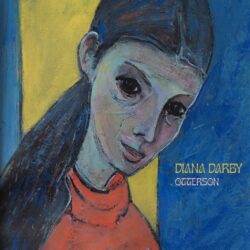 When the Eagles reunited to stage their Hell Freezes Over TV special, Don Henley famously said that “For the record, we never broke up, we just took a 14-year vacation.” The same margin of years separates Diana Darby’s new release, Otterson, from its predecessor, though the advantage of being a solo artist is that internecine warfare is unlikely to be cited as the cause of such a long hiatus.
Houston-born and raised, after graduating high school at 16 Darby moved to Los Angeles in order to put some distance between herself and family. Her studies led to work in the film and music industries, the former as a writer of comedy and the latter as a lyricist. Collaborations with writers for established names brought recognition and a meeting with Mark Linn of Delmore Recording Society. The pair recorded her début album in Brooklyn and all her subsequent releases have followed on that label, whose mission is “to expose singular artists that don’t quite fit into the world”. That may be a convenient way to describe the motivation behind the ethereal voice and sonic textures that are to be found in Otterson.
Breathy, sometimes whispered vocals bring to mind the 1960’s chanteuse Nico, the muse of many of the era’s movers and shakers, among them the Velvet Undergound. The song title Dear Jane echoes their Sweet Jane and along with Bob Dylan, the New Yorkers are cited among Darby’s influences. Fittingly, her light alto and measured delivery allow her lyrics to be easily heard, as befits a woman who has written more than 1500 poems.
Darby follows in a long line of confessional artists and troubadours, from the late Françoise Hardy to Carla Bruni and there’s something quite Gallic about the songs on this album. After a few listens it becomes tempting to imagine oneself in a Parisian café, artists gathered around their pastis, and the album takes its title from the painter, John Otterson, whose portrait of an otherworldly and large-eyed girl provides the cover art. The painting’s subject is not Darby, though as a sometime neighbour, she had herself made a film about Otterson’s life.
Several of the songs here were recorded years earlier and it was the isolation of the pandemic that caused Darby to resurrect old hard-drives and feed them into her Logic software, which as she says, give the album “a layer of ghostly eeriness which I love”.
All songs bar one were written by the artist and recorded in Chicago and Brooklyn, the exception being Rosie, Won’t You Please Come Home by Raymond Douglas Davies, recorded in Nashville. Otterson is a spare, sparsely instrumental album, with hypnotic rhythms and deceptively simple lyrics that almost bleed into the subconscious. Looking back at some bad times, Say Goodbye opens with a peal of thunder before the gentlest of melodies. It’s a neat way of summarising this collection of songs that, like Leonard Cohen’s Songs Of Love And Hate, both trouble and soothe the listener. As Darby herself says, “I feel things deeply, probably too deeply for my own well-being. But those feelings also fuel me.”

