
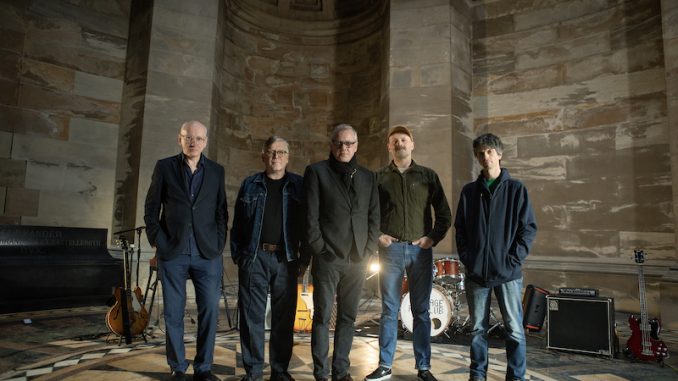
Teenage Fanclub were formed in Glasgow in 1989 by guitarists Norman Blake and Raymond McGinley, drummer Francis Macdonald and bassist Gerard Love. Blake, McGinlay and Macdonald had all initially been in the same band, the Boy Hairdressers, before Teenage Fanclub and are now all part of the 2025 line-up. They have produced 12 studio albums of consistently high quality, containing some fabulous tracks. Two of the albums are absolute gems.
The group is a bit off the beaten americana track, being better known as an alternative/indie rock band. However, the strong influence on their music of Laurel Canyon groups like The Byrds, particularly in their harmonies, and of the iconic American power-pop band, Big Star, is enough to get them inside the americana tent. Listening to Big Star’s first two brilliant albums, “#1 Record” and “Radio City”, it is startling how like them Teenage Fanclub sound.
Teenage Fanclub’s first two albums, “A Catholic Education” (1990) and “The King” (1991), are very much rock albums with lots of feedback and a grunge feel. “The King” is a mixture of covers and outtakes from the “Bandwagonesque” sessions, and so doesn’t really count as a “proper” album. “A Catholic Education” has some good songs on it, but the muddy sound, vocals that are difficult to hear, and the number of instrumentals make it one of my least favourite Teenage Fanclub albums. On the next three albums, “Bandwagonesque” (1991), “Thirteen” (1993), and “Grand Prix” (1995), things got more melodic, but they were still solidly a rock band. These were very good albums, and “Grand Prix” has a couple of my favourite songs of theirs on it, ‘Sparky’s Dream’ and ‘Neil Jung’.
After that, the group settled into being more of a guitar-pop band with less of the “full-frontal assault” approach, and they have ploughed this furrow up to the present day. “Songs From Northern Britain” (1997) is a superb album, one of my all-time favourites. It ran “Bandwagonesque” a close second. The next two, “Howdy!” (2000) and “Man Made” (2005), are full of strong songs. After these, their last few albums sound very similar on first listen- there are no great leaps into different musical directions. A Teenage Fanclub hip-hop album doesn’t look likely in the future. However, repeated listening pays dividends with them, as you realise how good many of the songs are. The exception to this is “Shadows” (2010), where the songs on it aren’t as memorable.
Love left the group in 2018, after not wanting to do the travel involved in their tours around the world. He had been a crucial figure in the band, writing some of their very best tracks and sharing singing duties with Blake. The group continued, producing “Endless Arcade” (2021) and the best of their recent albums, 2023’s “Nothing Lasts Forever”. Lyndon Bolton was full of praise when he reviewed it for AUK, writing that it was “a deeply satisfying listen”.
As of 2025, the group consists of Blake, McGinley and Macdonald, who returned in 2000 after leaving in 1989. Brendan O’Hare and Paul Quinn were on drums in the intervening years. Added to the trio have been Dave Magowan on bass and Euros Childs, frontman for the Welsh band, Gorky’s Zygotic Mynci, on keyboards. Watching them live in 2025 in Holmfirth was a great experience, even if the band did look a little like librarians. But then, who doesn’t these days? Their wild days with long flowing locks looked firmly in the past. They sounded so good as they went through their back catalogue, both early and recent, and looked to be really enjoying performing, even after all these years.
Can’t Live With It: “Shadows” (2010)
 “Shadows” is similar in tone to Teenage Fanclub’s final three albums, “Here” (2016), “Endless Arcade” (2021) and “Nothing Lasts Forever” (2023). All of these three are “growers”- you need to listen to them a few times. With them, you start to remember and like the melodies of songs after a few listens. However, with the exception of one song, on “Shadows” the songs aren’t as memorable. I found it a disappointment after really liking the two albums before it, “Howdy!” And “Man Made”. The one song that stands out, though, is the fabulous ‘Baby Lee’, where the writer has a massive crush on Baby Lee. Written by Blake, it has words from Ziggy Campbell, a member of the Edinburgh experimental pop collective, Found. It is a sing-along pop classic.
“Shadows” came five years after “Man Made” as the group were embarking on individual projects during this time. It was recorded swiftly in 2008, but the group did not release it straight away, spending time on mixing, for example. Blake, Love and McGinley wrote the songs, and Macdonald was on drums. Dave Magowan had been with the group since 2004 and played keyboard and some nice slide guitar, for example on ‘Today Never Ends’. Euros Childs played piano on ‘Dark Clouds’ and there are strings on this, too.
The lyrics on “Shadows” are thoughtful, but they are not quite as memorable or interesting as many of Teenage Fanclub’s others. They don’t have, for example, a great number of the interesting characters, passionate emotions, wise words or vivid stories that can grip your attention. It is often not totally clear what they are about, although you can usually have a bit of a guess. ‘When I Still Have Thee’ and ‘Live With the Seasons’ are love songs paying great tribute to partners. ‘The Past’ seems to be about a bad patch for the writer, “alone and lost and guessing” and ‘Dark Clouds’ seems to be about coming out of a depression. Many lyrics have descriptions of surroundings, for example, “Heading west towards the glowing evening sunset” and “Storm clouds in the harbour/ Dark waves have been drawing you in”. These work very well to paint an atmospheric picture throughout the album.
In the interests of balance, it has to be said that many critics liked “Shadows”. So perhaps not one to completely avoid if you want to listen to Teenage Fanclub’s back catalogue.
Can’t Live Without It: “Bandwagonesque” (1991)
 There is a squeal of feedback, then the words “She wears denim wherever she goes/ Says she’s gonna get some records by the Status Quo”, and then we are off into one of my favourite ever albums. ‘The Concept’ is the opener, and it settles into a chugging rock groove, with Blake telling the story of a woman he had encountered. The words apparently came together just 20 minutes before recording. The second half of the six-minute song is a slower extended guitar solo with harmonies. Guitar solos usually aren’t my thing, but this somehow works.
The next track, ‘Satan’, is a short instrumental. Again, these don’t usually do it for me, but this starts with feedback and squealing guitars but ends with a driving riff which acts as a good intro to the next song, ‘December’. A song about unrequited love written by Love, it has a Big Star-like feel. Love’s songs on here are generally poppier and less rocky than Blake’s.
Other Love tracks are ‘Pet Rock’ and ‘Sidewinder’, with its fabulous melodies, about a crush on a female drummer. The slower ‘Guiding Star’ strongly reminds you of fellow Scots, The Jesus And Mary Chain, in the echoey vocals and in the sonic backdrop. Love’s ‘Star Sign’ is one of the highlights, with a wall-of-sound intro that lasts over a minute and builds up the tension superbly. It then crashes into the main song, which is a power-pop classic sung by Love about his scepticism of mysticism. You guess that he is not that keen on getting his fortune told.
Blake also contributed the stomping crowd-pleaser ‘What You Do To Me’ and another song about a female fan, ‘Metal Baby’, which was a great start to side 2 of the record. He doesn’t sugar-coat things: “I’m not the sort of person she’ll admit she knows/ She’s not the sort of person who’s driven white as snow”. Likewise, ‘Alcoholiday’ deals with an ambivalent relationship that doesn’t seem to be going that well: “There are things I want to do/ But I don’t know if they will be with you”.
McGinley wrote just one song, ‘I Don’t Know’, but it is a good ‘un. Another with a debt to Big Star, it has a great chorus with harmonies over a driving guitar. The album finishes with a Love instrumental, ‘Is This Music?’, which is the weakest track. But this only serves to highlight how superb the other songs are.

