
The first great, breezy, summer “pop” record is here, from a self-described “Americanish” band with an old-country soul.
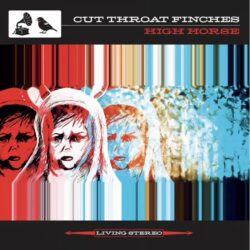 Much like their previous efforts, High Horse, by Cowtown’s Cut Throat Finches, defies easy categorisation. Is it a country record? Is it rock? Is it pop? It’s got fiddles and steel guitar, so it must be americana, right? The answer to all of these questions is, of course, yes. Cut Throat Finches write great pop songs, and this is no slam; it is, in fact, pretty hard to write a good pop song, especially in a Jack Antonoff-saturated landscape of songs that sound generic because they are, by design. For too long, pop has been shorthand for soulless, vapid tripe meant to appeal to, and never challenge, as vast and undiscriminating an audience as possible. It’s background noise for a dentist’s office. The rough edges are sanded down, and it’s careful not to offend. You know, it’s Music For People Who Don’t Like Music.
High Horse exists on its own terms. It delivers one catchy number after another. The energy is infectious, and it sounds great, a tribute to the Finches’ desire to make records that may cross genres, but always remain distinctly Texan. Sean Russell, the band’s primary songwriter, has an ear for mighty hooks and choruses delivered with road-worn wisdom. He’s cited his time working at Bill’s Records in Dallas in the heady 1990s, sharing the thrill of Oasis and Happy Mondays, as formative. In the intervening years, he’s honed his own voice, writing songs about loss, life on the road, and even NASA: Russell offered a song from the band’s 2019 moon-themed concept album to the space agency as “the perfect song for the Artemis II mission.” If you followed it all breathlessly and watched takeoff and splashdown with a lump in your throat, do yourself a favour and check out his Artemis II sizzle reel on the band’s Facebook page.
Thematically, the record is a Texas Mile away from the Finches’ cathartic post-pandemic outing, Unraveled, which dealt with anxiety (both personal and global), isolation, and personal trials the band endured during and after the days of lockdown. These included mental health issues exacerbated by The Plague Year, family crises, and, in the case of one band member, a DUI caught on a Whataburger run (welcome to Texas; you can’t make this shit up). Despite the heavy themes, the record was therapeutic and celebrated a band uniting in processing, healing, and recording.
High Horse feels like a sequel of sorts; Russell confronts lessons learned the hard way in San Antone, Corner Cutter, and Man on Fire, where he reflects on the fight he’s got left in him, despite the odds. “Harden like a coffee bean/the pressure builds but takes the heat,” Russell sings in his world-weary but resolute rasp. “God don’t burn bushes anymore/He sets a man on fire/’Cause a man on fire/Knows life clips a little piece of your wings/…Life clipped a little piece of my wings/But I’ll find a way to hold the line/God don’t burn bushes anymore”. Where Unraveled felt like responding to a moment while struggling within it, High Horse exists in remove from the moment. Russell’s had time to reflect, and he’s found hope. “Once you stop looking back, you start feeling free,” he sings in Come Undone.
In a better world, a song like Last Call Shooter would fit right into the playlist of contemporary country, with lines like “I’ve got an attitude problem, and it starts ’round closin’ time….” The song brings to mind George Jones’ Bartender Blues. It’s witty but, for some uneasy souls, easy to relate to. It’s catchy and droll. But the “mainstream country” landscape is an exclusive club of focus-grouped, pre-packaged “artists” and songs by committee that would make Lefty Frissell puke. The lyrics of Last Call Shooter, by contrast, fit nicely in the pantheon of hard-drinkin’ country hangover songs. “I’ve got anxiety problems, starts around morning time,” Russell continues. “There’s some things I don’t remember/Did I run my mouth, did I lose my mind?/I don’t think it’s who I am or who I want to be/But I’m headin’ back out tonight, so let’s wait and see.” Why isn’t this in heavy rotation on country radio! As though to drive this point home, in a lovely nod to their forebears, and to situate themselves within an authentic country tradition, the Finches close the album with a heartfelt interpretation of Tanya Tucker’s What’s Your Mama’s Name?
All these moments culminate in the penultimate song, Unsettled Minds, a show-stopping tribute to veterans coping with the personal fallout of their service to an indifferent nation that isn’t even trying to understand. “You were a child with a life when you left here, now you return alone,” Russell, a veteran himself, sings. “The call rang out that most don’t answer/many are called and lost/Wondering did anybody notice/That we were gone at all?” Russell served in a tank in the DMZ between North and South Korea, in the Joint Security Area, close enough to North Korean troops that the young men and women on both sides could look one another in the eyes. Like so many, he tries, in song, to explain the toll the experience took on him. “Part of your soul is trying to find its way back home,” he continues. “You say ‘I don’t think I think like they do – most don’t think at all’/You wish you knew the right words to tell them/What’s been going wrong.”
Perhaps the most direct song on the record is a love letter to Russell’s wife, photographer Honey (Godsey) Russell, The Man You Run To, which he wrote for her as a 13th-anniversary gift. “Who was I to even dream you?” Russell sings. “I was missing you before I knew you/Who would’ve thought at ten years we’d still wake up making promises to keep/Our home wherever we lay down to sleep/Who was I before I kissed you?” There’s a surprisingly affecting DIY video to the song that’s essentially a travelogue of a trip the couple took to Colorado and Parts West, featuring the couple and their dog, celebrating life and love on the American Highway. Russell, it seems, has found peace of mind in early middle age with a family he loves and a band that, while it may never be as big as Oasis, means a lot to him and to fans of earnest, authentic songwriting. “The songs don’t sell, but they’ll outlast us beyond our dying day,” he sings. If there’s a message uniting all the songs on High Horse, it’s that the quotidian things are enough, that the key to contentment is focusing on what matters: love, joy, and the journey.

