
A veteran activist singer-songwriter releases his latest bulletin on our troubled times, mixed in with more personal musings.
 Think of protest music, and one thinks of 1960s America, when the Vietnam War, in particular, inspired a host of singer- songwriters to start writing songs which were a world away from the the souffle-light pop which had emerged in the 1950s on the back of the emergence of ‘rock and roll’. Of course, the likes of Woody Guthrie, Yip Harburg, Pete Seeger and Paul Robeson had been voicing their controlled anger at societal and racial inequalities and injustices through song from much earlier; Brother, Can You Spare Dime had been written in 1932 in the midst of the Great Depression, for heaven’s sake. And countless blues singers had been doing so in almost complete anonymity for decades. However, Bob Dylan, Joan Baez, Phil Ochs, Tom Paxton, and others moved the protest song into the mainstream consciousness, and by the end of that decade and into the early 1970s, major artists such as Creedence Clearwater Revival and Marvin Gaye were releasing songs like Fortunate Son, and What’s Going On, which were huge sellers. Even former teen idols like Dion and Bobby Darin had moved on from frothy, catchy songs about romancing the girl next door to harder-hitting records like Abraham, Martin and John and Simple Song of Freedom. And, sure enough, a number of those previously anonymous blues singers were ‘discovered’ and projected into a measure of commercial success, not least on the back of vocal approbation from the likes of the Rolling Stones and Eric Clapton.
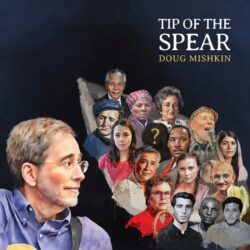
Which brings us to the retired lawyer, activist and, yes, protest singer, Doug Mishkin. To release an album like Tip Of The Spear in 2026 may seem fondly anachronistic, but perhaps the problems facing the US of A are not so very different from those which fired up that earlier generation. Except Mishkin is pretty much part of that earlier generation (although he is coy about his actual date of birth). He has released three records, each 20 years apart: Woody’s Children in 1986, Climbing That Ladder in 2006 and now Tip Of The Spear in 2026.
And Mishkin is still angry enough to be writing songs like If They’d Been Black about the January 2021 Capitol rioters “If they’d been Black, and smashed the door/Chanting ‘Hang Mike Pence’, and trespassed on the Senate floor/If they’d fought until policemen bled/If they’d been Black, they’d all be dead” and Reading Names (George Floyd) when he recounts that “A neck beneath a knee/While three watch silently/A bitter mockery/Of sweet hand of liberty.”
Mishkin’s signature song, Woody’s Children, also gets a fresh airing on this record, signposting his prime influence. This is a sing-along anthem, which has doubtless been sung along to at every Mishkin concert; “We are all Woody’s Children/We are all glory-bound/When we smile, when we sing his songs/We show we know the truth he found.”
With Mishkin’s gentle, straightforward voice, putting across his clear, articulate lyrics and simple melodies, supported by unobtrusive but skilled backing instrumentation, you could think you were listening to a soundtrack album from a stage play. In fact, most of the songs on the record are not railing at the ills of American society and cover broader terrain. They range from the simple Smitten, which is a catchy, rhyming ditty “Smitten/It’s akin to being bitten/By the cutest little kitten/Who won’t go away”, to the title track, which is the Almighty telling us off for the mess we are making of the planet “Your oceans are rising, your skies are on fire/Your battle for breath’s coming down to the wire/You’re losing a war with your own atmosphere/What must I do to make Myself clear?”.
One suspects that Mishkin does not expect his records to trouble the charts. He simply believes there are truths and feelings that need telling, and every couple of decades, he will articulate these, in part as an outlet for the frustration he doubtless feels about the fact that nothing really changes.
The personal songs on the album, such as The Delicious Part and Who Knew, tell of his contentment at being a grandfather. Others are more elegiac, as he ponders the passing of friends in Pour Me Another Year (with Tracey Grammer sharing vocal duties); “This year took two of my friends/I’ve prayed and I’ve cried, trust me I’ve tried/To move on as a voice recommends/Still – what to do with a year like this”, and in Egremont, the quiet joy of coming home. He even meditates on the fact that the memory of a young love lingers in Suite: Sweet Sycamore Street “Every day serves to remind/Life’s been full and love’s been kind/To me and mine, I hope to you and yours.”
So, a gentle album on the surface, but one with a bit more bite if one actually listens to the lyrics. After suffering the wall-to-wall coverage of the vacuous inanities of the recent Eurovision Song Contest, it is quite a relief to encounter music which actually has something to say.

