
This is a bit of a special Folk Tracks Roundup in that we’re not going to struggle to find a theme stitching all the song choices together, because we’re putting a bit of a spotlight on a particularly active exponent of folk music – The Broadside Hacks.
It is in the nature of Folk music that it goes through periods of lesser and greater popularity, and each such upswing in interest has attracted the label of a “Folk Revival“. It is, more or less, a generational thing – with folk revivals being identified as connected to the likes of The Pogues who made folk “relevant” by bringing in a chaotic punk inspired approach to a strand of the music which had become somewhat moribund, which allowed the likes of The Dubliners (heroes of an earlier folk revival) to become chart bound. English folk had a revival, which in part revolved around the young folk elements of Kate Rusby and Eliza Carthy, who were given a slight Blur/Oasis “rivalry,” with the very sensible caveat that one could like both. Throw in Bellowhead and the various companion/spin-off bands thereof (and recalling that the Remnant Kings were Eliza Carthy’s backing band at one point), and you’d find what we might refer to as a “scene” going on.
That’s another marker of a Folk Revival – local pockets of popularity allowing for a rediscovering of the tradition and a moving forward of the same into new or polished-off and cleaned-up (or alternatively muddied-down and made grittier) directions. And for the last couple of years, there’s definitely been the sense that new folk scenes have been rising up and making a bit of a stir.
Which brings us back to the focus of today’s Folk Tracks Roundup Special, which shines a light onto the Broadside Hacks label and associated tours and wandering folk club. They also organised two memorable celebration concerts this year, one for the music of Martin Carthy and the other the music of the Incredible String Band, which memorably featured Mike Heron.
Broadside Hacks is also the recording home for four exciting bands, most of whom we’ve featured previously: The Goblin Band, Spitzer Space Telescope, Brown Wimpenny, and Milkweed. They all have recent or shortly upcoming releases, so here’s a little about each of them.
Spitzer Space Telescope – real name Dan MacDonald – has just released a new EP “Spitzer Space Telescope III,” which follows on from two previous releases called… no, we’ll let you figure that out for yourselves. His performance, appearance, and sound is very in the vein of The Clancy Brothers, as featured song ‘Veritas‘ demonstrates. However, all the songs are all his as MacDonald explains, “From day one I’ve always aspired to be a songwriter. All I care about is great songs and who wrote them, and how the hell they came up with an idea out of thin air. If anybody asks me, where’d you get that song that you played at the show? I can have one answer: It’s all mine.”
Covering an earlier music vibe are Goblin Band, who can be seen here performing ‘Rosin The Beau‘, which is on their most recent release “A Loaf of Wax (live at MOTH Club).” There is a duality to London’s Goblin Band, who sound as traditional as anything and could have walked out of any local folk club of the last forty years or more – but additionally they have an inspiration as a collection of queer musicians brought together by shared desire to recover the radical and progressive energy at the core of traditional music. Inspired by the seasonal folk traditions of Britain and abroad, the quartet set their stall on re-energising timeless, much-journeyed songs for an ever-growing new community of enthusiasts. They have a special winter show at the Grand Junction in London on December 12th.
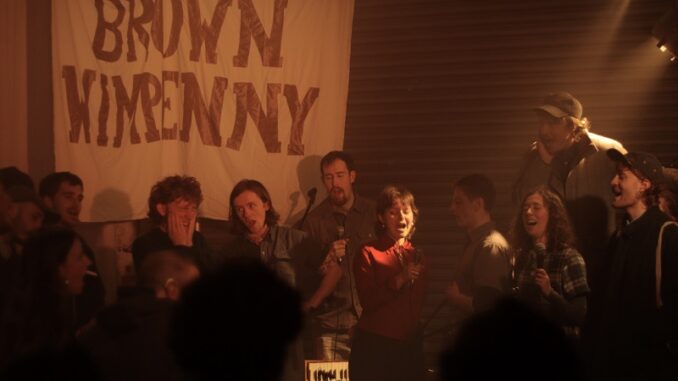
Another folk collective on the label is Brown Wimpenny, who are an eleven-piece London/Liverpool/Manchester folk collective who aim at bringing communities together to celebrate that rich catalogue of folk songs owned by no individual in particular, bar humanity itself. Taking its name from a distant 19th-century relative of tenor banjoist Seth Lockwood, Brown Wimpenny began with informal get-together Sunday jam sessions in his Manchester Living room. Growing as large as 25 members before being whittled down to its current number of 11, early gigs saw the band take up half the capacity of the room they were playing in, lyrics being passed around the attendees too, as part of a broader ideal of reducing the gap between audience and performer.
Speaking of their first release ‘The Sheffield Grinder‘, the band explain that “The Sheffield Grinder is a song we found in Roy Palmer’s book ‘Poverty Knock’. It’s about how workers in poverty – especially northerners – are often blamed and shamed by the rich and powerful for struggling to look after themselves. It was written as a protest song in Sheffield in the mid-19th century, when the Knife Grinders, notoriously poor artisans, were being publicly and unfairly blamed by MPs for their use of child labour, lack of education, and toxic working conditions. We wanted to do it because the North has a strong socialist folk history, and these important, rare songs are often underperformed. We paired this song with a Morris Tune, ‘The Black Joak’, to turn it into something danceable and channel the bitterness and resentment expressed in the song into something upbeat and radical.
As an aside, ‘The Black Joak‘ has its own history – the tune was originally coupled to rather bawdy lyrics which the EFDSS’ Paul Dennant described thus-wise: “it is feasible that the bawdy nature of the song caused the tune to become a signifier for lewdness and, as a consequence, to become extremely popular.” [my emphasis].
And finally – Milkweed – a duo who self-describe as a slacker Trad band and have a pretty unique sound that pulls together folktronica, strange, unearthly sounds somewhat reminiscent of the Incredible String Band, and an attraction to the weird, which brings to mind Seventies psych-folk and our old friends the Folk-Horror movies of that time. Add in that they may deliberately distort their music to sound like it comes from some rediscovered – but somewhat battered – short run LP from that era that no one has ever heard of before, and there’s a distinct mystique around their music. And it can be… somewhat disturbing in the strangeness that it invokes: but, well, folk has always been strange.


