
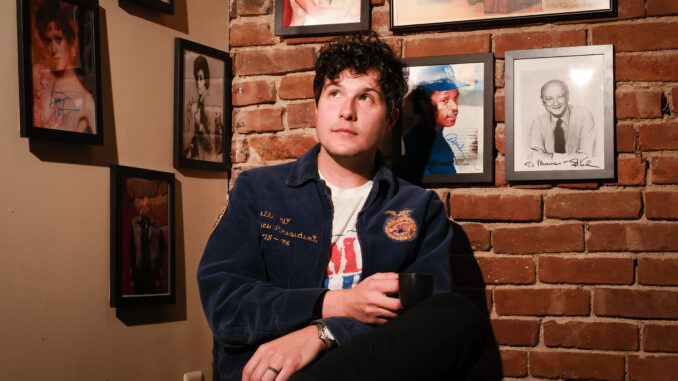
While patiently waiting for Brian Dunne to get his due from those who listen to and hopefully buy physical media, it is worthwhile to linger in the brilliance of his fourth album, “Clams Casino” (Missing Piece, 2025). It is the kind of record that stretches out without preaching, as Dunne weaves textures of americana, pop and singer-songwriter into one template. The result is a gratifying capsule of lyrical and melodic energy with the emphasis on lyrical. “Lyrics have the heaviest weight, but I think for me it all works together,” he offered. “I’m not sitting down writing a page of lyrics and then setting it to a melody. It’s kind of like doing the crossword puzzle; one part of your brain’s over here while the other part’s working on it over there, and they really do inform each other.
To listen to Dunne’s work is to see every turn in his brain become a collision. All of these parts fall into each other, and all of these parts tell stories so well. A song like ‘Gracie Mansion’ is forcefully strummed and accentuated by spurts of snare drums, his vocal melding flawlessly with the narrative. “Isn’t that the thing about getting to the top of the hill?” he asked. “It’s a bit of an illusion. And then once you’re there, are you happy? I mean, that’s sort of what the song touches upon, which is half the characters in my album have bottomed out, have run out of gas, and the other half are in Gracie Mansion. These are people who have succeeded and won the class war.”
Some would equate the class war as between Baby Boomers, who are seen by Gens X, Z and youth in general as draining America’s resources, with so many having reached the age to qualify for Medicare and Social Security. Where is the seat at the table for them, or will they be caught in a round of musical chairs with no open seats? “I kept thinking about if you are the anti-establishment angry young man, what happens when they do invite you in? What happens when you become establishment, and if you are the dreamer who it doesn’t quite work out for, what does happen to you? I wanted to tell those stories of where everybody seemed to be going, mostly just because I found it interesting.”
He came to New York City from Monroe, NY, to pursue his career and wound up moving around twelve years ago to the Red Hook neighbourhood in Brooklyn. The mayor’s mansion cannot be seen from either vantage point. “It’s an old longshoreman’s neighborhood that was run by the mafia in the sixties and has, in the last 20 years, kind of become a cool little artist hang. There are still some cobblestone streets down here. It’s right on the waterfront, a little nook of Brooklyn, and if you come down here, you will see me walking around.”

Dunne resides in comfortable quarters where he embraces the intrigue of his long-held passions. Here, he can indulge in the influence of the quirky ideas he so dearly pursues and shapes into narratives, some biographical and some fictional, or a combination of the two. “I would say I’m more of a fictional writer in that I’m trying to always inhabit a character, but there’s also a biographical element to each song. There has to be some sort of that in any song, no matter how narrative goes. There is some part of me in there that I’ve experienced, but I like the idea that you can use fiction as a more powerful tool than nonfiction because it frees you up.”
‘Some Room Left’ begins as a finger-picked ballad before a scurry of keys brings support beneath Dunne’s anchoring tenor. His character is spending hours on the Internet and ordering DoorDash, and probably can’t imagine asking a girl for a date, let alone interacting with people offline. Finally, he takes a tentative step outdoors: So I slip outside, To see if life is like the shows I watch at night, Past Upper East Side ladies and shopping carts, And the old men playing dominoes in the park.
Accompanied only with acoustic guitar, ‘I Watched the Light’ inhales and exhales like the growing world around us. Hopes and dreams are dashed as sympathy is offered to a friend who has decided to go back to Cleveland. I saw them wear you out and take you down, And I watched the light go out of your eyes. You could get lost in the song’s softness, and maybe we should.
Out of necessity, Dunne shouldered the load of playing all the instruments on his album except for enlisting Don Drohan for the drums and percussion parts, Alex Wright to play organ on the climactic ballad ‘Living it Backwards,’ and adding horns on a couple tracks. “I am mainly a guitar player, but when you’re making a record, and I produced this record myself, truly by necessity, you’re trying to express a feeling, and so that’s kind of a powerful motivator. You’ll be surprised what you’re able to do when you have something you need to get out of you. You’ll be able to sing; you’ll be able to play. I know my way around anything with strings, so I can kind of fake it.”
As for genuine talent, to borrow a song title from the album, there is no fake version of the real thing, and Dunne didn’t get hit with the lucky stick on the way to becoming a superior songwriter. He works constantly at his craft to produce these mini-novellas of music. This actually consumes his waking life. While doing this interview, he mentions nonchalantly that he is having a nice, easy morning with a cup of coffee, but there are probably ideas forming that are pounding on his skull to be released.
“I guess it probably consumes me,” he admits. “You’d have to ask my wife and my friends, but I’m pretty sure they’d agree with you that I’m enveloped in music at all times, thinking about what it means, what our responsibility is. As a songwriter, I live and die by the sword. I really believe in music as a bigger idea, and something that can be used as a really powerful public service. Hopefully, that’s not too lofty, but I think that it’s something that can change people’s minds. In this day and age, that is a powerful tool.”
In one way, Dunne is putting out a document of togetherness, through offering songs with a lot of made-up details, but the fictionality is delivered within the context of authenticity. Fans are clearly believing in what he’s saying. Though the music may play second fiddle, the intoxicating, even frisky melodies oscillate through clever tempo shifts that sink their hooks into you, such as on ‘Rockland County’, where conformity in a boring community wins out over the hustle of life on the margins. He taunts over an accompaniment of crisp percussion: Farmers market! Super Target! That used to be a Bed Bath and Beyond, Free parking! What a bargain!
For Dunne, the most personal song on the record is ‘Some Room Left,’ which is about how the wider issues trickle down to the personal feelings of cynicism and malaise. “Ultimately, it’s a hopeful song,” he made clear. “That song to me feels like it sums up what I’m getting at, which is a recognition of all that is cruel and cutting about the world and still finding some optimism at the end of the day, which I think is my general thesis.”
The acoustically-built, percussive, sprawling equation of ‘Living it Backwards,’ which is the tenth and last song, is the cream of the record, however, as it bursts into colour through an amalgam of both electric and acoustic guitars while an unshakable backbeat zigs and zags around the lyrics. It sounds like he went back in time and made another record with Fantastic Cat, a band he is part of and intends to tour with after supporting “Clams Casino” with solo gigs. There will be a few songs mixed in from “Loser on the Ropes” (Kill Rock Stars), one of the absolute best albums of 2023. In the notes for it, he mentioned being obsessed with failure as it’s more interesting than success.
“I actually was at that time,” he admits. “The truth is, every album I make, I’m usually chewing on something that I can’t put down. On “Loser on the Ropes,” part of why I titled it was that I was finding myself drawn to stories of failure because I found it so much more compelling than stories of success. It felt so much more humanizing. And so that’s what I was exploring, how failure can exist from the individual level to the governmental level on a global scale and how it’s all essentially in the recovery.”
Clams Casino is a tasty hors d’oeuvre that my father always ordered when the family went out to dinner, although it is merely a bivalve with a shell that opens like a mouth in order to have ingredients stuffed inside. In Dunne’s world, he thought of the appetizer as a larger idea, as if prepared by a chef with a flourish of hot sauce. “A working man thinks a rich man eats. It sounds fancy, but it’s not actually that fancy. It sounds like something that you order when you get to the top of the hill.” Dunne must have been prescient while imparting that explanation. My father usually dined at the Federal Hill Club and worked very hard to afford the luxury. The title song asks the rhetorical question: Is it bad to want a good life?
“I became really obsessed on this record with the idea of class and how that determines everything in America, how a lot of what we’re looking at in the modern political landscape actually has to do with class and where you’re coming from and where you’re trying to go. And for me, I was born in a working-class family. My dad worked at a factory. My mom is a legal secretary, and I’ve always had this duality by which I am proud of my working-class background. But I also understand the job of being a singer-songwriter is inherently fanciful and cosmopolitan in some ways. I’ve always struggled with this. Can I be proud of my roots and also want world domination, and does that make me a fraud? So, the song asks two questions: Why is it so hard to have a good thing? This is the working-class blues side. And then is it so bad to want a good life, which is the sort of class shame side? Is it bad that I want out?”
Is this an underlying shame or the American dream? Dunne offers an answer in the form of several questions. “That is what I’m trying to figure out. Am I a fraud if I want more, or was I a fraud before? Because is it the American dream, or is it just wanting to be invited to a party that you’re not invited to? Is it just jealousy? I don’t have an answer, but the album seeks to find one.”
These days, you can’t fold a paper aeroplane and launch it without hitting a singer-songwriter. It’s an overcrowded field, and air traffic controllers can’t handle the flow of new music coming at consumers from all angles. Separating yourself is not easy, and sometimes all you have to remain attached to is your ambition. Dunne is proud to not be letting go of his. “I had moved to New York, and kind of clunked around for a couple of years,” he related. “Finally, I realized that the thing that I had planned on hadn’t worked. I hadn’t been discovered or signed, and I took it on the chin and decided that I was going to do it myself, come hell or high water. And I’ve sort of built this thing on my own, and luckily now I’m signed, and have an agent, and a manager, and all that good stuff. I am proud that I had the stones to do that at such a young age, and that I set myself on a path that has grown and prospered and in a lot of ways is more meaningful than my original idea.”
At this point in his life, Dunne has plenty of inspiration and a bottomless stream of material to sluice through for more musical nuggets. He has a fertile imagination and acres of compelling ideas to seed.
“I suppose I have always felt there is no shortage of things to say,” he added without hesitation. “There is no writer’s block on the horizon for me. I don’t really think of it that way. It’s not about inspiration; it’s about I just find human life so incredibly interesting, whether that’s good or bad. I go through phases where I say that, in a derogatory or positive light, but I think that I have always found it’s so fascinating how humans interact with one another. And to me, there is never any end to writing about it.”

