
Introspective harmony-drenched folk americana with a message and a heart.
 Why are some harmonies so pleasing to the human ear? Actually, to the human brain. A physicist might answer that it is due to simple mathematical frequency ratios. Well, maybe simple to a mathematician, but Greek to an arithmophobe (like your humble reviewer). But not ‘Greek’ to some actual Greeks, such as Plato, who were on the vanguard of trying to answer what is truly an ancient question. So, 2,500 or so years later, what is the answer? Drum roll, please…
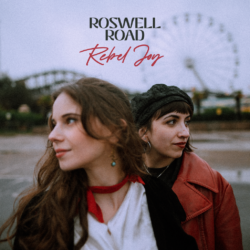
Don’t know, don’t care. But you know it when you hear it. And you are going to hear a ton of it on Rebel Joy, the debut album by americana duo Roswell Road.
The harmonies that saturate this album might lead one to believe they are so-called ‘blood’ harmonies, also known as ‘sister’ harmonies, to denote the type of perfectly matched voices that often come from siblings who share a gene pool. That is not the case with Roswell Road. Jasmine Watkiss and Zoe Wren are not related, at least not in this life. But the way their voices intertwine into something that often feels singular, they might have been in the distant past. And while the harmonies are the dominant feature of this duo, the songwriting and instrumentation are close on the harmonies’ heels. Wren’s mostly acoustic guitar work and a touch of piano along with Watkiss’ ukulele and violin are the solid canvas upon which their harmonies are thickly painted.
The album opens with Holy Mountain which immediately announces the essence of this duo’s sound. Sweet, high harmonies from word one, sung to a jaunty upbeat rhythm. These two are not going to just use harmonies to punch up a chorus; they are going to often, simultaneously, share vocals throughout a song so that the listener is unable to discern a lead vocal from a backup vocal. This song also introduces the very tasteful violin that is featured on several tracks.
The opening of Island Citizen is sonically reminiscent of a Crosby, Stills & Nash song; had CS&N recorded it in 1985, when David Crosby was in jail, and there were only two vocal parts. It starts with some very Stephen Stills-sounding guitar and a gentle, single voice for the first two lines. Then that magic second part comes in, a fifth maybe? OK, no more math. Whatever triad tone it is, it totally has that CS&N Helplessly Hoping feel. The chorus exits the CS&N realm and transitions into a scathing indictment of immigrant prejudice.
“Island citizen, how did you get here… Look again, you’re being played like a puppet on a string, your history is mythology, and there’s violence in your heart, who’s the enemy really, the small boats or the yachts?”
Lyrically, this song is a good example of thoughtful writing that is social commentary wrapped in a touch of abstraction. Lyrics that expect the listener to actually listen to the lyrics, which is not a given in today’s attention-deficit disordered ear-candy streaming culture. Lyrics that hope the listener comes with at least a cursory frame of reference. Even though these two could “sing the phone book” and have a really, really listenable album, there are no throw-away lyrics here.
Can’t Take My Soul is a rebuke of music industry misogyny and Bond Street/Madison Avenue bondage, delivered in a Gillian Welch/Dave Rawlingsesque package. The violin breaks approach, but don’t quite enter that uneasy-yet-beautiful dissonance that makes Rawlings’ guitar parts so unique and interesting. This whole album is so beautifully arranged, sung, and recorded that perhaps it could have benefitted from some moments of dissonance or imperfection to create a little more musical tension and raw vulnerability. In this day of soulless AI song-generation, where unnatural perfection and contrived production are starting to pollute the music industry, some artists are starting to purposefully leave a few flaws in their recordings to make them feel more human or a little more like a live performance, where happenstance often makes a performance unforgettable.
Arabella is a gorgeous love song that starts out sleepy and folksy and feels like a warm duvet on a grey London winter day. The second verse then punches in with the most prominent drumming and the only electric guitar on the album, turning it into a lively, almost semi-rocker that never loses the warmth. This works so well it may be something to include more of on future recordings.
Finally, as the old Monty Python catchphrase goes, “And now for something completely different”.
Bolder, a very Gaelic-sounding modern sea shanty about fishing ground ecotage, stands in sharp contrast to the rest of the album. The word ‘bolder’ is cleverly used as a homonym in this tale of Greenpeace monkeywrenching to fight indiscriminate sea bottom net dragging. Musically, it would feel at home on a Spotify St. Patty’s Day playlist or a Cousteau Society member’s iPod. Not every artist can pull off the insertion of an anachronistic song like this on an otherwise relatively musically consistent album. The Decemberists come to mind as a group that successfully does so quite often. So did these two. Fearlessly.
In a nutshell, this is a very solid debut by two very talented musicians and songwriters. For an album that uses pretty minimal acoustic instrumentation throughout, the production is rich and full. If at some point they put a full band together, it would be amazing. But they don’t need it. Judging from some live performance videos on YouTube, their live performances are just as good as their studio performances. Go see them if you can.

