
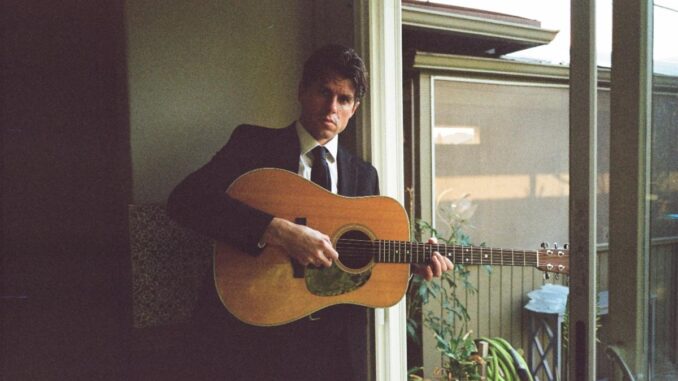
Cory Hanson writes songs …. a lot of songs, ten albums in eleven years’ worth of songs divided between the band he fronts, Wand, the Cory Hanson Band and his solo act. Asked if he is taking a break from writing with his fourth solo album being released, maybe taking a short stretch of downtime, his reply was: “Just working on music stuff. I’m always working on something.”
Well, aren’t we all? But for Hanson, he has taken to heart the practical advice he once received from the late David Berman of The Silver Jews. “You need to constantly be writing and reading. Whatever, it doesn’t matter,” he said, remembering the counseling. “Read a newspaper, read the back of a cereal box, just read things. Get a separate notebook and write twenty lines a day. And don’t think about it; just do it like you’re doing pushups. Over time, you will accumulate a ton of writing that you can pull from if you need something. If a line is kind of weak, you go through the notebooks and find this reservoir of material.”
I hadn’t heard very much of Hanson or his band’s music before, but a friend’s endorsement and the evocative cover art on his latest – crosshairs of a rifle scope superimposed over his image – were enough to sell me on listening to “I Love People.” It turns out Hanson loves people, well …. some of them anyway. “It’s the album’s title. It’s not, I love all people, so you can kind of take it however you like.”
He clearly loves writing about people and the crazy shit they get themselves into, the inner tussle between redemption and recklessness, a feeling that a reckoning is close at hand whether it be from the good or bad decisions his characters have made. This is what makes his songs so approachable while wanting to keep the sticky situations at arm’s length.
Take ‘Joker,’ an amalgamation of not just the Batman villain played by Joaquin Phoenix, but also folk characters or anti-heroes like Steve Miller’s Joker or Dylan’s Jokerman. “I wanted to write about an agent of chaos, some force of nature that can only do evil,” he explained. “while I get to be the narrator or straight man, watching everything burn.”
These agents turn out to be like people you can have a beer with in a dingy dive bar, until the eventual fight breaks out. Hanson is seated at the end of the bar, taking it all in. But instead of fiddling like Nero as Rome burned, Hanson plays guitar and has skills that shine. Whether you are having a good day or a bad day, you can always use a guitar as a celestial entity to put yourself above the fray. He introduced his listeners to those skills in Wand, and they burst from the grooves on his previous album with the prurient title of “Western Cum.”
That one has the high-octane solos and string-bending riffs you might associate with noted slingers like Hendrix or Peter Green. Just listen to the opening track, ‘Wings,’ which exchanges dueling cowboys for angels with a grudge to settle. ′Cause you hadn’t found the time, to clear the case file of the murders in your mind.
His uncle had a hand in showing Hanson the way around a fretboard as well as teaching him to use his hand and all the fingers. He had learned the solo to ‘Purple Haze,’ but was playing it by using only his index finger. His mother used to tease him that he was going to be one of those guitarists who only played lead and sat down for the chords. She sang in some country bar bands while his father was a classical and jazz pianist. “They did play together briefly,” he remembered. “I think they met through gigging in the ‘80s in Los Angeles and then split up pretty fast. My dad was always playing Mozart and Bach and also Miles Davis and John Coltrane, and my mom was playing a lot of Tom Petty. She was listening to top 40 CMT country shit like Garth Brooks, Trisha Yearwood and Faith Hill.”
Hanson has these two parallel career paths, one being the still active band Wand, the other his solo work. Wand put out “Vertigo,” their sixth album in 2024. When the band formed, Hanson did all the songwriting but since has ceded some of it to his bandmates. “The band has become more of a democratic writing machine, and so I don’t have to really mess with it by bringing all the songs in.” he reasoned. “It just somehow develops. We walk into the room with nothing, and then we come out with a bunch of stuff that we’re like, what the hell is this? And then we work on it for eight months and it turns into songs. Maybe someday I’ll take all that on again.”

For “I Love People” he recruited most of the same people who recorded “Vertigo.” Evan Backer played bass, horn and string arrangements while Evan Burrows was on percussion and Robbie Cody co-produced, leaving Hanson to alternate between guitar and piano. The two projects come across as quite different in certain ways because Hanson treats each one differently. Where Wand demands some heavy studio tinkering, the solo material is more relaxed and free-flowing. “The record has an organic quality that comes from not overdoing it in rehearsals or the studio,” he said. “Everything was recorded live, including the vocals. This comes from an accumulation of musical effort for all of us to communicate together through the language of music. We instantly have a rapport that you build by doing this for so long. It’s like a musical conversation, just like the one we’re having, where we listen and respond to each other.”
Hanson’s subject matter is so varied and plentiful that there is never a question of short-changing the band or himself. The ideas can come from anywhere. “I write constantly, not in a super focused, stressful way or a work way. I just write because it’s fun. I’m not sitting down in an office with an acoustic guitar and a pen and paper and trying to write earwormy songs. It’s more like futzing around. I’ll wash the dishes, take my son for a walk, exercise, do all kinds of things. I hang out in my garden and just write if a song comes in my head, and it usually does.”
Whereas his 2021 album, “Pale Horse Rider,” was infused with soft ballads and poignant lyrics, “Western Cum” was up front, loud and brash, and at times weird as in the tune ‘Twins,’ a send-off of the ’80s Schwarzenegger-Devito movie (What if twins were two connections of a soul? Like Arnold and DeVito, One egg with two yolks). “I Love People” is even more wide-open and adventurous. The twist to ‘Santa Claus Is Coming Back to Town’ is the children will be happy, or maybe not.
Hanson always wanted to write a Christmas song and make a Christmas album. “I really love Christmas and the music,” he said enthusiastically. “I guess this my kind of twisted take on that. I mean, I love writing about these American folk characters. You would never think about Santa Claus as a vessel for expressing something outside of the commercial world of Christmas music that they play one time a year. I wanted to take him outside of that context and put him in some foreign place like Afghanistan. Why would he be there? I don’t know, but it’s interesting to me.”
He admits there might be a little Leonard Cohen reference in the opening track, ‘Bird on a Swing.’ “That song lived in my head for a long time. I couldn’t figure out if I was ripping off Cohen or Jerry Jeff Walker or Springsteen. Then I got this big John Denver 12-string and it all came together in ten minutes.”
Given recent events in the Lone Star State, ‘Texas Weather’ is a rather eerie title. Hanson is aware how violent and terrifying the weather in Texas can be. The hallucinatory, poetic images reflect that in a ‘70s Laurel Canyon kind of vibe. “I’ve been on the road from El Paso many times, and there’ll be thunderstorms, flooding, insane winds that drive the van off the road. It’s a really chaotic region, one of the most dangerous parts of the United States to drive, and I had to write a song about it. I’ve just lived it so much.”
Hanson’s vocals feel marinated and grilled in sweet sauce, like for a juicy steak. He casually sears the meat of his words on the piano-driven ‘Old Policeman’ and the oxymoron titled ‘Bad Miracle.’ He radiates the moments of struggle we all feel at times with lyrics that show your inner demons can become routine but your inner angels can become a journey.
“I was in Sparks, Nevada, just thinking about bad shit that happens somewhat seemingly at random like in those “Final Destination” movies,” he said in reference to ‘Bad Miracles.’ “Well, the whole point of the movie is it’s like a slasher flick, but there’s no slasher. There’s just this force, like a supernatural force that starts to unwind reality and then construct these horrible death sequences that appear to be accidents. How could this ever happen? You watch this invisible thing guiding a sheet of glass to fall seven stories and cut someone in half or something horrific like that. Yeah. It’s just the idea of being in constant fear that was fun to contemplate.”
The willing suspension of disbelief is what movie buffs do by accepting and engaging in a fictional narrative. Hanson gets some of his ideas from films and especially loves the western noir of “McCabe and Mrs. Miller.” He looks for tiny bits of inspiration like peering into the enlarged eye of Julie Christie at the end scene and find yourself in another dimension.
“I think that for songwriting, any material that you can get your hands on, you just hear a line here, a line there, a little piece of dialogue in movies or books is of value. Like Bob Dylan where he’ll have a line like, my father was a feudal Lord, and it’s like he pulled that from a Yakuza biography in the 1960s. It’s like a search or a hunt for tiny nuggets of inspiration and phrases. I look at a lot of church signs. There’s always something good in a church sign, and I’ve taken a couple lines from those in the past.”
What about the one in the opening sequence of the “True Blood” TV series – “God Hates Fangs” – could that be a song? “Oh, there’s vampires in my songs,” he replied facetiously (I think). “There’re tons of vampires and blood. Lots of blood.”
Well, I’ll have to check the back catalogue on that one including his first, “The Unborn Capitalist from Limbo.” All four seem to have a different flavor yet come from the same songwriter. “Robert Altman made a lot of different types of films, but they are always Altman films,” he reasoned. “‘McCabe and Mrs. Miller’ they call a snow western, but it’s still Altman. I guess you could say the same about my songs. I mean, for this new record I was listening to songs Nelson Riddle arranged for Frank Sinatra and how the orchestration fit perfectly. That showed up on my record.”
 When Hanson takes these songs on the road, however, the gloves come off. “Well, the notes will be the same, but the instruments playing them will be less lush and panoramic,” he said while indicating the connection would remain close. “It’s fun to add that kind of ornamentation and frame the songs that way, then take them to a live arena and shrink them back down to what makes them songs, what makes them the way they were written at a piano or a guitar.
You could exemplify “I Love People” as a synthesis of tales from the dark and fantastical side of indie rock with a twist of Neil Young, Dylan or Lou Reed in the cocktail. Reed’s music especially resonates with Hanson as did the man himself. During his time as a student at Cal Arts, he met Reed and what he was told has stuck with him like chewing gum on a shoe, an unshakeable reminder that has followed him throughout his journey, shaping his path. “I consider myself very fortunate to have met him,” Hanson said of the fabled ex-Velvet. “He told me that his goal was never to be like a punk rocker per se. His goal was to make music that sounded the best and was the highest fidelity from the get go, regardless of what record he was working on. He emphasized you have got to have some kind of goal over your whole career, otherwise you’re just going to end up a poor schmuck.”
More artists than you might expect have written songs about or referencing Lou Reed, such as: Conor Oberst (‘Next of Kin’), Jens Lekman (‘Cold Swedish Winter’), Sun Kil Moon (‘That Is Not Possible’) and the tremendous “Blue Moves” album by Nils Lofgren. Hanson’s contribution is simply titled ‘Lou Reed’ in the form of a fan letter to the one who was notoriously averse to the trappings of rock stardom.
“I didn’t set out to write a song about Lou Reed,” Hanson explained. “I was reading Laurie Anderson’s obituary that she wrote in the Long Island newspaper, and I was really touched. As I was reading it, the song just showed up and the refrain: You were a prince and a fighter, you were a Tai chi master. I just liked that as a way to sum up a life, especially a life like Lou’s, which was so dedicated to mastering both the form of T’ai Chi and the form of rock and roll with each one being like a constant pursuit.”
When I had the opportunity years ago to meet and converse with Lou Reed, it was at a martial arts seminar in New York. Both his master and mine had been main students of one of the Four Tigers of Chen style. I shared with Hanson what I had related to Reed about my T’ai Chi master’s advice on practicing the form. Basically, his instructions were to practice every day because if you miss one day you go backwards two days in ability. Hanson thought for a moment then said, “I love that. But it’s very different from what Lou would say about rock and roll. He never practices. For him, the whole thing is about showing up and being natural and and not trying to stress out the music with scales or different chords. He had a devotion to the three-chord way of songwriting.”
Those words gave Hanson a quiet determination to eventually fulfill his own goals and indelibly accelerated his career path. To put it in martial arts terms, “recognize what you soon will be.” You understand how to let the lyrics and melody just flow through you to the page. As he observed about writing ‘I Love People.’ “I sat down at the piano but I don’t fucking remember writing the song at all. Actually, it’s like, what did I do? How did I write this one?”

