
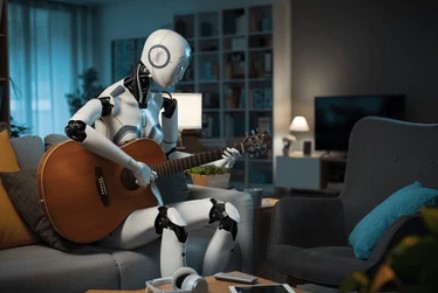
Some years ago, the director Alex Garland made a movie with a title similar to this column, except it was Ex Machina, not Musica, which I’m guessing is the Latin word for “music.” Although Deus or God had very little to do with the movie’s business tycoon developing a humanoid woman that was, of course, super hot, the point was this was a walking, talking replica of a female with an IQ of 1900. And, if the fellow tapped by the titan of industry to administer a Turing test to discover whether Ava was real flesh and blood or something other played his cards right, well, she would soon be fucking his brains out.
That’s kind of how I feel about Artificial Intelligence, or its innocuous acronym AI. Whoever has been using AI to generate music is fucking us, and by “us,” I mean the people who believe music makes the world go round.
Technology has been used to change and shape music for generations. I’m sure classical guitarists were horrified when the electric guitar was invented. The synthesiser was hailed as the sound of the future, yet many recording artists denied or hid its use (Queen on their ’70s albums). Maybe you remember the controversy that erupted when, a year or two after Phil Lynott passed away, the surviving members of Thin Lizzy went into the studio, took some vocal tracks from the files, and produced the hit song Dedication.
It’s a decent song, and they released it as a Thin Lizzy song despite Phil obviously having nothing to do with its production, being, uh, dead and probably not grateful. But they were completely up-front about what they’d done; they weren’t trying to fool anyone. In fact, they said they’d done it as a final tribute to Phil, which was sort of cool, but a lot of people thought otherwise and said as much in a particularly brutal social media thread.
And that is just one example. For the single Now and Then, Paul McCartney and Ringo Starr had AI used to isolate and enhance John Lennon’s voice from a decades-old demo, allowing the final Beatles song to be completed.
And here’s another one. After a stroke impaired the ability of Randy Travis to sing, AI was used to recreate the country singer’s voice from archived recordings for his single, Where That Came From.
In a different direction, ambient music pioneer Brian Eno used generative AI to create an app version of his album Reflection. Actually, we suspect Eno himself is an AI creation, but let’s get to the bad stuff.
Does the name Sienna Rose ring a bell? Prior to last month, I had never heard of up-and-coming singer Sienna Rose, but based on social media mentions, it appears a lot of people had. Sienna landed three songs in the Spotify Top 50, and a soul ballad called Into the Blue has been played more than five million times. Rather ironic, wouldn’t you say, since Sienna has no actual soul. In case you were wondering, she is as much a real person as vegan cheese is real fromage. That’s right, this mysterious singer has no social media presence, no videos, no tour schedule or a discernible human form. She was AI-generated, and well over a million people count themselves as her fans, although some randos have proposed she is the black sheep daughter of the Rose family in the Canadian TV series Schitt’s Creek.
Americana and country music have not been immune to the advances of AI artists. The Velvet Sundown, perhaps formulated on early Eagles, has been releasing albums faster than you can say Lyin’ Eyes. The #1 country song on Billboard charts last November was Walk My Walk by Breaking Rust, an artist that cannot walk because “it” is AI. Songs by Cain Walker (perhaps a character from The Walking Dead) and Xania Monet are nipping at Breaking Rust’s fake heels. And then we have the until-proven-otherwise real artist, Beans on Toast, whose songs are a gas, gas, gas. His song AI was created to bring awareness to the impact of artificial intelligence by using AI to create the lyrics. It is on the album The Toothpaste and the Tube, which you could view as a metaphor about the improbability of putting toothpaste (AI) back in the tube.
There are even some “fake” fakes out there. Back in the ’90s, Dave Matthews let loose a herd of lawyers throughout the country to drop in on music retailers selling DMB bootlegs, with the mission of intimidation, seizure, and demands of compensation. I forgot to add “allegedly” to the previous sentence. My bad. But how do you think the DMB feels about the AI song Bots Marching? You have to admit that’s pretty funny.
What’s not so funny is Apple’s metadata “Transparency Tags” feature, which asks record labels to voluntarily disclose when they upload AI-generated music, which is like trusting students to admit when they use the revolutionary, game-changing tool ChatGPT to cheat on their exams more efficiently than ever before. You know, pretty please, be honest. Right. Why would labels or independent producers comply? It is like asking the mullahs in Iran to hand over their supply of enriched uranium without being convinced it’s in their best interest. Now, we are not suggesting that, instead of the honour system, the musician’s union (yes, there is one of those – AFM) should (figuratively) bomb AI music merchants to oblivion, but as the old saying goes, “there oughta be a law.”
The problem is some musicians are too casual about AI use. For example, Selena Gomez, who plays Mabel Mora in the hit Hulu series Only Murders in the Building, posted a series of photos on Instagram after the Golden Globes and soundtracked it to Where Your Warmth Begins, a Sienna Rose “original.” You would think that Gomez, who has sung pop hits like Calm Down, would have a smidgen more awareness. Actually, rather than warmth, the song leaves you so cold you might feel the necessity of a steam bath.
Left unattended, this could well become an intractable problem, like the rise in popularity of pickleball. Admittedly, I’m not a fan of AI or pickleball. Your pilgrim has not yet learned to love the Dark Passenger, and I don’t mean Dexter. Who knows what AI will bring to the future of recorded music? It all started with those two sweet-talking floozies, Alexa and Siri, and now we have Sienna, and others sure to follow, maybe with AI bodies in holograms. Of course, that lies far in the future, which by definition has not yet occurred. But how far?
The writer Dorothy Parker titled her biography after her famous phrase, “What fresh hell is this?” If AI fundamentally changes the ways in which people create music, will the music industry and the copyright system resist or adapt? Music is fueled by innovation, but shouldn’t there be some designation that separates humanus from machina? Maybe take a page from legislation that forced the tobacco industry to put warning labels on packs of smokes. Something on the order of: “The use of AI could be hazardous to the health of original music.”
Right now, most artists are only concerned with recording and distributing their own music, putting it on Spotify and the other streamers. However, one day they will come to realise, as Snoop Dogg did before lighting up his morning spliff. “They did what? When? How? Are you sure?”

