
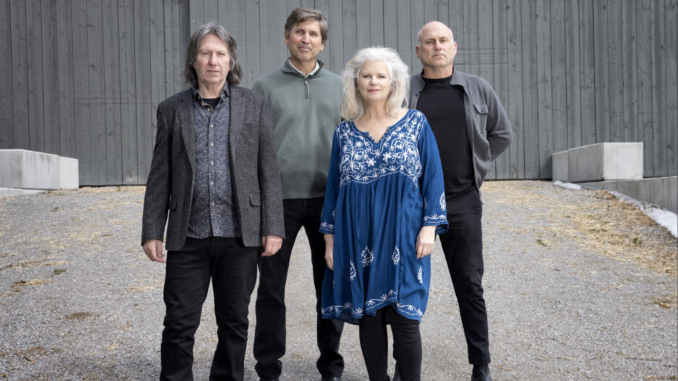
A few months ago, we got an album of more (acoustic) junk from the Junkies. Okay, that is a horrible image. Better start over. Michael Timmins, along with siblings Margo and Peter, and Alan Anton, the Cowboy Junkies, served us a delicious plate of acoustic versions of their songs, which was supposed to tide us over until the next full studio recording. Only, it whetted our appetite, leaving us hungry for more, like banging knives and forks on the table hungry. “It was intended as a transition album,” Timmins said during a Zoom call, “giving us the chance to play some of our older material on this coming tour.”
But why quibble. The fact is, every single Cowboy Junkies record I have heard is worth savouring, and I’ve heard them all, unless there is an outlier in witness protection. Cowboy Junkies music has always been about good people, bad people and misunderstood people, but it always leaves room for redemption and that muddy space between good and evil. We’ve heard characters be good or bad in the swing of a song, or similar ones act differently based on their changing choices and motivations.
The band has always sprinkled a fair amount of covers into their sets. In fact, they launched what has become a 40-year run in 1987 with Whites Off Earth Now, which contained old blues songs and only one original. While my initial reaction to this was, Do we really need this?, I had a change of heart once the needle hit the groove. Early 21st Century Blues in 2005 was another collection of covers on the theme of war, like, what is it good for including songs from John Lennon (I Don’t Want to Be a Soldier) and George Harrison (Isn’t It a Pity), amid two originals. December Skies displayed pent-up anger and frustration: September skies / bodies falling / Time to kill our children / and sing about it. And one of the four albums that composed the Nomad series consisted entirely of Vic Chesnutt songs.
The Velvet Underground classic, Sweet Jane, has become associated so strongly with the band that fans who cut rock ‘n’ roll history in school probably think it’s an original. After hearing so many other not-great versions, Timmins wanted to restore the song to its 1970s glory. No less an authority than Lou Reed (he wrote it) said theirs was the best version, and they recorded it lo-fi with one mic and a Sony recorder inside Toronto’s Church of the Holy Trinity.
In a fun little twist, it turns out that rather than the four members defining the band’s sound, instead the band’s name defined its sound. The first show they played at a local venue, the owner of the club asked for their name. “We sat down and began to throw words around at each other,” Timmins recalled, “and our only criteria was that we wanted a name that would make people go, huh? What’s that? Sorta putting two words together that didn’t make any sense.” At the time, Cowboy Junkies didn’t play any country or folk; they were more of a blues-type band. After a few years had gone by, it became apparent country-folk, eventually to become americana, was the secret sauce.
For his part, Timmins likes most everything they’ve recorded. He has this deep, visceral approach to both songwriting and playing guitar. It goes to a post-punk, DIY thing. There is no question that it all works and continues for four decades down the road.
Americana UK: I’ve read you like fly fishing for sport.
Michael Timmins: Besides music, that’s my thing. I also play hockey, being a true Canadian. And attend Blue Jays games since I am in Ontario.
AUK: Baseball. When I lived in Montreal for a while in the ’70s, the Expos were still around. Played in Parc Jarry before moving to Olympic Stadium.
MT: Actually, I grew up there. I was just across the fence, and we could hear the Jarry Park announcers from our backyard. I was there all the time – 50 cents in the bleachers.
AUK: Let’s start with your album, More Acoustic Junk (Cooking Vinyl 2025). It feels like you have this large vault where music is stored, like in a junk drawer in the kitchen with the thread and tape and paper clips, or in a safe deposit box that you open every so often. Is it a bottomless supply?
TM: I don’t know if it’s bottomless, but there’s a lot. We’ve had our own studio for a long time. If we’re playing, we’re recording, and I tend to archive stuff. And then a decade later, two decades later, somebody says, how about this? Or do you have a cover of this artist? I go through the archive and listen back, and if it’s worth getting out there, then I’ll release it.
When we first joined the major labels, way back when we signed with RCA, I remember being in the New York offices and going into their CD and vinyl vault, which we were allowed to for collecting stuff. Of course, they had Elvis coming out of everywhere. A guy told me, well, basically, the Elvis catalog is what keeps us going. Okay, interesting. I learned early on that catalog is something that’s important to archive.
AUK: Why did you do half and half – five songs from the 2009 album Acoustic Junk and five new tracks?
MT: This was originally a Record Store Day release, so to me it’s like a minor release. We could have just released the old Acoustic Junk and let it go there, but there were a few songs I wanted to add from our catalog that we’ve been playing live that I felt were important and would probably have been missed. It was just another way of putting attention on a few songs. The other thing was Acoustic Junk was a very limited release, only on CD, and we only sold it at our shows. There were a few songs on there that I thought were really great, and I wanted to get those out there.
AUK: Angel in the Wilderness is an intriguing song. Would you talk about that one?
MT: It is really inspired by the book Gilead by Marilynne Robinson, which is one of my favorites. It is a beautiful meditation on a father to his son. He’s a preacher, so there’s a lot of religious imagery and some beautiful ideas about the reality of a relationship, whether it be your spouse or your child, or just the reality of the difficulties that one has to face.
AUK: Cowboy Junkies are going on the 40th anniversary tour. Most marriages don’t last that long. Being a family band, how has the band managed to survive four decades?
MT: Well, I think when marriages last that long, it’s about communication, changing the relationship when you need to and listening to each other about who needs what, who’s getting what out of the relationship or the partnership. Also, it’s what each of us need in order to keep it going, keep it fun and exciting and moving forward. We’ve done that on all levels, from the artistic side, but even more importantly, on the business side, how we put out records and who we deal with. Most importantly, on touring because that is what breaks up most bands. It’s the hardest and most stressful part of being in a band. So, we’ve really been aware of who’s where in their life and adjusting how we tour, how long we go out for, where we go, how we travel, all those things.
AUK: What will the setlist look like on this tour?
MT: We never keep it static. These days, we are doing two sets; the first generally will be focused on the newer material. Ferocious Beauty (Latent Records 2023) is not that new, but that is what I consider our latest record. And then the second set is full on catalog, and that changes a lot from night to night. There are a few songs that we play every night, like Sweet Jane, Blue Moon Revisited and Misguided Angel, but generally it changes night to night.

AUK: Any new covers? Fans look forward to the band’s take on Dead Flowers and the others.
MT: We’ll do some from Whites Off Earth (Latent Records 1986), which was all covers. And we’ve reintroduced Me and the Devil, the Robert Johnson blues. But it will be more our material this time.
AUK: You started out in Toronto in the ’80s, I believe. This is Cowboy Junkies’ 40th anniversary, so I can do the math. What was the music scene like back then?
MT: It was actually really good. I’d been in bands in Toronto in the late ’70s, and that scene was riding on the tails of the whole punk movement out of New York and London. It was a very vibrant punk scene with lots of different music and styles. Then it kind of died for a few years, and lot of the clubs closed down, and many of the bands disbanded. We actually moved to New York and then to London (England) for a while, and when we came back in the mid-’80s, there was this nascent roots music thing happening, especially country music that was very rootsy before it became a big thing. Americana wasn’t a term yet. There wasn’t much money with it, and no major labels involved. So, it was very organic, and everybody helped each other. We are good friends with the band Blue Rodeo, and they lent us their rehearsal space for a year free of charge just to get our band up and going.
AUK: Your sister, Margo, is the singer, but sometimes a song will seem to come from the male perspective. Cheap Is How I Feel strikes me as one that could be taken as either from the male or female view.
MT: It depends on the song. That’s the best example I think of me writing a song that is me. But we quickly realized as soon as Margo began to sing, it took on a whole new perspective. Until Margo gets the song, we won’t decide whether we want to keep it. If it is a song that’s about a specific character, and it has a he or a she in it, we decide whether we want to flip the pronoun or not. When I’m writing, I’m not really that aware of it, though sometimes I am thinking in terms of a female protagonist, but often I’m thinking and writing as a male.
AUK: If You Were the Woman and I Was the Man is the example I was looking for.
MT: That is definitely from both sides.
AUK: Cowboy Junkies seems to be able to capture the essence of live music in studio recordings better than most bands who try to replicate what they sound like on record.
MT: For us, live performance is really the key of our era of band and style of music. Playing live is what it’s all about. You start a band, especially back then, you’re thinking about getting up on stage and performing songs, performing music, that energy and that expression and communicating with an audience. So, when we were in the studio, we want to make sure we capture as much of that energy as possible.
AUK: I sense that there is not much overdubbing in the studio.
MT: No, there’s not. I mean, some records we say, okay, let’s make this a thicker record or more produced, but generally speaking, even on those records, we try and capture as much off the floor as we can. With the band playing together, we just feel like there might not be as much precision, but there’s a better energy to it. Live and studio have a certain amount of continuity.
AUK: How do you determine when a song is ready to be taken to the band? And how does it evolve from there to the finished product?
MT: As I said, I write for myself, and I just have to be my own best judge about when it’s finished. You have to be your own self-editor and as honest as possible to yourself that it’s a song worthy of going forward. That’s really hard because, as you know, writing is hard, so it’s easy to trick yourself and go, oh, that’s good enough. When I’m happy with it as an acoustic song with me playing and singing it to myself, then I bring it to Margo, and we work on it together. We put it in her key, and maybe I make a few changes, and then we take it to the full band and work on it some more. In the full band setting, the warts become really obvious. Then I either discard it or put it in the archive and maybe return to it a few years later. It’s pretty much always been done that way. Alan (Anton, bass player) will send me some ideas, recordings of some core changes or bass parts that I’ll write to, but that’s very rare. It’s usually a section I’ll use and then add something or change something.
AUK: One could say you’ve captured part of the essence of Canada in your music. You married an American woman. Did this give you a perspective on the differences between Canadian and American societies?
MT: My wife is from Virginia, so there’s even a southern side to it as well, which is a whole other world. We’ve been married now for 35 years, and she’s lived in Toronto that whole time. She still complains about the difference there. Canadians are more reserved, and this is very generalized, obviously, but there is a certain reservedness or inwardness. Americans do seem much more open, so when she first moved here, she was kind of taken aback by how little communication people have with one another on the street or in a store.
I do think it shows more societally, the collective versus the individualism of America. Canadians are much more community-oriented, just as a way of approaching the world and approaching one’s society. I don’t think one is necessarily better than the other. I mean, there’s a certain dynamism in the states that we don’t have up here. Certainly, dealing with the business side of the band, you feel that there’s a real energy in the States towards getting things done, people making decisions, putting their neck on the line sometimes to make a decision. That doesn’t happen up here. It’s very hard to get things moving forward. Everybody’s a little bit timid, and I think that’s a big part of our nature.
AUK: From my experience living in Montreal and being immersed in Québécois culture, French Canadians may be more open like Americans.
MT: I agree. Quite a bit more open. Even the English side of French Canada is more open because I think the French influence, from just anecdotal evidence, rubs off a little. Like when we play live in Montreal, those audiences are so different than a Toronto audience. They’re much more American. And we’re playing to English speakers generally.
AUK: In hockey terms, kind of the difference between the Bell Centre (Montreal) and Scotiabank Arena (Toronto).
MT: There you go. Perfect example. One crowd is pretty animated, and the other more reserved.
AUK: The Things We Do to Each Other from All That Reckoning (Latent Records 2018) is a particularly riveting song. Could you talk about that one?
MT: That’s a good example of a song where Alan gave me some stuff, and I wrote to it. I pretty much kept what he gave me as far as the internal structure and then just wrote lyrics and melodies on top of it. It is this idea that you can push, whether it be a society or an individual, to a certain limit, but there’s always more to go, and it doesn’t take much to get them into that next phase of whatever it is. There’s a very short lyric, which we just repeat. I wrote that verse and then thought, well, I don’t really want to say anything more with this, so let’s just repeat it.
AUK: Missing Children, you’ve said, was inspired by one of Blake’s poems. Listening to the song again, I can’t help but think of the 300,000 children that went missing when America’s southern border was open. No one knows what happened to them.
MT: There is that for sure. Partly, it was inspired too by the missing children in Canada, missing native children. Also, there was a huge influx of migration from Africa into Europe, and a lot of kids died in that. And the Blake poem in there is a funny thing, as I’d had a verse of that for many years, and I didn’t know what to do with it. Then all these events started to happen, and going through my archives, came across that and thought, well, this seems more relevant now. “The Tyger,” I think it’s called. It’s a very famous Blake poem. That old saw of, sure, there’s a God, but how does a God allow this to happen?
AUK: How did it happen that you became involved in the John Murry project?
MT: We met John many years ago when he opened for us doing a tour of England. We did a show in Scotland as part of a festival, and I was entranced by him. I didn’t know his music at all, but even from backstage, I thought, wow, this is cool. So, I went out and watched his whole show, which is unusual for me, and loved him, his rawness and openness. We talked afterwards, and he’s a very engaging fellow. We kept in contact, and a few years later, talked about doing something together. With John, you have to keep the ball rolling, so to speak.
He’s going in all directions, so finally I just said, look, come to Toronto. I got a studio; bring some songs. We’ll figure it out. The Short History of Decay album (Tenor Vossa Records 2017) we did together over the course of a week. And then when he started to do the documentary, they called me to do the score. Again, it was one of those things where John was in town, and I said, let’s just go to the studio. He started to play new songs and old songs on acoustic. I had this idea of merging my soundtrack, my score for his film, with these songs. With John, I find if you try and plan too much, it’s not going to happen and gets frustrating. So, I’m very open to letting his turmoil feed the project, and I just go with it, capture it when I can.
AUK: Around the time of the Nomad series, I read that you moved to China.
MT: We have three kids, and two are adopted from China. So, we went back to China with them and our son. My wife’s a teacher, and she got a job for three or four months teaching English at a school in China. And they put our whole family up in this huge compound in a small town in Jiangsu province near Shanghai, just up the Yang River. We were basically the only English-speaking people in the town, and therefore, we were celebrities. It was an amazing experience.
My wife would go off to work every day, and I’d just sort of wander the town. I brought along a little zoom recorder and just recorded the sounds. The visuals and the smells were one thing, but to me, the sounds of the city and the streets were just incredible. I ran into a lot of musicians and got to know them. I connected with a young guy who was a huge music fan, and he brought me to various little weird clubs and performances. Then, in Redmond Park, there was a little pagoda, basically, where older people would gather every day and play, which I found out were sort of Peking opera outtakes with traditional Chinese instruments and singers. I took the recordings and built them into loops for Redmond Park, the first volume of the Nomad series.
AUK: The Chinese do spend a lot of time in the parks. My t’ai chi master would tell me about hundreds of people practising together.
MT: They do so much in the parks. There was this great old man, Mr Lu, 80-plus years old, who was kind of one of our unofficial sponsors. I would meet him in the park two or three times a week. He was ex-PLA, a serious dude, actually had been in the labor camps for a while. And I would meet him and his 80-year-old friends to play badminton, and they were incredible. He took me to his veterans’ hall and played some ping-pong. These guys were amazing players.
AUK: Speaking of the Nomad series. The song Unanswered Letter seems quite dark at first, but almost mystical in a way. Would you talk about that song a bit?
MT: It is a dark song. If you notice, it’s dedicated to (the initials JB), a good friend of mine who was a musician. He lived in Toronto for a long time, and I did some work with him and also some shows with him. He was very talented, though one of those musicians who always felt he wasn’t getting his due. There are a lot of those around. It’s the luck of the draw or whatever. He moved to Vancouver, and I sort of lost track of him, and then a few years later, I heard that he’d hung himself. His body was flown back here for the wake and the funeral, where I met his parents and brother and learned the story. Basically, the song is sort of this idea of losing connection with home.
AUK: You mentioned Such Ferocious Beauty being the last studio album. It seemed like there was a sense of impermanence or unsettledness in that entire record.
MT: Definitely. That record was written around a few different things. On a personal level, our mother had just died a couple of years earlier, and then our dad was on his way out, too. He was in his nineties and had dementia. There was this combination of him physically leaving us, but more importantly, mentally as well. At the same time, it was around COVID, so totally kind of questioning everything. The societal and personal stuff combine to the sense of impermanence, a sense of what is real or what lasts. Things that you thought would last forever or you didn’t think much about going away were all of a sudden on the table.
AUK: One song from that album, Circe and Penelope, is from Homer’s The Odyssey. One woman was the lover of Odysseus, and the other his wife, yet they eventually got along. This kind of kinship is not necessarily unusual today.
MT: In my writing, I tend to like archetypes and myths. I also like biblical stories. I like using these for what they are, which is to stand in for broader problems or a way of deflecting, too, putting it onto Circe rather than taking on yourself. It’s really about two women that I know, and using Penelope and Circe as the stand-ins.
AUK: Cowboy Junkies was built from the ground up. Was there a piece of good advice you got from someone that helped along the way?
MT: Yeah. Lou Reed told us, fire your manager and get a good lawyer, which we amended to, well, we did eventually fire a manager and get a good accountant as opposed to a lawyer. I found that more important. We did a lot of touring with John Prine, to drop another name. And every night, this is in the early nineties, we’d beat around a while. We were trying to break away from what was the “albatross” of the Trinity Sessions. So, we wouldn’t play Sweet Jane every night. We were just trying to get people to pay attention to other things that we were doing and getting a little frustrated about that, not realizing how absolutely lucky we were to have the Trinity Sessions in our repertoire. John would always play Angel from Montgomery, Sam Stone, Hello in There and three or four others every night, and he’d do them with sincerity, justice.
He said, “Look, at this point, those songs are not my songs. They’re the audience’s songs. I’m a conduit for them, but they’re not mine. People are coming to experience that, so that’s what you got to do. That’s being a pro.” That really stuck, like, okay, you’re right. Even though one or two songs, you’re not necessarily inspired by them that particular night, you still have to find a way into them because the audience is reacting to them. You have to connect into that energy and put them across.
AUK: Sounds like solid advice. I remember Warren Zevon saying he was never going to play Werewolves of London again, though, in fact, he kept playing it right to the end – his end, not the end of the song.
MT: I know some people like that, and that was where we were heading. But watching John do his thing was like, okay, I get it. Playing live is about energy transference, us putting something out, the audience putting something out, and sort of trying to create this energy transference as you go along. So, if you have a few songs in your set which make it easier to connect, to get people buzzing a bit, use it. It feeds the whole set because there’s the anticipation of what’s coming.


this was a great interview–informed and smart. and a joy to read. thank you