
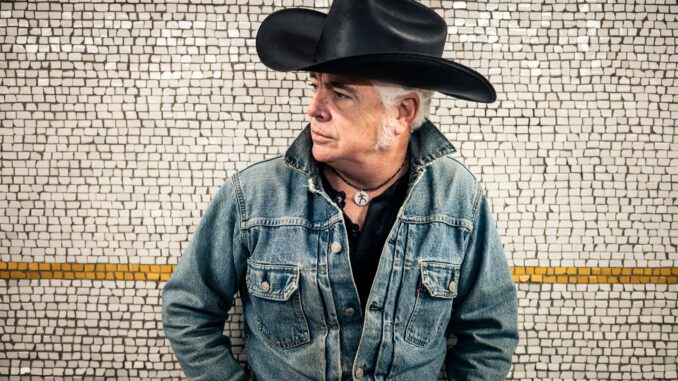
Dale Watson figured it out. He figured out what’s wrong with our disconnected, polarised era. He figured out why we’re caught in a death spiral of social media outrage, intractable positions, and argument instead of dialogue. And it’s so simple. It’s been right there all along: Bucket seats.
“I had an epiphany about the one thing that divided society and separated people from each other,” Dale says. “Bucket seats. If we just went back to bench seats, I think we’d all get along a lot better.”
This revolutionary philosophical approach is all about empathy. “With bench seats, three guys get into a pickup truck, they’re shoulder to shoulder, you know? There’s physical contact,” Dale says. “And having your woman right beside you, your arm around her, that’s just the best way, instead of having a console dividing you. I’m not a fan of bucket seats.”
Dale has a record coming out. It’s impossible to refer to him as anything else once you get to know the guy. He’s easy to laugh, doesn’t take himself or much of the stuff folks get worked up about seriously. “Mr Watson” just doesn’t fit Dale. It’s called “Unwanted,” and it features a song called ‘What the Hell Happened to the Cadillac.’ It’s a kick-ass roots rocker that features some of Dale’s best guitar work, for which he doesn’t get the credit he deserves. It also sums up Dale’s worldview pretty nicely.
“Whatever happened to the Cadillac?” Dale sings. “Stretched out, chromed up, long and black/Used to stand out from the rest of pack/What the hell happened to the Cadillac?/What ever happened to the radio?/The music used to have so much soul/It all sounds the same/I traced it back/to what happened to the Cadillac.”
Dale owns a ’66 Cadillac, and on a trip, he rented one of today’s models. “I never rented a Cadillac, so I told them, I want a big Cadillac car,'” Dale laughs. “‘I don’t want the SUV. I want a car.’ And I got there, and they gave me this thing. It didn’t resemble a Cadillac at all. And it had bucket seats!”
Cars, Music, and Love. It’s as good a basis for a philosophy as anything. There are a few songs about love on the record, as you might expect. What you may not expect is that Dale got a little help writing one of them, a lovely ballad called ‘Just Yesterday,’ from one of his idols.
“It came to me in a dream,” Dale says. “I feel I should give Ray Price a songwriter’s credit. In the dream, I was on Ray Price’s doorstep, and he opens the door and says ‘Dale, I’m glad you’re here. I wrote this song, and I think you’d be great singing it.’ He starts singing it, and I realized ‘how am I going to remember this?’ I started panicking, so I woke myself up and I wrote down what I remembered, the melody and all, then I went ahead and wrote the second verse. I tell people, Ray Price wrote a song for me nine months after he passed!”
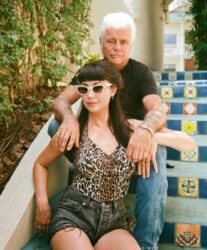
Speaking of love songs, there’s more that Dale figured out. He figured out that the key to happiness is being true to a good gal by your side. Dale married Celine Lee at Sun Studios in 2020, and he’s never been more at ease in his own skin. Her lovely countenance graces the cover of “Unwanted.” There are a couple of songs on the record that allow Dale to address Celine directly, to say things folks have a hard time saying.
In ‘If I Can,’ Dale sings “One of these days, you’ll wake up and find that I did not/No, I didn’t wake up, I moved on/When that day comes, I hope you know how much I love you so/And it did not change because I’m gone.” He wrote the song for Celine, and in it, he makes a promise: “If I can, I’ll stay beside you/If I can, I’ll prove it too.”
Dale figured out what authenticity means to him, and what kind of music he feels in his soul. He’s spent a lifetime playing it, recording it (35 albums and counting), and promoting it. Dale’s old-school. He’s an originalist who, along with Ray Price, cites Bob Wills, George Jones and Lefty Frizzell among his influences, with a heapin’ helping of the Sun Studios Sound. He knows where he stands, and is happy to keep pure country alive. “It’s a new house built on an old blueprint,” he says.
A gentleman, Dale isn’t judging – just staking out the difference between the roots music he plays and the mainstream stuff that dominates the airwaves today. “There’s a lot going on these days that sounds like Rock ‘N Roll or even Hip Hop,” he says. “I’m not going to diss them – they’ve obviously got a crowd and an audience, but we do too. We’re coming from the roots, and we want to stick to the roots.”
So, Dale promotes what he refers to as “Ameripolitan” music, based on four key elements: honky tonk, western swing, rockabilly and outlaw country. To keep the music in the public’s consciousness, and to support young artists who are staying true to the roots, Dale founded the Ameripolitan Awards in 2014. “Those others, they’ve got their CMAs and ACMs, but there’s plenty of other stuff going on” he says. “It’s so easy for a young artist to get to a record company and the record company says ‘we love you, but change.’ I don’t want them to change. That’s what I hope comes out of the Ameripolitain Awards – we get these people and give them a pat on the back and say ‘here’s your award, keep doing what you’re doing. It’s great.’ I think it’s important to give them appreciation for all the hard work they’re doing early on.” The list of past winners is eye-catching, and includes Rosie Flores, Jesse Dayton, Margo Price, Charley Crockett, The Reverend Horton Heat, Cody Jinks and Sierra Ferrell, among many others.
To ensure that vital venues for the music still exist, Dale restored the legendary Hernando’s Hideaway in Memphis, and owns The Little Longhorn in Austin, where Sunday Chickenshit Bingo is alive and well. (“Chickenshit Bingo?” You make a small donation for a ticket. There’s a mat on the floor with numbered spots, you pick a number. There’s a chicken. The chicken does what chickens do, and there’s a winner. It’s custom that the winner buys everyone a round. Oh, and there’s live Honky Tonk. It’s a gas.)
Dale and Celine also run “Lil’ Graceland,” an Airbnb in Memphis with themed rooms – the Peacock Room, the Jungle Room (complete with tiki bar and a jukebox loaded with 45s), and the “I Love Lucy Room,” which recreates Lucy and Desi’s bedroom right down to the wallpaper and twin beds. It’s madness. It’s Dale and Celine.
Downstairs at Lil’ Graceland, Dale built Wat-Sun Studio, a full-service recording space that features the 1936 RCA 76C Tube Console from Sun Studio, Various Vintage RCA EV & Altec Microphones, and a 2 Ampex 350 reel-to-reel. Dale offers the space to seasoned and emerging musicians alike, and proudly records old-school analogue in an intimate setting, with digital recording also available. He recorded his own 2021 instrumental record, “Dale Watson Presents: The Memphians,” which gives him room to let his guitar work rip, at Wat-Sun. To set the mood, along with Sam Phillips’ board, the studio also features a red leather sofa originally owned by Jerry Lee Lewis, so musicians recording at Wat-Sun can lounge in style.
On a darker note, Dale figured out how to deal with grief, though it took him a while. “I’ve never been good with loss,” he says. That’s largely what Dale’s 2025 book, “I’d Deal With the Devil to Get Her Back,” is about. Dale figured out he doesn’t want anything to do with the devil. He’s not a religious man, wasn’t raised in the church, says he “only went to church a few times” in his childhood. He’s not sure what heaven is, or if there’s a hell. But he knows the devil. He’s tangled with the bastard and beaten him.
Call it the evil in men’s hearts, if you like. Dale writes about it firsthand. He confronted his own demons over the course of a life-altering, terrible night, and got help. Now he’s ready to share his story, in the hopes of helping others facing similar crises. The book is brutally honest. Dale lays himself bare, sets doubt and shame aside, and exposes himself in ways lesser men might avoid. Dale has figured out what courage means.
The book is part memoir, part confession. Ultimately, it’s a story of redemption. In September, 2000, Dale lost his girlfriend, Terri Lynn Herbert, in a car crash. She was on her way to meet Dale at a gig in Houston when she lost control of her car on Texas Highway 71. The story’s well-documented, both in the press and on record, 2001’s achingly beautiful “Every Song I Write is For You.” Dale checked into an Austin motel room with a plan to end his life. He was found the next day, unconscious, by his friend and road manager, and rushed to Austin’s Breckenridge hospital. He recovered, put out the record, got back to touring, and thought he’d dealt with the loss. The part of the story that’s less well known is that two years later, things went badly sideways for Dale. On tour in Europe, after reading self-help books, seeking counsel from religious leaders, and ultimately “fooling with the Ouija Board,” Dale suffered a breakdown. For some time, he heard voices in his head – the voices of his “Spirit Guide,” Terri, Jesus, and ultimately the devil. He spent a night holed up in another hotel room, this one in Rome, wracked with visions, voices, and terrible visitations. It was the worst night of Dale’s life. He survived, and the next morning, booked a flight back home, to Austin, where he checked into “the nuthouse.” He was diagnosed with PTSD, got treatment. It took time, but Dale recovered.
Why choose to publish a book now? During the ordeal in the Rome, Dale made a deal with God: “To deliver myself from all that, I said I’d do a gospel record and a book,” Dale says. “That was my end of the deal, so that’s why I held up to it. Yep.”
The book is not for the faint of heart. The audiobook is an even more intense experience. It features 21 songs written about that time, and Dale narrates. Writing the book was hard, he says, but “it was even harder to do the voice (recording) because…” Dale trails off for a moment. “I had to stop a lot of times, because it’s just – it’s just hard to reenact all that stuff.”
Dale hopes the book helps others in crisis feel less isolated. “In my generation, we didn’t talk about stuff like that,” he says. “It needs to be.”
Dale’s figured out his mission. It began back in that “nuthouse,” and continues to this day. Delivered from his ordeal, he emerged with a new, healthier purpose. The music, the live shows, preserving historic venues, the Ameripolitan Awards celebration weekend, Wat-Sun, and the book – they’re Dale’s way of giving back. He hopes to collaborate with mental health support organizations in conjunction with promoting the book. Despite a brief hiatus, the Ameripolitan Awards are slated to return in 2027, with renewed hope: “to give like minded individuals an opportunity to come together to celebrate and promote the music we all love. It serves as an event to rally around and we hope that it will be a source of inspiration for artists and fans alike,” according to the Ameripolitan Awards Mission Statement.
“I think it’s important to lift people up,” he says. “That’s just me. Helping others. And helping them to get on the road, stay on the road, and do what they do. That’s my passion, my calling. As for me, I’m going to keep playing and do what I do.” As Dale is fond of saying, “come out and see me. I’ll be playing live as long as I am ‘live”
For tour dates and more (there are currently nearly 40 dates on Dale’s upcoming schedule), visit his website.

