
A beautiful reflection on family, and the search for home and belonging, with a new depth to the music.
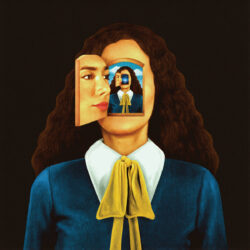 Bedouine is the project of Azniv Korkejian. Her family has migrated between Armenia, Syria and Saudi Arabia across generations, and Neon Summer Skin was written after what she knew would be her last visit to her parents in Saudi Arabia before they retired to Armenia. “I felt so frustrated about the places that I’m from becoming war-torn or difficult to return to,” she says. “My family has been split apart time and time again. I wanted to document and honour my family’s stories.”
Her previous two albums have been built around acoustic guitar, so the piano opening of On My Own was something new. The soft 70s feel is reinforced by the muted drums and the upward sweep the music takes halfway through. Long Way To Fall is written to a family member struggling with addiction. The description her press gives to the music here is “chamber pop“, making comparisons to Carole King and Karen Carpenter. Carpenter is certainly a touch point for her voice, and you can hear King and other writers, Janis Ian and Randy Newman especially, in her approach to the songs. That was apparently the plan set with producer Gus Seyffert, with Todd Rundgren’s poppier moments also an influence. Korkejian explains the shift from guitar to piano: “My first instrument was piano that I begrudgingly practised daily due to my mom’s militant approach.”
The string-filled Always On Time exposes a Sarah Vaughan-style intimacy to Korkejian’s singing. One Thing Right sets its intention to be a lilting Bossa Nova tune with a flute introduction. The brass stabs later in the song add a soulful edge. Brass instruments were her second love, and the valve trombone, which leads the album title song, sets a melancholy tone to the first song featuring her guitar. While superficially more like her earlier work, there is a richness to the writing and arranging which is new.
The centrepiece of the album is Canopies, and it starts with a conversation with her own mother, who had been placed in an orphanage as a child. She was put there by her own mother as a way of escaping her abusive father. The exquisite song which follows explores Korkejian’s reaction to the event and includes samples of her mother relating the story. Deghma Cheega is another song with a Bossa rhythm, although this time rather drowned in strings and whistling. Na Na Na continues that musical theme with more from the Tuba of her childhood and a bubbling synth line behind the strings.
The album closes with a solo piano instrumental around the themes used in Canopies, underlying its place as the key element of the album. She says of the very personal nature of the music and words here. “It was the first time I had the inclination to write a record about one main subject, which gave me a clarity and motivation I hadn’t quite had before.”
This is “a record about displacement, migration and the impossibility of going home, along with the more personal realisation of the end of childhood.” That is something which often accompanies a parent’s later life events and is at the core of the wistfulness which runs through many of the lyrics here. The search for home and the realisation that you can’t go back, physically or in time, is conveyed beautifully throughout the album, which is a major step forward in Bedouine’s sound.


