
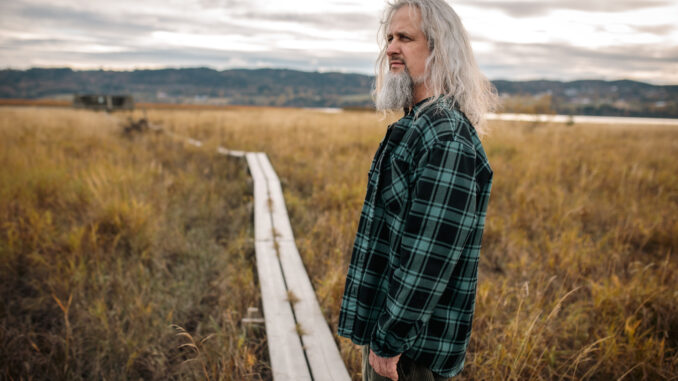
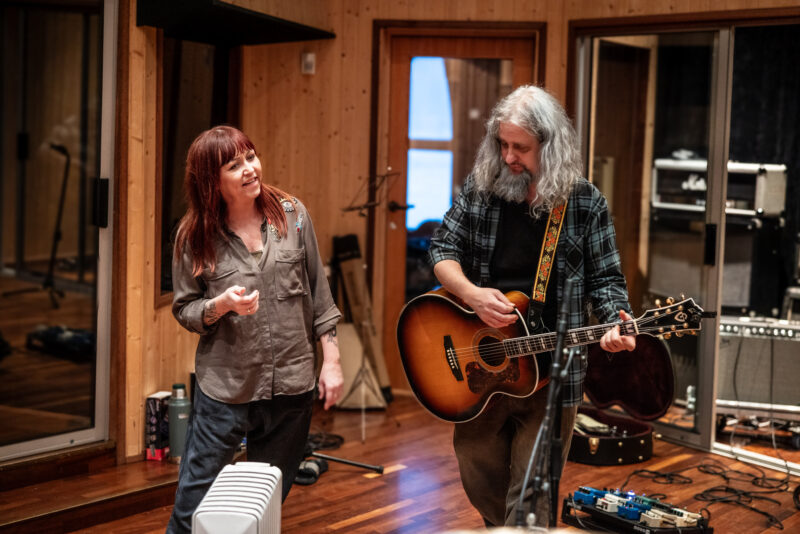
Two days before I heard them fill Martin’s Bar in Lillestrøm, I watched Thomas & The Angry Hearts make music in a wooden house surrounded by trees. In that studio, sound was built patiently: a harmony tried and set aside, a drum fill repeated until it settled, guitar chords progressing and then repeated to perfection. Nothing was hurried. The songs were allowed to arrive in their own time.
On stage, those same songs felt entirely different, not careful but wonderfully alive. What had been examined under studio lights now moved instinctively, stretching out into the room as if it had always belonged there. The shift from quiet concentration to communal release revealed something essential about the band. Craft matters deeply, but only in service of feeling.
At the centre of this is Thomas Warhuus Ådland. In conversation, he is reflective and unshowy, careful with words in the same way he is careful with melody. One idea returns again and again. “Without passion,” he says, almost matter-of-factly, “there is no music.” For him, passion is not theatrical intensity. It is commitment to people, to language, to the difficult work of staying open. It is what allows a marriage to become a band, what allows a private doubt to become a song, what allows vulnerability to exist without spectacle.
That principle surfaces in unexpected places. In his decision to sing in English, even within a Norwegian scene that often assumes otherwise. In his belief in non-violence and generosity, drawn from political heroes who saw restraint as strength. And in the way the band members listen to each other, to the shape of a song, to the quiet signals that say enough is enough.
Spending time with Thomas & The Angry Hearts – in the studio and later under stage lights – made clear that theirs is not a pursuit of grand gestures. It is something steadier. A belief that music, when handled with care and conviction, can hold complexity without collapsing into cynicism. What follows is a conversation about language, love, identity and the stubborn, necessary act of choosing passion.
Without Passion, There is No Music
Americana UK: How would you describe the core identity of The Angry Hearts’ sound to someone who’s never heard you before?
Thomas Ådland: The core of the sound is, quite simply, folk rock, but with plenty of seasoning from several decades of songs in all kinds of genres. We’re not trying to sound like one particular era or place. We take what feels honest to us and let it mix naturally. If it feels right, we keep it.
AUK: Having seen you in the studio and on stage, I was touched by how intimate you were as a band. It made me think about what it is like for you to have your wife in the band.
TA: It’s great, and rather magical. The band actually came from one of the difficult patches that all marriages inevitably have. We have always performed in different bands, but one evening we just started singing together, and it clicked; we reconnected.
AUK: And it feels as if the coupling of your voices still sits at the heart of the band. Americana itself often balances intimacy with widescreen storytelling. Where do you feel your music sits on that spectrum?
TA: Sometimes storytelling can be quite intimate as well. Although close, fragile, and emotionally charged are often keywords for my lyrics, I also like to play with the bigger pictures: oceans, queens, kings, and infinite universe. But these are usually symbols for complex thoughts and challenging relationships. Passion is beautiful, but when you have a lot of it, it can quickly become complicated.
Passion is probably the word I’d choose if I had to sum up our music. It includes love, but also the complications that come with true love. Love is a universe where it’s easy to lose yourself; power and greed hunt there every day.
AUK: When you write, what usually comes first: a lyric, a melody or a concept?
TA: It almost always starts with a feeling – a sense that this is the song that needs to come out. Then I pick up the guitar and play around with chords, singing whatever words come to mind. Suddenly, there’s a melodic theme that works, and some lyrics to build on. I’m not very good at writing on command. The bassist and I have annual songwriting workshops together. Rarely do great songs come out of them, but it’s good training for the creative muscle.
AUK: That’s interesting, you say that about the process of songwriting. I am wondering what the feeling of writing a song is like.
TA: As with a lot of people, I have had my mental health ups and downs. I used to have a lot of motorbikes, and I loved playing with them, fixing them. It was my special place when everything came together, just being in that moment and forgetting the rest of the world. I feel the same with songwriting. I have an idea and work on it and work on it.
AUK: You’re right, many of your songs feel deeply personal. What draws you back to that emotional territory?
TA: Relationships and passion are my absolutes. I love people. Without passion, there is no music. Writing is also cathartic for me. A lot of emotion can come out in a song, and if I write something that really works, I can be on a high for weeks. My favourite songs are always the most personal ones, those with a direct emotional line.
AUK: Your songs seem to be able to catch a wonderful blend of the very personal and the universal. What wider influences do you bring to your work?
TA: My political hero is Gandhi. That idea of nonviolent protest is so powerful. It’s a cliché, but if we could all turn the other cheek, the world would be a much better place. Gandhi’s message was powerful: even if you’re attacked, do not respond. I am vegetarian, but I’m not angry about it! It would be great for the planet if everyone was, but I respect other people’s choices. Some people can be very attacking, but I always try to respond with kindness. Hopefully, that comes over in the music too.
AUK: There are moments on your recordings where secondary instruments, banjo, synth, the wonderful violin, add unexpected depth. How do you decide when a song needs something more?
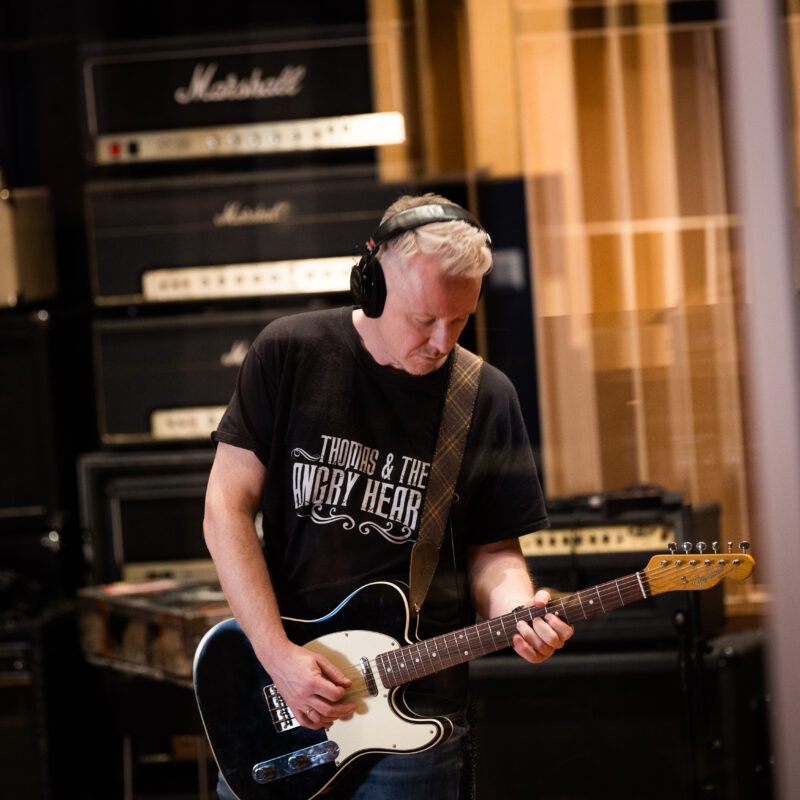
TA: This is probably where the most discussion happens. Nils [guitarist with the band] overflows with great ideas for themes, hooks and little clever motifs, which often give the song that extra something. He’s skilled on most string instruments that don’t require a bow. During the idea phase, he has free rein, and then we narrow things down and keep what we agree the song itself likes. We believe the song tells us when it’s enough and when there’s room for more. So far, we’ve always reached an agreement.
AUK: You sing in English, which isn’t always the obvious choice for a Norwegian band. Why does that feel right for you?
TA: Quite simply, it suits my voice. I’ve tried singing in Norwegian, and it just sounds weird to me in this kind of music. It does make things harder in Norway. People expect our type of music to be in Norwegian; usually, only big pop artists sing in English. I’m absolutely in favour of Norwegian-language music, and I love many bands who sing in Norwegian. But for some artists, English is just the best language to sing in. If I said this in the Norwegian mainstream press, I’d probably be called a traitor to the country, but I could live with that.
AUK: How do you see the Norwegian americana scene evolving right now?
TA: To be honest, I’m not very good at keeping up with the genre as a scene. What frustrates me is seeing talented artists who sing in English get record deals and then be pushed to sing in Norwegian. I think that applies across genres here, except pop. That said, Norwegian artists who sing in English are often the ones who dare the most. When you dare to dream bigger, you push yourself further and challenge the genre more. That’s where something interesting happens.
I am absolutely in favour of Norwegian-language music and have several Norwegian bands who sing in Norwegian on my favourites list, especially Staut, with composer Ørnulf Juvkam Dyve, one of the greatest poets in Norwegian folk-rock. We also have a strong folk tradition in Norway. Many people grow up dancing folk dances, especially in rural areas, and that rhythm and tonality stays with you. You can imitate music from elsewhere, but if you want to make something genuine, you have to search within yourself and back through time. You can’t draw inspiration from the future.
AUK: The new recordings feel very intentional. Did you have a clear vision from the start?
TA: The album came together along the way, with a lot of help from Ronni Le Tekrø. He’s been an important mentor, guiding us in terms of sound, concept and delivery. Pre-production with him was crucial. The sound engineer, Kjartan Hesthagen, also played a big role. His musical understanding shaped the recordings in ways that really mattered. Most of the songs were already there when we arrived, but the way they became this album happened in the studio.
AUK: The band dynamic feels unusually strong, on stage and in the studio. How important is that sense of family?
TA: It’s everything. Family is incredibly important to me. Music is about connection – between people, between emotions – and if that isn’t there within the band, the audience will feel it.
AUK: Finally, where do you see The Angry Hearts heading next?
TA: We want to build a fanbase in the UK and Ireland and play more there. There’s so much good music coming from those places right now. With the new album, we’re hoping to tour more widely and play mid-sized venues across Europe. We’re ambitious, but we want to do it properly.
