
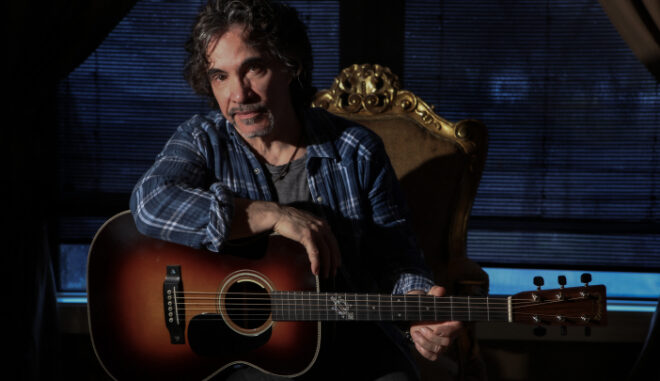
At 77 years young, the Rock and Roll Hall of Fame vocalist is as active as ever, having released two albums: 2024’s stripped-down, acoustic Reunion and 2025’s groovy Oates, in the past two years, while regularly performing at venues all over North America. It would be a serious mistake to suggest that Oates’ music without Daryl Hall would be devoid of interest. Au contraire. For all of the duo’s platinum-selling albums, sold-out venues and many awards, they have now gone their separate ways; Hall continuing to make engaging Philly soul records, and Oates carving out his own path with a combination of early rock, blues, R&B and folk, basically americana with a twist.
In March 2026, Oates embarked on a brief seven-concert run, then he will head out for more dates in September. “My Good Road Band is amazing, and we play real music,” Oates said during an interview. “I’ve put together a full rhythm section: two guitars, bass, drums and keyboards, made up of new Nashville friends and some guys who I’ve been playing with for a long time. There are no samples, there’s no Auto-Tune, there’s no ProTools. It’s just guys playing and singing. We’re waving the flag for the old school.”
And, yes, in case you were wondering, he still busts out fan favourite Hall and Oates hits like Out of Touch, Maneater, and, of course, She’s Gone. They are in a part of the show called The Songs That Made Me, which fans won’t want to miss. “We do everything, and what it does is give people an idea of who I am and why I am who I am.”
It seems as if Oates has been making records since the demise of clay tablets, starting 55 years ago with the Whole Oats album on Atlantic Records. Hall & Oates sold more records than any other duo act in history. In many of their multitude of hits over the decades, the vectors of romantic and sexual longing that emanated from these songs were strong and soulful. With H&O, the rough edges were sanded off, but not so much with Oates solo. While Oates may have been perceived as the lighter side of the duo, his talent and depth as a musician are undeniable.
Would he rather it were like when it all began for Hall & Oates, before all the albums and plaudits piled up into a long career? At this stage, he has seen too much and forgotten too little. The split with Hall was about as congenial as a foreclosure notice. “It gave me a new lease on my creative life,” he said, making a steeple with his fingers. “If I was to go there now, it would be like visiting a museum; a great place to visit, but not somewhere I’d want to stay.”
From here on out, you won’t see any Hall & Oates reunion; you might not even see John with the “stash” that earned him a place in the Moustache Hall of Fame. He has been clean-shaven off and on, and to paraphrase one of the biggest hits, his face ain’t getting any younger. Daryl’s gone, but as long as he’s got the strength to carry on, that is exactly what he intends to do.
Americana UK: Good morning, John. I understand you are living in Nashville these days.
John Oates: We still have the ranch in Colorado, but we don’t have the animals anymore. My wife grew up on a farm in Illinois, so we had everything: emus, llamas, alpacas, peacocks, you name it. It was more of a fun farm.
AUK: Wasn’t Hunter S. Thompson close by in Colorado?
JO: He parked his car beside our cabin when we bought the property. Even though he didn’t own the property, he just stuck his car in there because it had been vacant for years. The area of Woody Creek is hard to describe. It has its own rules; let’s put it that way.
AUK: You’re now the americana artist in residence at NYU. Did that just happen?
JO: Yeah, it was really cool. I didn’t know what to expect. I had done something similar at Berklee in Boston years ago. And this was really a great experience. Phil Gladstone, who runs it, is the head professor in the songwriting department. I’ve known him for years and years, and he goes way back as a recording artist and a songwriter. So, we have a lot of people in common. But the kids were great, and I think we gave them some insight into various things and had some fun putting a little group together, workshopping their music.
AUK: If I’m not mistaken, Rosanne Cash did one of those, too.
JO: A whole bunch of people have done them. I think Taj Mahal has done it, and Rodney Crowell. I actually spoke to Rodney, and he gave me the lowdown on what to expect, and he was right on the money. As I said, it was a really good experience. I think I could have been a good teacher if I had to change careers.
AUK: You’ve also been involved in several benefits. There was “Pushing A Rock,” which Roger Daltrey heads for Teen Cancer, and “Benefit for Nepal” in Nashville. What prompts you to get involved in these causes?
JO: Overall, I think it’s important for me at this point in my life and career to give back when I can, especially when I can combine it with something I love to do anyway. So it’s a win-win. There’s no real downside to it.
AUK: When you put out Reunion in 2024, did people think it was confusing and assume you had gotten back together with Daryl?
JO: I don’t know about that. It was inspired by my father. He was a hundred years old at the time, and he knew that his next step was drawing near. We were talking about it, and he was saying how he wanted to reunite with family. And it was very powerful for me, especially since I’m older now and can relate to it. He had an amazing life. And I kind of came away from that visit thinking about the real definition of the word reunion. What does it mean? Reuniting, breaking it down that way. And I thought, rather than thinking about a family reunion or a high school reunion, I was thinking about it more on a spiritual level.
I had an idea for it and a few lines that I thought were really powerful. And then I ran into AJ Croce at the Ryman a few years back. We were both doing a benefit for John Prine, and we really hit it off. There was something about him as a kindred spirit. And with his songwriting ability, family DNA, I thought he might be a good person to collaborate with. And sure enough, I went over to his house, we wrote the song, and he got it. He knew what I wanted, was able to enhance it and bring it out. It was a great collaboration and a very powerful song.
AUK: You chose to record one of Prine’s songs, Long Monday.
JO: I did that song at the John Prine event at the Ryman. And I mean, how do you pick the best John Prine song? You can’t, because they’re all great. I felt I could bring something to that particular song. I had an idea to arrange it slightly different and change it a little bit melodically, just to make it more my own, but not lose the essence of what it originally was.
AUK: There is an unplugged version of All I Am on YouTube with Adam Ezra, who also covered Prine’s Hello in There. Can you tell us a little about that?
JO: I met Adam through a mutual friend years ago. Here again, we hit it off. I base my collaborations and working friendships on gut feeling and whether or not it just feels right. I could tell he was a really honest, pure soul. He brought that idea to the table. He wanted to write in Nashville, so he came down, and we wrote the song, and then I surrounded him with some really great players and made a single. Then I did my own version of All I Am, but a little different, just to make it my own.
AUK: Tell us about Field of Mine, another very powerful song.
JO: That was inspired by my wife’s father and mother, who have a working farm in Illinois. Just talking about the idea that is there any real ownership in a piece of land? In a sense, whether you have a deed to it or you paid for it or whatever, you’re only leasing it from the universe for a while. And at some point, someone else is going to be on that property, maybe with a different house. But they’re very proud. They’ve been farming through many generations, and he just refused to sell that little farm even though the surrounding areas were being built up and the suburbs were encroaching. I thought it was very noble. I was working with Sam Bush at the time. He and I had always been talking about trying to write something together, but we never got around to it.
AUK: There is a similar, looking-back feel to All I Ask of You.
JO: Needless to say, the songs that you’re choosing, I think you can see the theme that’s going on here. It has to do with maturity. It has to do with growing older. It has to do with taking a look at the horizon as opposed to the sunrise, without getting too zen about it. But All I Ask of You was just an idea I had about what maybe my family might think of me if I wasn’t around, or at some point when I’m gone.
AUK: You were born in 1948, so a child of the ’50s and early ’60s. What caught your ear musically while growing up in Pennsylvania?
JO: First of all, I was born in New York, and when I was four years old, my father had a job transfer to Pennsylvania, but the rest of the family remained in the New York area. So, we were the only part of the family that moved away, and we would go back and forth from Pennsylvania to New York almost every weekend. You say you were born in ’47, and I think it’s a unique perspective being our age, because we remember music before rock and roll. My parents listened to big band music and swing. So that was my earliest music memory. When rock and roll hit in the early ’50s, I was still a little kid, but I was old enough to realize that something really different and groundbreaking was happening.
Of course, I jumped in with both feet and began to listen to all the early Chuck Berry and Everly Brothers, Elvis and Little Richard and so on and so forth. So, when I began playing guitar at six years old, I immediately started playing those early, simple three-chord rock songs. In a way, I think my personal life has paralleled the growth and the evolution of rock and roll from the very beginning. As I said, having heard music before it happened, realizing it had happened, and then kind of taking the ride with it over the years. Then came the branches, the folk revival, blues. I began to make the connection, as I got older, between where rock and roll really came from and started to listen to and experience some of the originators, both in Appalachian and bluegrass and the blues communities. And to this day, I look at it as a whole. I don’t look at it as all these separate genres. They all are part of one great American song tradition.
AUK: What was your first experience playing in a band?
JO: As soon as I could play enough chords to accompany myself, I started singing and playing guitar. I had pictures of me playing at seven, eight years old. My first band started in sixth grade with a couple guys who were a little older than me. I stayed with that group through junior high school and high school, and then we actually made a record in the summer of 1966 after I graduated from high school. Coincidentally, Daryl Hall made his first record that exact same summer with a separate band. We were aware of each other because the music scene in Philadelphia was quite small.
AUK: What was your first band called?
JO: We actually had a few names: The Avalons, Soul Sound Continentals, then the Masters.
AUK: You’ve written a book: Change of Season. It is fascinating the people you’ve met outside the music world, for example, Andy Warhol.
JO: I was living in Greenwich Village and hanging out in the ’70s and throughout the ’80s in the downtown scene. I had one friend in particular who worked with Andy at his place, what did he call it? Not the warehouse, the Factory. And it was down on 19th Street and Park Avenue. I met him a number of times. He came to a few of our shows in the early days when Daryl and I were first starting out. We played Max’s Kansas City a few times before it became a glam rock scene and home for the New York Dolls. And one of my biggest regrets was, one time, I was walking around the Factory, and things were happening. I remember him saying, “If you see anything you like, just pick it up and let me know.” And of course, I didn’t buy anything. I mean, literally, there was stuff sitting against the wall on the floor, and obviously, the value of his artwork has gone insane, but I was too stupid to realize that at the time.
AUK: What brought about your partnership with Daryl Hall?
JO: He and I met in Philadelphia, but we were both doing different things. I was playing in blues bands and still doing the folky stuff. He was doing some studio work and playing with a bar band in New Jersey. Neither of us were really happy with what we were doing, and it was just a weird circumstance that brought us together. After I graduated from college in June of ’70, I wanted to go to Europe. It was a dream of mine to go because my whole family has European descent. So I packed up my guitar and a backpack with a few hundred dollars and hitchhiked around Europe for about three or four months. During that period of time, I had sublet my little apartment to Daryl’s sister and her boyfriend. When I came back, there was a padlock on the door because they had not paid any rent.
I had nowhere to stay, so I literally walked down the street to where Daryl was living in this tiny house and basically just said, “Hey, man, your sister kind of screwed me up here, and I’ve got nowhere to go.” And he said, “Well, you can just sleep here, stay here for a while.” There was a little room upstairs, and it had a fold- out couch. That’s where his electric piano was. I moved into his upstairs room, and of course, he would come up and sit down at the piano and start playing. And I had a guitar, so I started playing. And we said, “Hey, you know what, maybe we could do this.” We started playing in art galleries and coffee houses, just the two of us, and we would swap songs. All of a sudden, we started to get this local following in the Center City hippie enclave of Philadelphia. One thing led to another, and we got some publishing deals, and then the rest is history.
AUK: You came together with different tastes in music. How did you work that out and end up with the Hall & Oates sound?
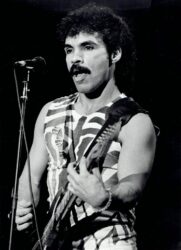
JO: Not easily, and it took quite some time. When we first started doing things together, our voices did not blend very well, and we really were coming from two different places. As time went on, I learned from him; he learned from me. In a way, we became part of a collaborative experience in that somehow you subjugate, perhaps, your purer instincts and influences for the good of the whole, and then something else emerges that’s not individual but more of a blending. Over the years, we learned how to take certain influences that seemed to be common between us and focus on those, and the pure individual roots of either of us were swept into the background. And of course, when I started doing my solo material, starting in the early 2000s, I went back to the purity of what made me start to be a musician. And that’s what I’ve been doing in Nashville for almost 25 years.
AUK: I didn’t realise you’ve been in Nashville that long.
JO: I came to Nashville in the ’90s thinking I was going to write country songs. Of course, I found out very quickly I had no clue on how to do that. So, I gave up on that idea, and I said I’ll just be myself and see what happens. I basically became part of the early days of the americana music movement with Sam Bush and Jim Lauderdale, and Jerry Douglas. Those guys led the way for me. I realized that they had a lot of the same early influences in folk and traditional American music. In a sense, what I did was go back to go forward. I went back to rediscover who I really was prior to Hall & Oates, and then used that as a jumping-off point to develop myself as an individual.
AUK: Not that you weren’t and still are a talented guitar player, but was it a little intimidating coming to Nashville with all those great pickers in town?
JO: Well, I realized that the bar was set very high, and that was probably one of the best things that ever happened to me because having played the Hall & Oates show over 25 to 30 years, I was basically treading water instrumentally. It was easy for me. My parts became kind of ritualized, and it wasn’t challenging at all. Obviously, it was lucrative and successful, but when I came to Nashville, I realized there was a whole level of musicianship that was way beyond where I was. Not that I couldn’t get there, but I actually started practising, started woodshedding, rediscovering my early folk roots of the type of music that I was listening to as a kid. And then, of course, playing with these great players just elevated my playing.
AUK: I have heard a few versions of Maneater, and the one with Sam Bush is very cool.
JO: I’ve done about 20 versions of Maneater already. I just did one in Jamaica with the All Stars of Reggae, the guys who played with Bob Marley and Toots and the Maytals. I’ve done it acoustically. I’ve done it electrically. I just keep reinventing that song.
AUK: Are there any songs from your first album in 2002, Phunk Shui, a pun on the term “feng shui,” that remain in your repertoire?
JO: I hadn’t for many years. Just recently, I put a new band together, and I resurrected a song called Go Deep, which I hadn’t played in a while. It’s kind of a metaphysical funk song, which sounds weird in a way. But I pick and choose. I’ve got so many songs to play, so it really depends on the players I’m with. I do an acoustic show called The Stories Behind the Songs, where I do much more of the folky, acoustic-oriented stuff. But when I’m with the electric band, we do more of the R&B funky stuff. It really depends.
AUK: On A Thousand Miles (2008), which was your second, you did I Found Love. Was that a personal song? I knew a man who had everything, the world on a string.
JO: Sure. I wrote that about my wife. I put it on the Reunion album again, but I wrote that in the mid-’90s. I was coming out of a very low point in my life. In the late ’80s, I had gotten divorced. Our manager went on to greener pastures, and things really felt like they were falling apart. I had to reevaluate everything I was doing, and I moved to Colorado and met my future wife. The song came out of that experience.
AUK: On Good Road to Follow (2014), you collaborated with several other artists. Pushing the Rock was an interesting song, though probably not one of the better-known tracks.
JO: That’s another one I recorded in various ways. I wrote it with Nathan Chapman, who is the guy that produced Taylor Swift’s first four albums and was basically responsible for getting her first record contract. At the time II was making that record, Taylor had started working with other producers, and Nathan was not sure what his next step would be because that was such a big deal to not be her producer after all that time. That gave the idea of a struggle. I know that’s a universal idea that everyone has something they’ve got to overcome, but I thought of Sisyphus pushing a rock uphill as an analogy for struggling to overcome something.
AUK: That thought of a struggle reminds me of a couple of fine songs on the Arkansas (2018) album: Dig Back Deep and Lord Send Me. That record had an americana feel throughout.
JO: I guess that’s a recurring theme that I’m not always aware of. Well, Lord Send Me is a Mississippi John Hurt song. In fact, that album was actually not supposed to be the Arkansas album. At first, I was going to do a tribute album to Mississippi John Hurt, who’s one of my heroes. And I started recording a bunch of his stuff, just me and a guitar in the purest way possible. After I recorded three or four, I just said, “Why am I doing this? This is stupid. It’s never going to be as good as the original, and what am I trying to prove here?” But then I really had a revelation. But then I thought these songs are so cool, and I’ve never heard them done with a band. Now that would be something different. So, I assembled this incredible band with Sam Bush, Guthrie Trapp and Steve Mackey, and I had Russ Pahl on pedal steel and Nat Smith on cello. It was a really unique band. When I got them in the studio, we did Lord Send Me, and I remember my engineer turned to me and goes, “Man, I don’t know what this is, but just keep doing it.” So I started looking at other types of traditional songs and old popular songs from the early 1900s. But because the band sounded so good, it didn’t matter what we played; it sounded great.

AUK: What is the story behind that comedy duo, Garfunkel and Oates? They did sort of folksy songs that had pretty raunchy lyrics.
JO: Those girls are so, well, I mean, I’m going to go way back to the MySpace days. In the early days of the Internet, someone had told me there’s somebody called Garfunkel and Oats, and they’re doing a parody kind of thing. I heard them, and totally as a goof, I reached out to them on MySpace and said, “Oh, by the way, this is the real John Oates, and I’m going to sue you.” They came back and said, “Please don’t sue us; we don’t mean anything.” They were so nice and sweet, we eventually became friends and actually did shows together a number of times. They’re two actresses. Kate Micucci is an incredible graphic artist. And Riki Lindhome has been in many successful movies and TV shows.
AUK: What’s the story behind Johnny Gore & The C-Eaters from the War Babies album? The album was a different direction for Hall & Oates that likely had something to do with Todd Rundgren producing it.
JO: That’s kind of a weird story. It happened during the gas crisis, which, being a year older, you must remember, and a lot of people don’t. But anyway, we were touring in the South, and in those days, it depended on if you had an odd or even number on your license plate that determined which day you could get gas. We’d be playing a show, and we had one crew guy who would run out and fill the van up so we could drive to the next town. One night in Alabama, we were driving through the night and came through a little town. There was a marquee, and it said Johnny Gore & The Cheaters. I wrote it down, and then the next day we were coming back the exact same way, and on the other side of the marquee it said Johnny Gore and the C_eaters, and the “H” was missing. I was like, “Oh, that’s cool.” So that’s where the title came from.
AUK: The Hall & Oates Voices (1980) album became a massive hit, spinning off four singles and charting for quite a while. Tell us about how that album came together.
John Oates: That was a stripped-down album recorded with lots of nervous energy. I would walk 15 blocks or so from my apartment to Electric Lady Studios in New York. It was in an incredibly chaotic, dirty and dangerous neighborhood. Dogs shitting all over the place. We were absorbing a lot of the local culture, and that album harnessed that feeling. I remember writing songs at Daryl’s apartment, and the New York Post had a headline about some guy who was slashing people on the subways. So, we wrote a song about a serial killer who becomes obsessed with the doo-wop voices singing in his head and called it Diddy Doo Wop (I Hear the Voices). There’s a lyric in that song that goes, “Charlie likes the Beatles, Sam he likes Rich Girl, but I’m still hung up on the Duke of Earl.” The references, of course, are Charlie Manson, who was a Beatles fan, and the Son of Sam, killer David Berkowitz, who had mentioned the song Rich Girl had meant something to him. Daryl and I felt the album was still missing a key piece. We were in a pizza place having a couple of slices, and You’ve Lost that Loving Feeling came on the radio. We looked at each other and just knew that was the missing piece. That was a classic New York City moment; two guys having a pizza and listening to the jukebox.
AUK: We need to address the new album, Oates (2025). What were you going for there?
JO: Oates is really a complete 180 from Reunion, which for me is the culmination of my Nashville americana experience. I think it’s my best acoustic record, but I decided to start writing some groove-oriented stuff that felt more like ’70s R&B style. The thought was to let me capture this aspect because they’re all parts of my personality. I worked with a couple of younger artists, a guy named Devin Gilfillian from Philadelphia, a young R&B singer. It’s definitely groove-oriented.
AUK: Is the fame gained from Hall & Oates everything people might imagine it to be?
JO: It’s what you make of it. I mean, fame has given me a certain lifestyle and economic cushion. It’s enabled me to travel all over the world and have incredible experiences. The downside is that the business side of it, unfortunately, has colored and stained the good part of the experience for me. Some bad business decisions, obviously, some challenging partnership issues with Darryl Hall recently. Now that it’s over, it’s great because I feel really good, and I’ve got nothing more to give to that world. The commercial success of Hall & Oates has given me this creative freedom, which a lot of people don’t have and wish they did. I’m very aware of that and don’t take it for granted. Otherwise, I couldn’t be making these records, any kind of record I want to make. I mean, if I wake up tomorrow morning and want to go in the studio and cut something, I just go in and do it. I don’t have a record company. I don’t have a manager. I manage myself. I have a booking agent and a social media person, and that’s it. Like I said, I’m a completely independent artist, and that’s the best part of fame.


Does John still own Mississippi John’s guitar?