
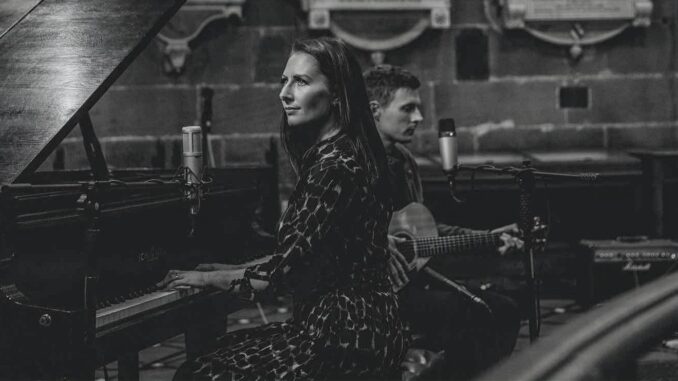
Igloo Hearts gives folk-pop music a new shade of ardency. In true outlier fashion, the North Wales-based husband and wife duo have gone quietly about their business with an eye to gaining traction outside their realm. To take their art into other corners of the UK and ultimately the world, this is the way songwriters can truly find their place, and Katie and James MacGregor intend to take broader steps towards that goal when their debut album, “Eyes Closed Against the Sun,” arrives in November 2025. It is an honest, soul-stirring collection capturing everything they’ve lived through together: grief, joy, connection, and transformation.
Katie is a classically trained pianist who earned distinction in her Grade 8 and was featured on Channel 4’s The Piano, where Mika described her performance as “one of the best vocal/piano performances they’d ever seen.” James started out as a solo roots artist who supported the likes of Oysterband and Nick Harper. When they met at an open mic, they discovered not just love, but an uncanny vocal blend that audiences describe as “like one voice in two bodies.” You could also say split like Gemini, or rather, two hearts beating in the same chest.
It is a lengthy proposition in this modern age of music to go from demos and singles and an EP to a full-fledged album. You can compare their first songs to what has been heard so far of the new album and sense that the album will stack up seamlessly against their tantalising early efforts.
Igloo Hearts are tale spinners of heartbreak and woe, but also hope and desire. From songs on the EP (“Metamorphosis”), you could absorb the imagery of fish food congealing at the bottom of the tank equating with obsession (‘Fish Food’) or the difficulty in telling the real from the fake on social media and filters (‘The Redeemer’) or the sad tale of an old man who reminisces after losing his wife (‘Watering Can’).
Their new songs are equally as atmospheric and alluring, guiding you to voices you may not have acknowledged. At times, a portal to the past, but not in a nostalgic way. There’s a different dimension at play here in the new material, located somewhere between the dashing of hope through the heartbreak of failed IVF (‘Body Clock’) to the dark tale of a guy who meets a prostitute, murders his mother, and runs away to no good end (‘Teddy’).
Their songs, accompanied by cinematic piano and intricate guitar, oscillate between hope and haunting in something of a wide-screen quality in the way they can move people to tears. In the following interview, Igloo Hearts answered a series of questions about their journey so far and the inspirations behind the destinations they hope to reach.
Americana UK: Hello. I can see behind you it is sunny in North Wales.
Katie MacGregor: It’s very sunny here today. We’ve just been out with our little niece in the park, so that was nice. But, it’s not usually sunny. We’re from Wrexham, which is quite a well-known place at the moment. We’ve had a documentary. Have you heard of Ryan Reynolds at all, the Hollywood star? He’s just bought our football team, and there’s lots of press around it at the moment, how we are going up the leagues because we’ve had all this money injected into our team. It’s like a movie story, how we’re this little Welsh town and they’ve sort of made us and improved all our lives. That’s the narrative.
AUK: That reminds me of this movie called “Local Hero,” which was made by a Scot director, Bill Forsyth. Peter Riegert of “Animal House” fame played the lead role about an American firm looking to make over a little town for corporate purposes.
KM: Actually, we’re quite often around Liverpool, which is where The Beatles are from. There is a big music scene, of course, but in Wales we have a big festival called the Eisteddfod (sitting together). People from all over the world come to Llangollen, which is a little Welsh town by where we live. We run a monthly night called the Blue Lantern Sessions in Chester. Recently, we had Michelle Stodart from The Magic Numbers.

AUK: The name Igloo Hearts evokes isolation yet warmth. You think of the Eskimos up in the Yukon territory and igloos, Native Americans and teepees, and indigenous people in Mexico with their adobe huts. How does the name represent you?
KM: We wanted a really cool name when you first start a band. You want to be cool, don’t you? We had a few discussions. We were a married couple as well, so we obviously argue a lot about this type of thing. But it was a band called Guided by Voices. Have you heard of them?
James McGregor: It was a title of one of their songs. They have really strange song titles, things like ‘Hardcore UFOs,’ ‘Dreadful Buzzards and Crows,’ that give you some imagery. I think we’ve sort of grown into it.
KM: Because of my classical background, I like major-minor chords that are sort of conflict. So, we always think of igloos as cold and hearts as warm. I wish we had a cooler story. We’ll have to make one up.
AUK: I read that James used to play with Oysterband. That is quite a lively group.
KM: That was a long time ago. But we do have a story about them. When we were putting on one of the Blue Lantern sessions a few weeks ago, they were in the other theatre and got absolutely hammered and trashed the Green Room. They’re pretty rebellious, aren’t they?
AUK: Tell us why the EP is called “Metamorphosis,” a transformation.
KM: I think a lot of bands have used this title as we look more into it, but I think it’s coming to music a bit later in life. I’m an accountant by day, and James is an engineer, and we sort of got into music. We’ve gone through quite a tricky IVF battle over the last few years, so music has helped us focus on something productive and positive and lovely. It’s that, isn’t it? It’s that realisation that your life doesn’t go where you think it’s going to go sometimes. But you can do whatever you want. So that title is coming from being restrained and thinking, Oh, actually, we can do whatever we want and just fly away like a little butterfly.
AUK: Before you became a music duo, what type of music attracted you?
JM: For me, I suppose it was Guided By Voices, short poppy songs, but also more country like Ryan Adams, Jason Isbell and Radiohead as well.

KM: Yeah, Radiohead is a big influence of ours.
AUK: I’ve heard you cover 2 or 3 of their songs.
JM: We need to rein that in a bit. Don’t want to become a Radiohead tribute band.
KM: My background is classical piano, and I think there’s a lot of classical stuff in Radiohead, which is why I like them. But Rufus Wainwright as well. I’m a big fan. We travelled quite a long journey to see him, much to James’s distaste.
AUK: Were there any composers of classical music that particularly appealed to you?
KM: I liked the more romantics like Debussy and Beethoven, anything where the chords move in a funny way.

AUK: How did you two get started? As a group, not necessarily married.
KM: We had a friend’s wedding that was coming up, and he’d asked us to do that. I think a lot of people start hobbies because it was nothing else to do other than drink gin and watch Netflix. So, we just started to do it more and more. I think it’s a confidence thing. When you’re younger, you don’t think that you can do anything, or you’re not very good at anything. And then as you get older, you give less of a crap what people think. It was just building that confidence initially, wasn’t it?
JM: Initially, it was scary even to share ideas with each other. It takes a while, but now, I think the reins have been let out.
AUK: Did you start by writing one song together?
KM: We gave ourselves a challenge of 10 songs a month to get better at songwriting. At the end of the month, we’d play them to one another. It was a really good exercise because it’s hard sometimes to finish anything creative, to get to the end and think, okay, I’m going to let that go now. Some of them were awful, but some we still play.
AUK: Is the first song you wrote still in existence?
KM: I think it might be. But there’s one that we play that James wrote called ‘Waving at Elephants.’ It’s a short little Beatles-inspired pop song, and that goes down really well when we play that.
JM: You would never write that sort of song without having someone challenge you to write a song about an elephant, I suppose. It forces you down alleys that you wouldn’t usually go down. We should do that again.
KM: We went on a songwriting retreat a couple of weeks ago in a place called Snowdonia in Wales, and that was with Michelle Stodart. She was leading, and that was brilliant. It was nine people, all like-minded, creative people, being showed different ways to write songs, and it was a fantastic weekend.
JM: It was really daunting, actually, being thrown together with someone you didn’t know to write a song.
AUK: So, it was like speed dating, except with songs?
KM: That’s exactly it. And you couldn’t choose who you were put with either. James was with someone who was quite shy, and James can be quite shy, so that was awkward.
JM: You don’t want to upset someone by saying that has to go, but still, it was a good experience.
KM: You need that sometimes. I don’t know if you find this with writing, as if you ever feel like you’re having a bit of a block, but just to be around people who are like-minded and creative, sometimes they can release that flow again.
AUK: When you write a song, is it collaborative or is one of you more melody and the other more lyrics?
KM: I think it’s a bit of both. We’ve wrote some on our own, some separately, so it usually starts with the chord progression and then the words come later. James wrote this song about IVF, our journey with that. We’ve just finished a new album, and it is on this album from his perspective, really about the situation. Whenever we play it, it is always quite emotional, and people connect with it because I suppose it’s a different angle coming from James’s point of view. That one is a tricky one to sing, but it always goes down really well. I think it’s funny with music, isn’t it? How people connect with what you say and what you sing, and you don’t even realise until people come up to you afterwards and say, Oh, we went through something like that.
JM: I think the interesting thing about doing it together is sometimes I may think that a song idea is a bit rubbish, but Kate’s like, No, I really like that; it’s got legs. Then you’ll kind of see it through and write it together, and, oh yeah, I actually like it now. It is just getting someone else’s perspective on it is really helpful. I get crippled with self-doubt about things, but if you’ve got someone else to back you up and say, No, actually, that’s good. That helps.

KM: Do you ever feel like this imposter syndrome when you’re doing something creative, are people going to like this? Is it any good? It’s a funny feeling, isn’t it?
AUK: Well, you have to put yourself out there in front of the public, whether it’s in a live setting or people buying the music and listening to it. Still, it’s out there, and people are judging what you do. At some point, you must stop worrying what people think of your work.
KM: When you can get to that stage, you’ve nailed life because we’ve got a songwriter friend and he’s like that. He says, well, people either like it or they don’t, and he really means that. He produces some wonderful stuff because he’s not restricted by anything. That’s the aim. We always say, Be more Jim.
AUK: Husband and wife or couples’ duos have become very popular. It’s a concise way of doing things effectively because living together cuts expenses down. There’s no band, really. It’s just the two of you.
KM: Not so much. We have been compared to that ‘80s group All About Eve. And someone described us as Radiohead Garfunkel because of the harmonies. That was quite cool.
AUK: When will this new recording come out?
KM: That’s out in November. We’ve got a little tour around that, playing in a place called Green Note in London, which is a cool venue for our type of music. It’s recorded live, so all our previous tracks that you probably heard they’ve got quite a big cinematic sound to them. We wanted to go back to our roots in musicality and not have a metronome and stuff. It’s a bit of a risk.
AUK: Yes, I don’t know what I’d do without my metronome drum kit.
KM: We’ve worked with some musicians and have a fiddle and cello player. It’s going back to that essence of hearing something live, hearing the guitar, hearing the breathing. I think music has been watered down, and you miss that real feeling sometimes.
JM: It’s a lot more intimate-sounding and just a lot warmer. It is just a live take with a few overdubs on top. I’m really pleased with that.
KM: We were listening to a singer called Adrianne Lenker with a band called Big Thief, and they recorded, wasn’t it, in a hut somewhere?
JM: It was live takes recorded to analogue, and we wanted to go for that.
KM: It feels real, doesn’t it? When you listen to it, you really believe what she’s singing about.
AUK: So, have you decided on all the songs yet?
KM: They’re new songs, so they’re not out anywhere yet. We’ve been writing them for a long time, so it’s quite good to let them go now and start on some new stuff. Twelve months is a long time to live with these songs.
AUK: Would you talk a little bit about those songs? Anything really that you’d like to say about them.
KM: ‘Body Clock’ is written by James. It was a period where we had just got married, and we were thinking about children and starting a family. It’s been a rocky road with all sorts of treatments and things. It was just a conversation that we’d had in a restaurant in Manchester. I was ready to start a family, and maybe James wasn’t quite there yet, and it was that discussion, wasn’t it? So, it’s a conversational song rather than prescriptive.
JM: It’s where Katie said I want children now; I won’t be young for long. That’s the chorus, and it was quite weird to play that. There was a guy I was listening to a lot, Henry Jamison, who I think is connected to Big Thief. Our song has a similar way of phrasing.
AUK: Have you decided on a single?
KM: Not really. There is one called ‘Teddy’ that’s like a folk song. We watch a lot of Netflix and stuff that’s really dark, like shows about serial killers and murderers and really shitty people, and that sort of seeps into our songwriting. It’s a good thing with songwriting, how you can use your imagination and come up with these horrible people. The song is about a guy who meets a prostitute, and then he robs and ends up murdering his mother. They run away together, and in a nutshell then he meets a sticky end.
AUK: It sounds similar to a show called “We Hunt Together.”
KM: Actually, we got the idea from a show called “You.” It’s about this guy who meets women, gets obsessed and ends up killing them. He is very good-looking, though. I don’t think I’d mind being stalked by him.
JM: Another one is ‘Elvis.’ My granddad was a huge Elvis fan, and he was a singer himself, actually a touring musician in the seventies in a country band called Wildwood. When he found out that he was ill, he did the whole Elvis thing. He went to Graceland and sang some there, and he got them recorded.
KM: It was his dream to do that. When he found out, he basically used all his savings and went across to America and recorded this music. We’d only found this out recently, so it was weird. James’s mum found a record of his granddad, and we put it on. It sounded just like James. His voice had the same tone, and it was really weird how it’s skipped a generation.
JM: So, the song is about Elvis looking down on my granddad as he’s singing, smiling. He had such a good voice. It’s a slow, acoustic-y ballad with piano and cello in there.
AUK: Do you have a cello player who regularly sits in when you record?
KM: We are members of a Chester folk club, and you meet lots of different musicians through that. Fluff is just a magician at all stringed instruments, so she’s a handy person to know. She plays a lot in Glastonbury as a session musician, really talented.
AUK: What would you say is the song that you like best of your recorded output so far? ‘Mannequin’ and ‘Hoodwinker Jeweler’ are particularly good.
JM: I quite like ‘Fish Food’ with the weird chord progressions.
KM: We must have a bit of a dark soul. I think we’re maybe a little psychopathic. ‘Fish Food’ was about obsession, this feeling of being obsessed with someone and how you go to any lengths to get them. We were trying to think of imagery of really horrible stuff. I think I was sitting in my nana’s house, and there was just this fish food congealing and sinking to the bottom of the fish tank. It’s just a feeling of uneasiness, isn’t it?
JM: And the music matches the imagery. There are triplets at the end. When Katie was being taught the piano, she wondered when am I going to use triplets. All those years later, there they are.
AUK: What would be another favourite?
JM: I quite like ‘The Redeemer.’ That was one we wrote for a competition – Liverpool songwriting competition, and it’s kind of Radiohead-esque on the chorus.
KM: We had to write about a piece of art in Liverpool; that was the criterion. You had to find a piece of art and write a song about it. We couldn’t find anything, so we ended up in a pub. There was this big sculpture in Liverpool Docks, and it had different coloured paint. The song is really about how we mask our true selves, which happens a lot now, doesn’t it? With social media and filters, you can’t really tell what’s real anymore. It got banned in a few countries for being too biblical or too religious.
JM: We made a video, and there were some pictures of Jesus in there. Apparently, that’s not the done thing in some countries.
KM: We never knew we were that edgy.
AUK: Do any of the songs or their characters emerge from your own lives? There is some darkness to them.
KM: There are lots of deeply personal songs. ‘Body Clock’ is one. There is one on the album called ‘Eyes Don’t Lie,’ which came from just going through an unsuccessful IVF round, and I was feeling particularly angry with the world. I think it is good therapy. If you’ve had a bad day, it all comes out in the music. That one’s quite emotional.
AUK: For someone who hasn’t heard your music before, what genre would you say it inhabits?
KM: It’s always tricky, this question. I think every musician thinks they’re unique, don’t they? Like, we don’t sound like anyone. But we call ourselves classical folk pop in a nutshell. There are many influences in our style.
JM: Didn’t one call it adult contemporary?
KM: Oh, no, don’t say that. That’s not so cool. I do think the way we recorded the new album, it brings it back to a more folk americana type route. You can hear James’ guitar much better, and he’s very good. That sometimes gets lost when you add a lot of orchestral into the production mix.
AUK: Do any of your songs ever come to you in the night? Some dark thoughts perhaps while falling asleep?
JM: I’ve definitely had things like that where you wake up and you think, oh my God, this is brilliant. And then you’ll creep downstairs and play it. Kate is still in bed, but then usually, when you’ll listen to it the next day, you find it’s not very good, actually. Weirdly, I write in the shower. I don’t know what it is about hot water running over your head.
KM: We hadn’t written anything for about twelve months, and we were starting to worry that we couldn’t do it anymore, that we’d lost our mojo. So, we booked a little cabin in mid-Wales, just the two of us, and our goal was to write some songs again. But we didn’t realise there was only one room in this cabin. So, James was writing most of his stuff on the toilet. I was in the good room.
JM: That did not work for me.
KM: But it was so lovely to be away from social media and away from emails and away from people. It was in the middle of nowhere, and there was beautiful scenery. I think sometimes you’re so stressed in life, it’s hard to do anything creative because your mind is so full with other crap. I think we need to do that more often. We’re not so good with words in some ways. It’s like a new skill, but I think the more you do it, the more it becomes natural.
JM: Henry Jamison writes really good romantic love songs. But I think to do that in a non-cliched way, you have to be a bit of a poet because it’s been done so many times.
AUK: There was a line of yours that is very poetic: the skin of a peach in the teeth.
KM: It was this image of this awkwardness between two young lovers, and the things you noticed about the situation. Sometimes it’s saying things that are not obvious. It’s saying the things that are a bit more obscure, that draw you into a situation. We’d love to be able to do that better.
AUK: What is your favourite rainy-day activity?
KM: Netflix and gin. We’re having a bit of a teetotaler year, so we are straight edging it. To be honest, there isn’t a lot of time in between working and music. Music is so full on, and we’re putting on these monthly nights now. They’re taking up a lot of time. So, we are now becoming promoters as well as musicians.
AUK: So, you both have day jobs. What do you work at?
JM: I’m an engineer working for Airbus, which is like Boeing in the USA.
KM: I’m an accountant. So very exciting job.
AUK: Is it a surprise when someone becomes very connected to your music?
KM: Yes, there are a lot of people who have cried tears at our gigs. We love it. Especially this one lady who came up, and she was in floods of tears and was like, Oh, I connected with you on such a level.
JM: There is a song called ‘Watering Can’ that Katie wrote. It’s about an old man who loses his wife, and he’s just recounting the things that they’d done together. It’s very sad.
KM: We’ve watched the video and cried, just an emotional mess. I think music has got to make you feel something. It’s that connection, isn’t it, with people. If you can do that, then you’re winning. Most of the time, people don’t say anything, though. But you’d rather that than bad comments.
AUK: What piece of advice have you gotten that has really taken hold?
KM: Everybody’s weird, so everybody feels the same. Everyone feels that they’re not good enough, and they’re thinking everything that they say is rubbish. And I think if you realise that we all have weird thoughts, then life isn’t so scary, is it? That was a good piece that stuck with me.
JM: Everyone’s on their own journey, so whereas you look at other musicians who may be doing better than you in your eyes, well, they’re just on their own journey, and you are on yours. So, I think that helps you cope with the highs and lows of music. The feeling of having a great gig is you can’t even compare it to anything. It’s brilliant. But then you’ll get some days where you look all your gear somewhere, and it’s a shitty venue and the people are awful, and you drive home, you think, why are we doing this? So, it’s to try and keep a levelheadedness.
AUK: For the reverse, what piece of advice did you get that you wish you had taken?
KM: Don’t be an accountant. My dad said that, and he’s an accountant, so I wish I hadn’t done that, really. I think you go down a path and then, oh, I wish I’d done this a lot sooner.
JM: I wish we’d done music sooner, but because we’ve been together for 17 years and we’ve both done music separately. I think we’d convinced ourselves that our styles were too different. That’s a regret.
KM: Yeah, should have got our asses into gear, shouldn’t we? But in terms of advice that we haven’t followed, sorry, it’s usually your parents’ advice, and you realise at a certain age that your parents don’t know anything. They don’t actually know much at all.
AUK: When you’re looking out the window these days, in terms of your career, what are you seeing for your future?
KM: We are at a crossroads in our lives. Our IVF hasn’t worked, and you always think that your life will be weaving a certain way, and it hasn’t. But with everything that’s happening with music now, we would love to be able to quit our jobs and to do this full-time. That is the next goal, whether that means doing original music or maybe doing some weddings in my spare time, whatever, to supplement the income. When you don’t have children, you can take more of a risk. You don’t need as much money, maybe to live. And we’ve done things backwards, really. We’ve got our careers now, and then we are thinking, well, can we just take that leap of faith and do this because we love it so much. And with the promotion side as well, putting on events, we’d love to do that more. Create some kind of folk festival in this area and promote music.
JM: It’s working out that puzzle, because there’s just not very much money in original music.
AUK: Sometimes stepping off that ledge is the best way to go.
KM: We have a friend who’s 80, and he’s lived a brilliant life. He was in a blues band in America, and he’s done a bit of everything. He said the only way you’re going to be happy in life is to take risks because that’s the way you live. We could be stable now and have good jobs and just keep paying the mortgage and keep doing this, but I don’t think we’d ever feel like we’d given it enough of a go. I think we just need to be brave and not have any regrets.

